
Can Day Traders Achieve 100% Profit? The Truth Behind Day Trading Success Rates
The promise of quick profits draws thousands of aspiring traders to day trading every year. Social media is filled with screenshots of massive gains, and online advertisements suggest that anyone can achieve 100% returns—or even more—through intraday trading. But what does the actual research tell us? Can day traders realistically achieve 100% profits, and more importantly, what does long-term success in day trading actually look like?
The Statistical Reality: What Research Tells Us About Day Trading Success
Before we explore strategies and possibilities, let's examine what academic research reveals about day trading outcomes.
The Sobering Statistics
A comprehensive study published in the Journal of Finance analyzed the trading records of day traders in Taiwan over a 15-year period. The findings were striking:
Only 1.6% of day traders were able to predictably and reliably earn positive abnormal returns net of fees
Approximately 80% of day traders quit within the first two years
The average day trader loses money, with losses often exceeding initial expectations
A similar study by Professor Brad Barber at UC Davis examined day trading patterns in the United States and found that:
Less than 1% of day traders are able to generate profits after accounting for fees and taxes
The vast majority of profitable trades are attributed to a small minority of exceptionally skilled traders
Beginners and inexperienced traders face the steepest losses
Research from Brazil's securities regulator (CVM) analyzing over 19,000 day traders between 2013 and 2015 revealed:
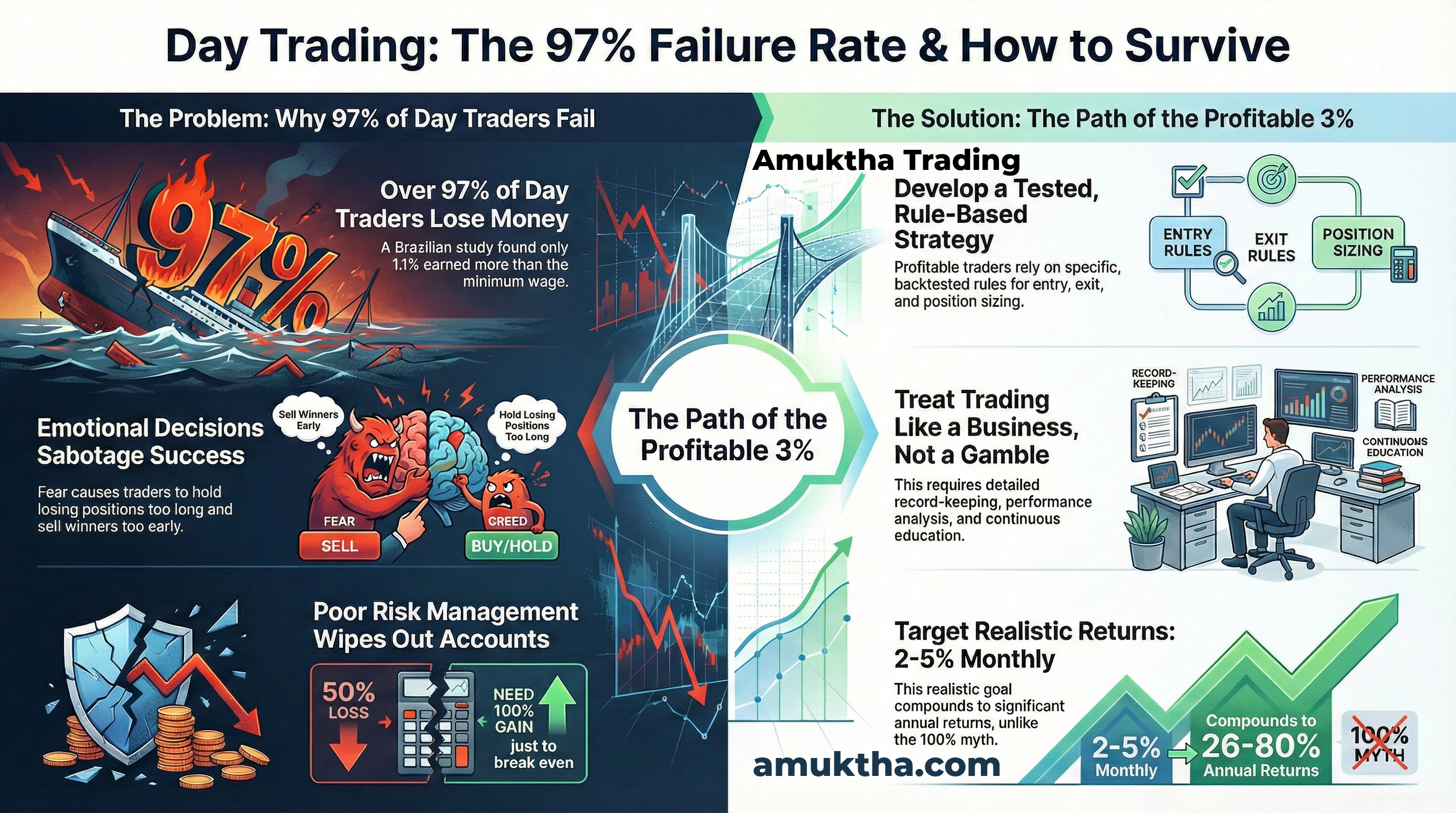
97% of day traders who persisted for more than 300 days lost money
Only 1.1% earned more than the Brazilian minimum wage
A mere 0.5% earned more than the initial investment required for a bank employee position
These statistics aren't meant to discourage you, but rather to provide a realistic foundation for understanding what day trading actually entails. The question isn't whether 100% profits are achievable on every trade—they clearly aren't. The real question is: what separates the 1-3% who succeed from the 97-99% who don't?
Understanding What "100% Profit" Actually Means
When discussing profitability in day trading, it's crucial to clarify what we mean by "100% profit."
The Misleading Nature of Single-Trade Percentages
Achieving a 100% return on a single trade is theoretically possible. If you buy a stock at ₹100 and sell it at ₹200 within the same day, you've achieved a 100% return on that specific trade. However, this metric is essentially meaningless for several reasons:
Position sizing matters: If this represents only 2% of your trading capital, your actual account growth is just 2%, not 100%
Cherry-picking fallacy: Highlighting one successful trade while ignoring multiple losses creates a distorted picture
Sustainability: A single exceptional trade doesn't indicate a repeatable strategy
The More Meaningful Metrics
Professional traders focus on different metrics:
Average return per trade: What percentage do you gain (or lose) on average across all trades?
Win rate: What percentage of your trades are profitable?
Risk-reward ratio: How much do you risk to potentially gain on each trade?
Maximum drawdown: What's the largest peak-to-trough decline in your account?
Annual return on capital: What's your total account growth over a full year?
A trader with a 40% win rate can be highly profitable if their average winner is significantly larger than their average loser. Conversely, someone with a 70% win rate might lose money if they let losses run while cutting winners short.
Why Most Day Traders Fail: The Four Major Obstacles
Understanding why the majority fail helps illuminate the path for those who succeed.
1. Emotional Decision-Making
Human psychology is poorly suited for day trading. Our brains evolved to avoid immediate threats, not to make rapid, probabilistic decisions in uncertain environments. Common psychological pitfalls include:
Loss aversion: Research by Nobel laureate Daniel Kahneman shows that losses feel approximately twice as painful as equivalent gains feel pleasurable. This causes traders to hold losing positions too long (hoping they'll recover) while selling winners too quickly (to lock in the good feeling of a win).
Overconfidence bias: Early success in trading is often attributed to skill rather than luck, leading to excessive risk-taking. Studies show that traders who experience early wins are more likely to increase position sizes beyond what their strategy warrants, leading to eventual large losses.
Recency bias: Recent events feel more significant than they statistically are. A string of losses can cause traders to abandon profitable strategies prematurely, while a few wins can create unwarranted confidence.
2. Inadequate Risk Management
The difference between a trader who survives and one who blows up their account often comes down to position sizing and stop-loss discipline.
The mathematics of recovery: If you lose 50% of your capital, you need a 100% return just to break even. Lose 75%, and you need a 300% return to recover. This asymmetry means that preserving capital must take precedence over seeking profits.
Professional risk management typically involves:
Never risking more than 1-2% of total capital on any single trade
Setting predetermined stop-loss levels before entering trades
Adjusting position sizes based on volatility and market conditions
Maintaining adequate liquidity to weather drawdowns
3. Transaction Costs and Slippage
Even with discount brokers, costs accumulate quickly in day trading:
Brokerage and fees: Even small per-trade fees become substantial when multiplied across dozens or hundreds of trades per month.
Bid-ask spread: The difference between buying and selling prices represents an immediate loss on every trade. In less liquid stocks, this spread can be significant.
Slippage: The difference between expected and actual execution prices, especially problematic during volatile periods or when trading larger positions.
Tax implications: In India, day trading profits are treated as business income and taxed at applicable slab rates. Factor in additional costs like STT (Securities Transaction Tax), GST on brokerage, and stamp duty.
A strategy that shows profitability in backtesting may fail in live trading simply because it didn't account for these real-world frictions.
4. Lack of a Statistical Edge
Markets are highly efficient, meaning that most available information is already reflected in prices. To profit consistently, you need a genuine edge—some systematic advantage that allows you to predict price movements better than random chance.
Most novice traders don't have an edge. They're:
Trading on news that's already priced in
Following patterns that don't have statistical significance
Using indicators without understanding their underlying logic
Competing against algorithmic traders with superior speed and information
The Path to Consistent Profitability: What Actually Works
While the statistics are daunting, they also tell us something important: consistent profitability in day trading is possible, albeit rare. What distinguishes successful traders from the majority?
1. Developing a Tested, Rule-Based Strategy
Successful traders don't rely on intuition or feelings. They develop specific, repeatable strategies with clear rules for:
Entry criteria: Exact conditions that must be met before initiating a position Exit criteria: Predetermined profit targets and stop-loss levels Position sizing: How much capital to allocate based on the setup and current portfolio status Market selection: Which instruments to trade and under what conditions
These strategies should be:
Backtested: Verified using historical data to ensure statistical validity
Forward-tested: Validated with real-time data before committing significant capital
Documented: Written down in detail so that execution becomes mechanical, not emotional
2. Specialization Over Diversification
While diversification is appropriate for long-term investing, successful day traders often specialize intensely:
Index specialization: Rather than trading dozens of different stocks, focus on one or two indices (Nifty 50, Bank Nifty) until you understand their unique behavior patterns, typical volatility ranges, and response to various market conditions.
Time specialization: Some traders focus exclusively on the first hour after market open when volatility is highest. Others trade specific patterns that emerge during lunch hours or the final hour of trading.
Pattern specialization: Master a few specific setups (breakouts, pullbacks, reversals) rather than trying to trade every possible pattern.
This depth of knowledge creates pattern recognition capabilities that can't be achieved through superficial exposure to many different markets.
3. Treating Trading as a Business
The traders who fall into the successful minority approach trading with the same rigor as any serious business:
Capital allocation: Maintain sufficient operating capital separate from living expenses, ensuring that emotional pressure doesn't force poor trading decisions.
Record-keeping: Maintain detailed trading journals recording not just what was traded and when, but also the reasoning behind each decision, emotional state, and market conditions.
Performance analysis: Regular review of trading metrics to identify strengths, weaknesses, and areas for improvement. Which setups are most profitable? What times of day produce the best results? What conditions lead to losses?
Continuous education: Markets evolve, and what worked last year may not work today. Successful traders commit to ongoing learning, strategy refinement, and adaptation.
4. Realistic Expectations and Gradual Scaling
Professional traders set achievable targets based on statistical reality rather than wishful thinking:
Conservative return targets: Rather than aiming for 100% profits, successful traders might target 1-3% monthly returns, which compound to substantial annual gains while remaining statistically achievable.
Incremental capital increase: Start with smaller positions to test strategies with real money and real emotions. Only increase size as consistency is demonstrated over extended periods (typically 6-12 months of profitable trading).
Acceptance of drawdowns: Even the most successful trading strategies experience losing periods. Professionals accept this as normal and have the capital reserves to continue trading through drawdowns.
The Role of Technology and Market Structure
Modern day trading has changed dramatically from even a decade ago, and understanding these changes is crucial for anyone entering the field today.
Algorithmic Trading Dominance
High-frequency trading (HFT) firms now account for a significant portion of daily market volume. These algorithms:
Execute trades in microseconds, impossible for human traders to match
Identify and exploit price inefficiencies before they're visible to retail traders
Provide liquidity but also increase competition for profitable setups
This doesn't make manual day trading impossible, but it does mean that certain strategies (like scalping small price movements in highly liquid stocks) have become far less viable for individual traders.
The Advantage of Focus
Where algorithms excel at processing vast amounts of data across thousands of securities simultaneously, human traders can develop nuanced understanding of specific patterns in specific instruments. This contextual intelligence—understanding why a pattern might work differently before earnings announcements, or how Bank Nifty typically responds to specific global cues—remains a potential edge.
Indian Market Specifics: Nifty and Bank Nifty Day Trading
For traders in India, certain characteristics of local markets deserve attention:
Market Structure and Liquidity
The Nifty 50 and Bank Nifty futures and options offer excellent liquidity for day trading, with tight bid-ask spreads and sufficient volume to execute sizeable positions without significant slippage. This makes them more suitable for day trading than many individual stocks, which may lack sufficient liquidity.
Volatility Patterns
Indian indices exhibit certain predictable volatility patterns:
Higher volatility in the first 15-30 minutes after market open
Reduced activity during mid-day (12:00 PM to 2:00 PM)
Increased activity in the final hour before market close
Significant movements around global cues (especially US market close and overnight developments)
Regulatory Considerations
SEBI (Securities and Exchange Board of India) regulations require day traders to:
Maintain adequate margin requirements
Square off intraday positions by market close (or face automatic square-off with potential penalties)
Pay applicable taxes on profits as business income
Understanding these regulatory requirements is essential for sustainable trading in Indian markets.
Building Your Foundation: A Systematic Approach
If you're determined to pursue day trading despite the challenging statistics, here's a structured approach that maximizes your probability of joining the successful minority:
Phase 1: Education and Strategy Development (3-6 months)
Before risking real capital:
Study market microstructure: Understand how orders are executed, what causes price movements, and how different market participants interact
Learn technical analysis foundations: Not to use every indicator, but to understand what price and volume data can and cannot tell you
Develop a testable hypothesis: What specific market inefficiency or pattern do you believe you can exploit?
Backtest rigorously: Use historical data to verify whether your strategy has statistical validity
Phase 2: Paper Trading and Refinement (2-3 months)
Trade your strategy in real-time without real money:
Simulate real conditions: Include realistic slippage and transaction costs in your calculations
Track emotional responses: Note when you want to deviate from your strategy and why
Refine and optimize: Adjust parameters based on actual market behavior, not just historical data
Establish performance benchmarks: What metrics indicate your strategy is working?
Phase 3: Small-Capital Live Trading (6-12 months)
Begin trading with capital you can afford to lose completely:
Start small: Trade the minimum position sizes to experience real emotional pressure without catastrophic risk
Focus on process, not profits: Your goal is to execute your strategy exactly as planned, not to make money
Maintain detailed records: Document everything for later analysis
Set clear advancement criteria: Define specific performance metrics that must be achieved before increasing position sizes
Phase 4: Gradual Scaling (Ongoing)
Only after demonstrating consistent profitability:
Increase position sizes incrementally: Double your size only after maintaining profitability for 3-6 months at your current level
Monitor for deterioration: Larger positions change emotional dynamics; watch for behavioral changes
Continue education: Markets evolve; your edge requires constant refinement
Prepare for inevitable drawdowns: Even successful strategies experience losing periods
When Professional Guidance Makes Sense
Given the high failure rate in day trading, the value of experienced mentorship cannot be overstated. The difference between learning through costly personal mistakes versus learning from someone who's already navigated those challenges can be measured in both money and time.
What Quality Mentorship Provides
Compressed learning curve: A mentor can help you avoid common pitfalls that might otherwise take years and significant capital losses to identify.
Strategy validation: Before committing serious capital to a strategy, having an experienced trader review your approach can identify flaws or unrealistic assumptions.
Emotional accountability: One of the hardest aspects of trading is maintaining discipline during losing streaks. A mentor provides perspective and accountability during these difficult periods.
Realistic feedback: Unlike online forums where anyone can claim expertise, a legitimate mentor can provide honest assessment of your progress and potential.
Evaluating Trading Education Programs
The trading education industry includes both legitimate educators and numerous scams. Evaluate any program based on:
Transparency about risks: Legitimate educators emphasize the difficulty and risks, not just potential rewards
Focus on process over profits: Quality programs teach methodology and risk management, not get-rich-quick schemes
Verifiable track record: While past performance doesn't guarantee future results, consistent profitability over multiple years indicates genuine expertise
Realistic expectations: Be skeptical of anyone promising guaranteed returns or suggesting that success is easy
At Amuktha Trading, our approach reflects these principles. We don't promise that everyone will become profitable—the statistics make clear that most won't. What we offer is structured guidance for those committed to doing the work required to potentially join the successful minority. Our focus is on developing robust strategies for trading instruments like Nifty 50 and Bank Nifty, implementing proper risk management, and building the psychological discipline that separates professionals from gamblers.
The Bottom Line: Realistic Expectations for Day Trading Success
Let's return to the original question: Can day traders achieve 100% profit?
On individual trades: Yes, occasionally, but this is statistically meaningless without context.
On overall capital consistently: Extremely unlikely and should not be your goal.
As sustainable annual returns: No. Even the most successful professional traders rarely achieve consistent 100% annual returns, and those who do are managing extraordinary risk.
What's realistic for a dedicated, disciplined trader who survives the initial learning curve?
First year: Most traders should expect to lose money while learning and refining their approach. This is tuition paid to the market.
Second year: Break-even or small profits if you've developed a valid strategy and proper discipline.
Third year and beyond: Monthly returns of 2-5% for highly skilled traders, which compounds to 26-80% annually—returns that far exceed traditional investment approaches but fall well short of the 100% myth.
These returns assume:
Consistent execution of a tested strategy
Proper risk management maintaining drawdowns below 20%
Significant time commitment to market analysis and self-improvement
Adequate capital to withstand inevitable losing periods
Making Your Decision
Day trading is not for everyone. Before committing time and capital, honestly assess:
Do you have sufficient capital to risk money you can afford to lose while learning?
Can you commit to the extensive education and practice period required?
Are you psychologically suited to handle significant stress, uncertainty, and losses?
Do you have realistic expectations based on statistical evidence rather than promotional materials?
Are you treating this as a serious business rather than a hobby or gamble?
If you answered no to any of these questions, day trading may not be appropriate for you. That's not a failure—it's an honest self-assessment that can save you significant money and stress.
If you answered yes to all of them, and you're prepared to approach trading with the discipline of a serious professional, then with proper education, realistic expectations, and possibly experienced guidance, you have a chance—albeit still a statistically small one—of joining the minority who achieve consistent profitability.
The path to successful day trading isn't about achieving 100% profits on every trade. It's about developing a systematic edge, managing risk meticulously, maintaining psychological discipline, and executing consistently over extended periods. Those who understand and embrace this reality give themselves the best possible chance of success in one of the most challenging—but potentially rewarding—financial pursuits.
About the Author: This article was developed with input from experienced traders at Amuktha Trading, who specialize in teaching systematic approaches to intraday trading in Indian markets, particularly Nifty 50 and Bank Nifty.
Ready to Learn More? If you're committed to approaching day trading with realistic expectations and professional discipline, explore our structured mentorship programs at Amuktha Trading. We focus on education, strategy development, and the psychological aspects of successful trading—no unrealistic promises, just systematic preparation for the challenges ahead.
Disclaimer:- Trading in securities markets carries substantial risk and is not suitable for everyone. Past performance is not indicative of future results. This article is for educational purposes only and should not be construed as investment advice. Please conduct your own research and consult a SEBI-registered financial advisor before making trading or investment decisions.
© 2026 Amuktha Trading. Telangana, India. Serving global traders since 2013.