
10 Options Trading Mistakes Indian Traders Make in 2026 — And How to Fix Every Single One
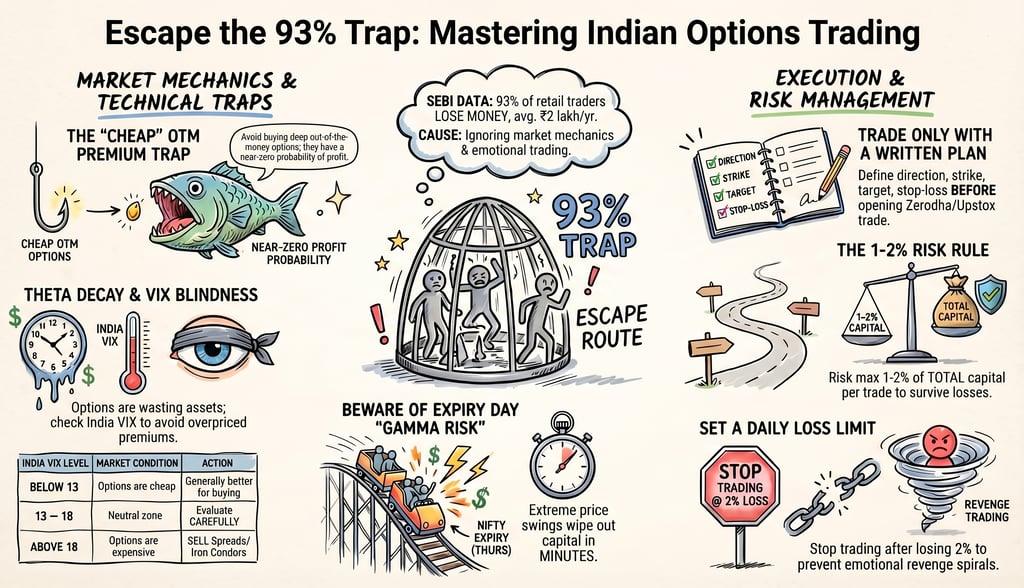
According to a SEBI study covering 1.13 crore individual F&O traders over three years, 93% of retail options traders in India lost money — with the average loss coming to ₹2 lakh per person per year. Four lakh new traders enter NSE's options markets every year, and most of them make the same ten mistakes within their first few months.
This guide is written specifically for Indian options traders — people trading Nifty 50, Bank Nifty, FinNifty and stock options on NSE. It covers India-specific pitfalls (weekly expiry traps, India VIX blindness, expiry-day gamma risk) alongside universal mistakes that hurt traders in the US, UK, Canada, Europe and Australia as well.
If you are serious about options trading in 2026, understanding these mistakes is your first real edge.
Why Do So Many Indian Options Traders Lose Money?
The structure of Indian derivatives markets creates unique risks that generic global content ignores. India has the world's most active options market by contract volume. NSE's weekly expiry structure — Nifty expires every Thursday, Bank Nifty every Wednesday — means retail traders have access to options with as little as one day to expiry. That's extraordinary leverage, and extraordinary danger for anyone without a structured approach.
Add to that the explosion of Telegram tip groups, YouTube trading channels promising consistent monthly returns, and social media influencers trading with paper profits — and you have a market where the information environment actively leads new traders towards the most dangerous behaviours.
The good news: every single mistake on this list is fixable with the right education and mentorship.
Mistake 1: Trading Without a Written Plan
What goes wrong: You open your Zerodha, Upstox or Angel One app, see Nifty moving sharply, and buy a CE or PE based on the momentum — no entry logic, no target, no stop-loss. Or worse, you follow a Telegram group's "sure shot" signal without understanding why the trade exists.
Trading without a plan is not trading. It is gambling with extra steps.
The fix: Before placing any options trade, write down five things: the direction you expect (bullish/bearish/neutral), the specific strike and expiry you are choosing and why, your entry price range, your profit target, and the maximum premium loss you will accept before exiting. This process takes three minutes and immediately separates you from the 93% who lose.
For Indian traders specifically: define whether your plan is for intraday, weekly expiry or monthly expiry. Each timeframe has completely different theta decay curves and requires different position management.
Mistake 2: Ignoring Theta Decay — Especially on Weekly Nifty Options
What goes wrong: You buy a Nifty 25,000 CE for ₹120 on Monday. By Thursday expiry, even though Nifty is trading at 25,050 — 50 points in your favour — your option is worth ₹18. You are confused and frustrated.
This is theta decay working exactly as it should. Options are wasting assets. Every day that passes, the time value component of your premium shrinks — and on weekly options with only 4–5 days to expiry, this decay accelerates dramatically in the final 48 hours.
The fix: Before buying any option, check its theta. A Nifty ATM weekly option might carry a theta of ₹15–25 per day, meaning you need the index to move significantly just to break even. As a general rule for beginners: trade monthly options for your first 6 months. They decay more slowly, giving you more time to learn and adjust positions. When you do trade weeklies, only buy options when you have a clear, near-term directional catalyst — a budget announcement, RBI policy day, or strong technical breakout.
Mistake 3: Buying Deep Out-of-the-Money (OTM) Options for "Cheap Premiums"
What goes wrong: Nifty is at 24,800. You buy the 25,500 CE for ₹15, thinking: "If Nifty rallies 700 points, I make 10x." What you have actually bought is an option with near-zero delta, extremely high theta decay, and almost no probability of finishing in the money.
This is one of the most common mistakes among new Indian options buyers. The ₹15 premium feels affordable, but the probability of profit is often below 5–8%.
The fix: Stick to ATM (at-the-money) options or options one strike OTM when you are starting out. Yes, they cost more in premium. But they have meaningful delta — meaning they actually move when the underlying moves — and they give you a realistic chance of profiting from a correct directional call. Once you understand Greeks and position sizing properly, you can evaluate OTM options selectively. As a beginner, never buy options more than 200–300 points away from the current Nifty level unless you are building a spread.
Mistake 4: Not Checking India VIX Before Buying Options
What goes wrong: India VIX is at 22 — significantly elevated because of an upcoming Union Budget or global macro event. You buy Nifty ATM calls for ₹350 per unit. The Budget announcement comes, Nifty moves 200 points in your direction — and your option is worth ₹280. You lost money on a trade where you were directionally correct.
This phenomenon is called "IV crush" (implied volatility crush). When India VIX is high, options are expensive because the market is pricing in uncertainty. Once the event passes, volatility collapses and option premiums fall sharply — even if the index moves in your direction.
The fix: Always check India VIX on NSE's website before placing a trade. A general guideline:
India VIX below 13: options are relatively cheap, generally better for buying.
India VIX between 13–18: neutral zone, evaluate carefully.
India VIX above 18: options are expensive. Consider selling option spreads (like bull call spreads or iron condors) rather than buying naked calls or puts.
This single check can save you from a category of losses that confuses even intermediate traders.
Mistake 5: No Stop-Loss Discipline — Holding Losing Options and Hoping
What goes wrong: You buy a Bank Nifty CE for ₹200. It moves against you to ₹120. You tell yourself it will recover. By Thursday expiry, it is worth ₹8. Your ₹200 is gone.
This is the single largest driver of retail losses in Indian F&O markets. Hope is not a trading strategy.
The fix: Set your stop-loss before you enter the trade, not while the trade is going against you. For long options, a widely used rule among professional traders is exiting when the premium falls 40–50% from your entry price. For example, if you buy a Nifty CE for ₹100, your stop-loss is at ₹55–60. Exit mechanically when it hits that level — no exceptions, no negotiations with yourself.
The psychological reason this is hard: your brain interprets a stop-loss exit as a confirmed loss, while holding the position keeps alive the possibility of recovery. Professional traders have learned to override this. It is a learnable skill, and it separates traders who survive from those who blow up their accounts.
Mistake 6: Overtrading and Revenge Trading
What goes wrong: You lose ₹8,000 on a morning trade. To "recover" it, you take three more aggressive trades in the afternoon — bigger positions, less thought. By end of day you have lost ₹35,000.
Overtrading comes in two forms in Indian markets: taking too many trades simply because the market is open (boredom trading), and taking oversized aggressive trades after a loss to recover quickly (revenge trading). Both are emotionally driven and both are statistically losing behaviours.
The fix: Set a daily maximum loss limit before each trading session — for example, if you lose 2% of your total capital in a day, you stop trading for that day. Log off. No exceptions. This rule feels restrictive until the first time it saves you from a ₹50,000 revenge-trading spiral.
Also set a maximum number of trades per day. Most professional options traders who consistently profit are selective — they might take 1–3 high-quality setups per day, not 15–20 impulsive ones.
Mistake 7: Misunderstanding Leverage and Over-sizing Positions
What goes wrong: You have ₹1,00,000 in your trading account. You deploy ₹60,000 on a single Nifty options trade because you are "very confident." The trade goes against you, and your account is permanently damaged.
Options provide enormous leverage — this is both their appeal and their danger. A small adverse move in Nifty can cause a 50–80% loss in an option's value within hours. When you have deployed most of your capital in a single trade, there is no room to recover.
The fix: Risk a maximum of 1–2% of your total trading capital on any single trade. On a ₹1,00,000 account, that means risking ₹1,000–2,000 per trade. This feels uncomfortably small to most new traders. It shouldn't — it means you can survive 50 consecutive losing trades and still have capital to trade and learn from.
A useful exercise: paper trade for 30 days before deploying real money. NSE's own platforms support this. Amuktha's mentorship programme includes structured paper trading phases specifically designed for the Indian market context.
Mistake 8: Trading Bank Nifty or Nifty on Expiry Day Without Understanding Gamma Risk
What goes wrong: It is a Thursday. Nifty expiry day. You buy an ATM Nifty CE at 11 AM for ₹80. By 1:30 PM, Nifty has barely moved — but your option is now worth ₹22. You don't understand why the market "isn't moving."
On expiry day, options near ATM experience violent gamma — meaning tiny moves in the index cause disproportionate changes in the option's delta and value. Combined with extreme theta decay in the final hours, expiry-day options are extraordinarily dangerous for buyers who do not understand what is happening.
The fix: Unless you are an experienced trader with a specific expiry-day strategy, avoid buying naked options on expiry day. If you want to trade expiry day, use defined-risk spreads (like bull call spreads) that limit your maximum loss. Better yet, observe expiry-day price action for three months before trading it — the dynamics are unlike any other session.
Mistake 9: Skipping the Options Greeks Entirely
What goes wrong: You know calls go up when the stock goes up. That is the extent of your options knowledge. You have no idea what Delta, Gamma, Theta, or Vega mean — so you cannot understand why your "correct" directional trade still lost money.
The Greeks are not advanced academic theory. They are the practical operating manual for every options position you hold.
The fix: Invest in learning the four primary Greeks properly before scaling your capital:
Delta tells you how much your option moves for every 1-point move in the underlying. An ATM Nifty option has a delta of approximately 0.5 — it gains roughly ₹0.50 for every ₹1 Nifty rises.
Theta tells you how much premium you lose every day simply due to time passing. This is the enemy for options buyers.
Vega tells you how your option's price changes with implied volatility. High Vega + falling VIX = loss even if direction is correct.
Gamma tells you how quickly your delta is changing — critical near expiry.
You don't need a finance degree to understand this. Amuktha's options mentorship course covers all four Greeks with live Nifty examples in plain English (and Hindi and Malayalam for Indian learners).
Mistake 10: Trying to Learn Options by Losing Real Money
What goes wrong: "I'll learn from the market" is the most expensive education strategy in options trading. The market will teach you — but the tuition fee can be your entire trading account before the lessons become clear.
Many Indian traders spend 12–18 months losing ₹1–3 lakhs before they develop a structured approach. This is entirely avoidable.
The fix: Start with paper trading on historical NSE scenarios. Get a structured mentor — ideally SEBI-registered — who can review your trade logic before you size up. The cost of good mentorship is a fraction of what the market charges for self-taught losses. And unlike market losses, mentorship builds compounding knowledge that stays with you for life.
At Amuktha, we have been mentoring traders since 2013 — through multiple market cycles, regulatory changes including SEBI's 2024 F&O framework changes, and the dramatic growth of retail participation in Indian derivatives markets. Our mentorship is built around your actual trades, not generic theory.
A Note for International Options Traders (US, UK, Canada, Europe, Australia)
While this guide is India-first, the core principles apply globally. Whether you trade SPY, QQQ, or FTSE 100 options, the same traps exist: buying cheap OTM options without understanding theta decay, ignoring implied volatility levels, over-sizing positions, and trading without a plan. The underlying mathematics of options pricing — the Black-Scholes model, the Greeks, the interaction of time and volatility — is universal. What differs is the market structure (CBOE vs NSE), the instruments (weekly SPX options vs weekly Nifty options), and the regulatory environment (SEC vs SEBI).
The Amuktha Approach to Options Education in 2026
Amuktha Trading and Investments has been helping traders navigate Indian and global markets since 2013. Our options mentorship programme covers:
Live Nifty and Bank Nifty trade analysis with real-time Greek monitoring
Personalised 1-on-1 sessions in English, Hindi and Malayalam
Paper trading frameworks before capital deployment
A full curriculum from options basics through to advanced strategies like iron condors, bull call spreads, and volatility plays
Ongoing support from SEBI-aware advisors as India's F&O regulations evolve in 2026
If you have been losing money in options and want to understand what you are actually doing — not just what to buy and sell — our mentorship is designed for you.
Frequently Asked Questions
Why do most Indian options traders lose money?
SEBI's own data shows 93% of retail F&O traders in India lose money. The primary reasons are: buying options without understanding theta decay, trading on unverified tips without a plan, over-leveraging, and not using stop-losses. These are all correctable with structured education.
Is options trading legal in India?
Yes. Nifty, Bank Nifty, and stock options trading on NSE is completely legal and SEBI-regulated. You need a SEBI-registered broker with F&O trading enabled on your demat account.
How much capital do I need to start trading Nifty options in India?
You can start with ₹25,000–50,000 for basic option buying strategies. For spreads and more advanced strategies, ₹1–2 lakhs provides better flexibility. For option selling, maintain at least ₹3 lakhs to manage margin requirements safely.
What is the difference between weekly and monthly Nifty options?
Weekly Nifty options expire every Thursday and carry faster theta decay — meaning they lose time value more quickly. Monthly options expire on the last Thursday of the month and are more forgiving for beginners because there is more time for trades to play out. Beginners are advised to trade monthly options for at least the first 6 months.
What is India VIX and why does it matter for options trading?
India VIX is NSE's volatility index — it measures how much uncertainty the market is pricing into Nifty options over the next 30 days. When India VIX is high, option premiums are expensive. Buying options when VIX is elevated means you often pay inflated premiums that collapse after the feared event passes, even if your directional view was correct.
Disclaimer:- Trading in securities markets carries substantial risk and is not suitable for everyone. Past performance is not indicative of future results. This article is for educational purposes only and should not be construed as investment advice. Please conduct your own research and consult a SEBI-registered financial advisor before making trading or investment decisions.
© 2026 Amuktha Trading. Telangana, India. Serving global traders since 2013.