
How to Earn Money in Option Trading in 2026
A Complete Guide for Beginners & Intermediate Traders in India, US, UK, Canada, Australia & Globally
By Amuktha Trading Services | Updated: 2026 | Reading Time: ~15 minutes
Introduction: Can You Really Earn Money in Option Trading?
Option trading has become one of the most talked-about ways to build income from the stock market — and for good reason. In India alone, NSE's options segment now accounts for over 95% of total derivatives volume, making it the largest options market in the world by contract count. In the US, UK, Canada, and Australia, retail options trading volumes hit record highs in 2025 and continue to grow into 2026.
But here is the honest truth: most beginners lose money in the first 6–12 months. Not because options trading doesn't work — but because most people start without a system, a mentor, or proper risk management.
This comprehensive guide will walk you through exactly how to earn money in option trading in 2026 — with real strategies, realistic income expectations, risk rules, and a structured learning path designed for traders in India, US, Canada, UK, Europe, and Australia.
"The goal of a trader is not to make money on every trade — it's to execute a proven system consistently so profits accumulate over time." — Core principle at Amuktha Trading Services
What Is Option Trading? A Simple Explanation
An option is a financial contract that gives you the right — but not the obligation — to buy or sell an underlying asset (a stock, index like Nifty/BankNifty, or ETF) at a specific price before a set expiry date.
There are two types of options. A Call Option means you profit when the price goes UP. Buying a call means you expect bullish movement. A Put Option means you profit when the price goes DOWN. Buying a put means you expect bearish movement.
There are also two sides to every trade. The Option Buyer pays a premium, has limited risk (only what you paid), and unlimited profit potential. The Option Seller (Writer) collects a premium, earns consistent income if the market stays within a range, but requires more margin and experience.
In India, Nifty 50 and BankNifty weekly options are the most actively traded instruments. In the US, SPY, QQQ, and individual stocks like AAPL and TSLA dominate options volume.
Why 90% of Options Traders Lose Money (And How to Be in the 10%)
Before we discuss how to earn money in option trading, it is critical to understand why most traders fail. A 2024 SEBI study of retail F&O traders in India found that over 90% of individual traders in equity F&O lost money over a three-year period. Similar patterns appear in US, UK, and Australian retail trading data.
The seven most common reasons traders lose are: trading without a defined strategy and reacting to tips or gut feelings; ignoring theta decay, which causes options to lose value every single day even if the market doesn't move; over-leveraging by using too much capital on a single trade; holding losing trades without stop-loss discipline while hoping they recover; chasing expiry-day trades without understanding gamma risk; trading during high-volatility events like earnings or RBI/Fed announcements without an IV strategy; and learning from random YouTube channels instead of following a structured mentorship program.
The traders who consistently earn money in option trading share one thing: they follow a written trading plan and never deviate from it, regardless of their emotions.
7 Proven Strategies to Earn Money in Option Trading in 2026
Here are the most effective option trading strategies used by professional traders globally — explained clearly for both Indian markets (Nifty/BankNifty) and international markets (S&P 500, individual stocks).
Strategy 1: Covered Call — Earn Regular Income on Stocks You Own
Best for: Stock holders in India, US, UK, Australia | Risk level: Low to Medium
A covered call is one of the safest ways to generate consistent income from option trading. If you already own shares of a company — such as Reliance, TCS, HDFC Bank, Apple, or Microsoft — you can sell a call option at a strike price above the current price and collect the premium immediately.
Here is how it works with an India example. Suppose you own 300 shares of Infosys at ₹1,500. You sell 1 lot of the Infosys call at ₹1,600 strike for ₹30 premium. With a lot size of 300 shares, the premium collected is ₹9,000. If Infosys stays below ₹1,600 at expiry, you keep the full ₹9,000 as profit. If Infosys rises above ₹1,600, your shares get called away — but you still profit from both the premium and the price rise up to that strike.
Covered calls can generate 2–5% monthly returns on your stock holdings, effectively creating a salary from your portfolio.
Strategy 2: Cash-Secured Put — Get Paid to Buy Stocks at Lower Prices
Best for: Investors wanting to buy stocks at a discount | Risk level: Medium
A cash-secured put means you sell a put option on a stock you wouldn't mind owning. You collect premium upfront. If the stock drops to your strike price, you buy it at that price — which you wanted anyway. If it doesn't drop, you keep the full premium.
Here is a US market example. Apple (AAPL) is trading at $200. You sell a $185 put expiring in 30 days for $3.50 premium, collecting $350 per contract (100 shares). If AAPL stays above $185 — you keep $350 with zero obligation. If AAPL drops to $185 — you buy 100 shares at $185, but your effective cost is $181.50 after accounting for the premium collected.
Strategy 3: Iron Condor — Profit When the Market Moves Sideways
Best for: Nifty/BankNifty traders in India, SPX traders in US | Risk level: Medium
The iron condor is a four-legged options strategy that profits when the market stays within a defined price range. It involves selling an out-of-the-money call spread and an out-of-the-money put spread simultaneously.
Here is a Nifty Iron Condor example using weekly expiry. With Nifty at 23,000, you sell the 23,500 CE (Call) and buy the 23,700 CE for protection. Simultaneously, you sell the 22,500 PE (Put) and buy the 22,300 PE for protection. The net premium collected is approximately ₹80–120 per lot. Your maximum profit is earned if Nifty stays between 22,500 and 23,500 at expiry. Your maximum loss is limited and pre-defined — your risk is fully capped on both sides.
The iron condor is particularly powerful in Indian markets because Nifty moves sideways 60–70% of the time, making premium collection strategies highly effective.
Strategy 4: Bull Call Spread — Directional Trade with Limited Risk
Best for: Traders expecting moderate upside movement | Risk level: Low to Medium
Instead of simply buying a call — which is expensive due to high premiums in India — a bull call spread reduces your cost by simultaneously selling a higher strike call. For example, you buy the Nifty 23,000 CE at ₹150 and sell the Nifty 23,300 CE at ₹80. Your net cost is just ₹70 per share compared to ₹150 for a naked call. Your maximum profit is ₹230 per share if Nifty reaches 23,300. Your maximum loss is only ₹70 — exactly what you paid for the spread.
Strategy 5: Bear Put Spread — Profit in Falling Markets
Best for: Traders expecting moderate downside | Risk level: Low to Medium
The bear put spread is the bearish equivalent of the bull call spread. You buy an at-the-money put and sell a lower strike put to reduce the premium cost while still profiting from a market decline. This is an excellent low-risk way to position yourself for bearish moves without paying full put premiums, which can be expensive during high-volatility periods.
Strategy 6: Straddle and Strangle — Trade Big Moves in Any Direction
Best for: Events like RBI policy, US Fed decisions, budget announcements, earnings | Risk level: High
A long straddle — buying both a call and a put at the same strike — profits when the market makes a large move in either direction. This is ideal before major announcements when implied volatility is expected to spike. A strangle works similarly but uses out-of-the-money options, making it cheaper to enter.
Important: Avoid buying straddles AFTER an event — IV crush will destroy your premium even if the market moves in your direction. Always enter BEFORE the event.
Strategy 7: Intraday Options Trading (0DTE) — High Risk, High Reward
Best for: Experienced day traders in India and US | Risk level: Very High
Zero Days to Expiry (0DTE) options trading has exploded in popularity in India (Thursday Nifty expiry) and the US (SPX daily expiries). These options are extremely cheap but move rapidly with the market. 0DTE trades require split-second decisions and strict stop-loss discipline. Never risk more than 1–2% of your account on a single 0DTE trade. Use volume combined with price action signals rather than relying on indicators alone. This strategy is not recommended for beginners — master at least one other strategy first before exploring 0DTE.
How Much Can You Earn in Option Trading? Realistic Expectations in 2026
One of the most common questions is: how much can I earn in option trading in India? Here are honest, data-backed answers.
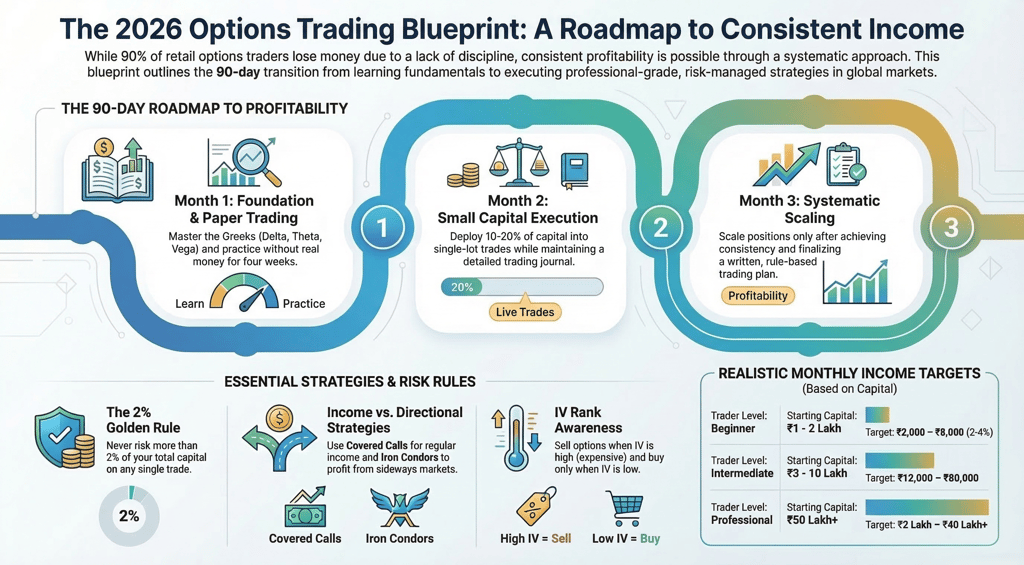
A beginner trader with ₹1–2 Lakh starting capital, following covered calls and bull spreads with disciplined risk management, can realistically target ₹2,000–₹8,000 per month — that is a 2–4% monthly return. An intermediate trader with ₹3–10 Lakh capital, using iron condors and straddle strategies, can realistically target ₹12,000–₹80,000 per month. An advanced trader with ₹10–50 Lakh capital, using portfolio margin strategies and spreads, can target ₹60,000–₹6 Lakh per month. A professional trader with ₹50 Lakh or more in capital, compounding returns across multiple strategies, can target ₹2 Lakh to ₹40 Lakh or more per month.
These figures represent realistic outcomes for disciplined traders following a proven system — not guaranteed results. Your actual returns will depend on market conditions, your strategy, and your risk management.
The real secret to making money in options trading is consistency over time. A trader making 4% per month consistently will turn ₹5 Lakh into ₹26 Lakh in 5 years through compounding — without taking excessive risk.
Risk Management: The #1 Skill Every Options Trader Must Master
No guide on how to earn money in option trading would be complete without a deep section on risk management. This is the single most important factor that separates profitable traders from those who blow their accounts.
The golden rules of options risk management are as follows. Never risk more than 2% of your total capital on a single trade. Always define your maximum loss before entering a trade — use defined-risk spreads wherever possible. Keep a trading journal and record every entry, exit, reasoning, and outcome. Avoid trading during the 15 minutes before major economic announcements such as RBI, Fed, or CPI data releases. Never add to a losing position — this is the most common mistake that leads to catastrophic losses. Scale your position size based on market volatility and trade smaller when VIX is above 20. Keep at least 50% of your options capital in cash — over-trading is a silent account killer.
Here is a simple position sizing formula for Indian options traders: your maximum trade risk equals 2% of your total capital. If your total capital is ₹5,00,000, your maximum risk per trade is ₹10,000. If the stop-loss on your trade is ₹50 per lot, your maximum position is 2 lots — calculated as ₹10,000 divided by ₹50 equals 200 shares, or 2 lots of 100.
Understanding the Option Greeks: What Every Trader Must Know in 2026
The option greeks are mathematical measures that describe how an option's price changes relative to various factors. You don't need to be a mathematician — but you must understand these four.
Delta measures how much the option price moves per ₹1 or $1 move in the underlying asset. At-the-money options have approximately 0.5 delta, while deep in-the-money options behave almost like the underlying shares themselves.
Theta measures time decay — specifically, how much the option loses value each passing day. Option sellers benefit from theta every single day, while option buyers must fight theta decay constantly. This is why premium collection strategies are so popular among professional traders.
Vega measures sensitivity to changes in implied volatility (IV). You should buy options before IV rises — such as before major events. Sell options when IV is already elevated and likely to fall after the event passes.
Gamma measures the rate of change of delta. High gamma near expiry means fast-moving options that can make or lose money very quickly. This is a double-edged sword for sellers, which is why 0DTE strategies require extra caution.
The most common mistake beginners make: they buy options when IV is at a peak — just before or after big news — then watch their option lose value even though the market moved in their direction. Always check IV Rank before buying.
How to Earn Money in Nifty Options: India-Specific Guide 2026
India's Nifty 50 index options are the most liquid and actively traded options market in the world. Here is what makes trading Nifty options unique in 2026.
Nifty options have a weekly expiry every Thursday, which is ideal for short-term premium collection strategies. The lot size is 75 units per lot as per current SEBI guidelines — always verify the latest lot size at the NSE website as this can change. Monthly expiry falls on the last Thursday of each month and is used for bigger positional trades. BankNifty options are more volatile and carry higher premium, making them better suited for experienced traders. FinNifty and MidSelect Nifty options are growing in volume and present emerging opportunities for active traders.
The best times to trade Nifty options vary through the day. From 9:20 AM to 10:30 AM, the market is in its opening range breakout phase — high volatility, strong premium moves, and good conditions for directional trades. From 10:30 AM to 1:30 PM, the market enters a trending session that is best for positional strategies and spreads. From 1:30 PM to 3:00 PM, the market typically consolidates sideways, which is the best time for iron condors and theta decay strategies. After 3:00 PM on expiry day, volatility can spike dramatically — avoid this window unless you are experienced with 0DTE trading.
Common mistakes specific to Indian options traders include: buying far out-of-the-money options for ₹5–10 hoping for massive returns — theta destroys these rapidly; not accounting for physical settlement rules for stock options near expiry; ignoring GIFT Nifty gap-up or gap-down signals before market open; and over-trading BankNifty due to excitement — it requires much tighter stops than Nifty.
Options Trading in US, Canada, UK, Europe & Australia: 2026 Overview
United States
The US options market, governed by the CBOE and OCC, is the world's most liquid. Key instruments include SPX, SPY, QQQ, IWM, and single stocks like AAPL, TSLA, NVDA, and AMZN. Brokers like Tastytrade, Schwab (formerly TD Ameritrade), Interactive Brokers, and Robinhood offer options trading for US residents. The major 2026 trend is the explosive growth of 0DTE SPX options — over 50% of SPX options volume is now 0DTE. This creates enormous short-term opportunities but demands strict discipline and tight risk management.
Canada
Canadian traders access options through TSX-listed stocks and US markets via IBKR, Questrade, or National Bank Direct Brokerage. The most popular instruments are XIU (iShares S&P/TSX 60 ETF) options and US cross-listed stocks. Regarding tax treatment, options income in Canada under CRA is typically treated as capital gains or business income depending on the frequency and intent of trading.
United Kingdom & Europe
In the UK, spread betting on options is popular as profits are generally exempt from Capital Gains Tax (CGT) for most retail traders. UK traders commonly use IG Markets, Saxo Bank, or IBKR. European traders must navigate MiFID II regulations, which restrict certain leveraged products for retail clients — always verify your eligible instruments with your broker.
Australia
ASX-listed options on top 200 stocks are available via CommSec, Westpac, or IBKR. Australian traders also widely access US markets. ASIC regulates options trading in Australia, and profits are taxed as capital gains, with a 50% CGT discount available for positions held over 12 months.
Step-by-Step Roadmap: How to Start Earning Money in Options in 2026
Whether you are a complete beginner or an intermediate trader stuck in losses, here is a structured 90-day roadmap to build a profitable options trading practice.
Month 1: Learn the Foundation (No Real Money Yet)
Start by studying the basics of options — calls, puts, strike price, expiry, premium, and ITM/ATM/OTM terminology. Learn the four greeks: Delta, Theta, Vega, and Gamma, and understand how each one affects your profit and loss. Study at least two core strategies: covered calls and iron condors. Open a paper trading account and practice without real money for at least four weeks. For reading material, Zerodha Varsity is excellent for Indian traders, while tastytrade.com is one of the best free resources for international options education.
Month 2: Small Capital, Real Trades
Start with just 10–20% of your planned total capital — for example, ₹20,000–50,000 in India. Trade a maximum of one lot per strategy until you are consistently profitable for four consecutive weeks. Keep a detailed trading journal recording your entry, exit, reasoning, emotion, and outcome for every trade. Review your trades every weekend and identify patterns in both your wins and your losses. This is also the right time to enrol in a structured mentorship program for personalized guidance and accountability.
Month 3: Scale and Systematize
Introduce a second strategy only once your primary strategy is consistently profitable. Define your monthly income target and the required win rate to achieve it. Begin compounding by reinvesting a portion of profits to grow your capital base. Set clear drawdown rules — if you lose 10% of your capital in a single month, stop trading and conduct a full review before resuming. Build your personal trading plan document that clearly defines your strategy, rules, position sizing formula, and maximum risk limits.
Frequently Asked Questions
1. Can option trading make you rich?
Yes — but not quickly, and not without a system. Option trading can build significant wealth over time through consistent returns and compounding. Traders who make 4–8% per month consistently can grow ₹5 Lakh to over ₹1 Crore in 5–7 years. But it requires discipline, a proven strategy, and proper risk management. Get-rich-quick thinking is the single biggest account killer in options trading.
2. How much can a beginner earn from option trading in India?
A disciplined beginner with ₹1–2 Lakh capital, following a defined strategy and strict risk management, can realistically target ₹3,000–₹8,000 per month — approximately 2–4% monthly returns. The focus in the first six months should be on consistency and capital preservation, not maximizing profits. Protecting your capital is how you stay in the game long enough to master the skill.
3. Is option trading better than stock trading?
Neither is inherently better — they serve different goals. Options offer leverage, defined risk for buyers, income generation for sellers, and strategies that work in every market condition — rising, falling, or sideways. However, options have additional complexity in the form of time decay and volatility that makes education and mentorship even more important than in regular stock trading.
4. How many option traders are profitable in India in 2026?
According to SEBI's study, fewer than 10% of individual F&O traders in India were profitable over a three-year period. However, among traders who received structured training, followed defined strategies, and maintained trading journals, the profitability rate was significantly higher. This is why mentorship and structured education make such a measurable difference in trading outcomes.
5. What is the best time to trade Nifty options?
The most consistent opportunities in Nifty options are typically found between 9:20 AM and 11:30 AM during the morning range breakout, and between 1:30 PM and 3:00 PM for afternoon consolidation and premium decay trades. Expiry day trading after 3:00 PM requires extreme caution and is best avoided entirely by beginners.
6. Do I need to quit my job to trade options full-time?
No — and we strongly advise against it initially. Most successful option traders run their strategies as a part-time income source for 12–24 months before even considering a full-time transition. Options selling strategies such as covered calls and iron condors can typically be managed in 30–60 minutes per day, making them fully compatible with full-time employment.
7. Is option trading taxable in India?
Yes. In India, profits from F&O trading including options are treated as business income and taxed at your applicable income tax slab rate. F&O losses can be set off against other business income and carried forward for up to 8 years. It is strongly advisable to consult a Chartered Accountant who is familiar with trading taxation. Do not neglect your ITR filing — SEBI and the Income Tax Department actively monitor F&O trading accounts.
8. What is IV Rank and why does it matter?
IV Rank (IVR) measures the current implied volatility of an option relative to its 52-week range. An IVR above 50 means options are expensive — this is the ideal time to be selling options. An IVR below 30 means options are cheap — this is a better time for buying. Ignoring IVR is one of the most common reasons traders pay too much for options or sell them too cheaply, directly damaging their profitability.
About Amuktha Trading Services
Amuktha Trading Services was founded with one mission: to help retail traders in India and globally build consistent, sustainable income from the stock market through structured education, expert mentorship, and battle-tested strategies.
Our coaching programs are designed for traders at every level — from complete beginners who have never placed a trade, to intermediate traders who are profitable but inconsistent. We specialize in Nifty and BankNifty options for Indian traders, and provide international market guidance for traders in the US, Canada, UK, Australia, and Europe.
What makes our mentorship different: we provide personalized 1-on-1 coaching tailored to your capital, schedule, and risk appetite. You learn through live market guidance in real market conditions, not just theory. Our structured 7-module curriculum covers everything from options basics to advanced strategies. Weekly strategy sessions provide market analysis and trade planning. Each student gets a dedicated trading mentor for accountability and progress tracking, as well as access to a community of serious traders for peer learning and support.
Ready to Build Consistent Income from Option Trading?
Book your FREE 1:1 consultation with an Amuktha Trading Mentor — Limited slots available.
📲 WhatsApp: +91 73821 77772 | amuktha.com
Disclaimer:- Trading in securities markets carries substantial risk and is not suitable for everyone. Past performance is not indicative of future results. This article is for educational purposes only and should not be construed as investment advice. Please conduct your own research and consult a SEBI-registered financial advisor before making trading or investment decisions.
© 2026 Amuktha Trading. Telangana, India. Serving global traders since 2013.