
How to Make Money in Option Trading in 2026 — Nifty, Bank Nifty & Global Markets
By Amuktha Trading & Investments | Founded 2013 | Updated April 2026 Reading time: 15 minutes | Beginner to Advanced | India · US · UK · Canada · Australia · Global
Available in: English · हिंदी में भी उपलब्ध · മലയാളത്തിലും ലഭ്യം . తెలుగులో కూడా
What Is Option Trading? (2026 Context)
An option is a contract that gives you the right — but not the obligation — to buy or sell an underlying asset at a specific price (called the strike price) before a specific date (the expiry date). You pay a fee called the premium to acquire this right.
Unlike buying a stock outright, where you profit only when prices rise, option trading lets you profit in three types of markets. In bullish markets, you profit when prices go up. In bearish markets, you profit when prices fall. In sideways or neutral markets, you profit when prices stay range-bound within a defined zone.
In India, the most commonly traded options are on Nifty 50 and Bank Nifty on the NSE, along with individual stocks. In the US, traders use options on the S&P 500 (SPX), individual stocks like Apple and Tesla, and ETFs like QQQ. In the UK and Australia, index options on the FTSE and ASX are widely used by retail traders.
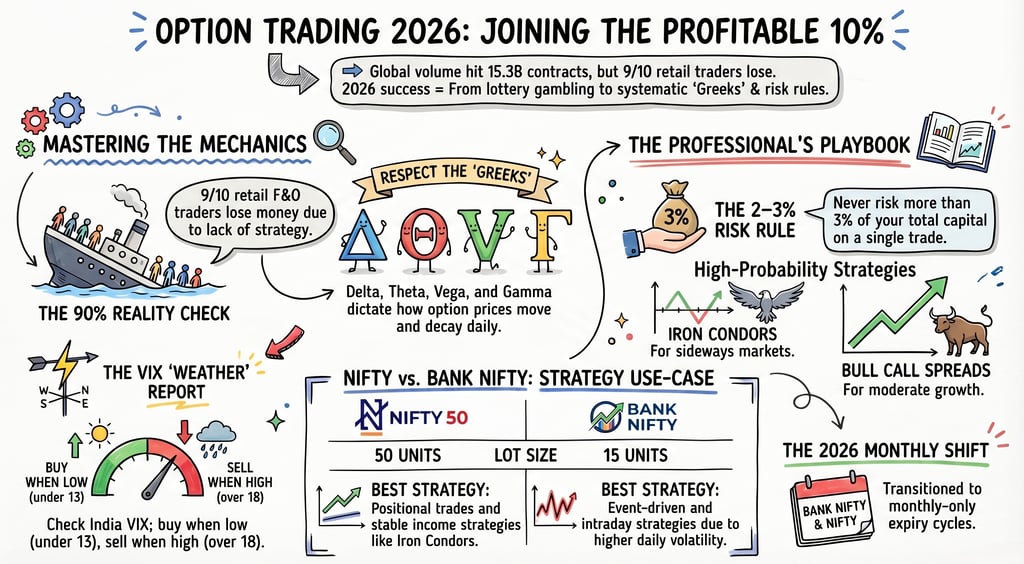
To put the scale of this market in perspective: over 15.3 billion options contracts were traded globally in 2025, a 24% increase year-on-year. India alone sees daily F&O turnover exceeding ₹10 lakh crore on NSE. Options are no longer a niche instrument — they are the heartbeat of modern financial markets.
However, there is one statistic every new options trader must confront before placing their first trade: SEBI's own data shows that 9 out of 10 retail F&O traders in India lose money. This guide exists to put you firmly in the 10% who don't — through strategy, discipline, and proper education rather than luck.
The India Market Reality: What SEBI Data Actually Shows
SEBI's research into F&O trading in India reveals that the vast majority of retail losses are concentrated in weekly expiry options bought without a clear strategy — typically out-of-the-money calls or puts purchased just before expiry, hoping for a lottery-style move that almost never arrives in time.
The traders who consistently profit from options are not lucky. They are systematic. They understand market structure, position size carefully, use defined-risk strategies, and treat trading as a skill that compounds over years, not weeks. There are no guaranteed returns in trading. Anyone promising "assured profits" or "fixed monthly income" from options is either misleading you or violating SEBI regulations.
The profitable 10% share clear, observable traits. They always trade with a written plan. They limit risk per trade to 1–3% of their total capital. They understand the instrument they're trading — not just its direction, but its time decay, volatility sensitivity, and strike selection logic. And they never trade emotionally, whether in profit or loss. These are all learnable skills. That is exactly what this guide teaches.
Key Terms Every Option Trader Must Know Before Starting
Before placing a single option trade, you need to be fluent in the language of options. These are not just definitions — they are the building blocks of every decision you will ever make in this market.
A Call Option (CE) gives you the right to buy the underlying asset. You profit when the price rises above your strike price. For example, a Nifty 23,000 CE profits if Nifty rises above 23,000 before expiry.
A Put Option (PE) gives you the right to sell the underlying asset. You profit when the price falls below your strike price. A Nifty 22,500 PE profits if Nifty drops below 22,500.
The Strike Price is the agreed buy or sell price written into the contract — for example, the "23,000" in "Nifty 23,000 CE."
The Premium is the price you pay to buy an option contract. If a Nifty option costs ₹150 per unit and the lot size is 50 units, you pay ₹7,500 for one lot. This is your maximum possible loss when buying.
The Expiry Date is the last day the option contract is valid. In India as of 2026, both Nifty and Bank Nifty are on monthly expiry (last Thursday of each month) following SEBI's discontinuation of weekly Bank Nifty options.
In the Money (ITM) means the option has intrinsic value — exercising it right now would be profitable. If Nifty is at 23,200, then the 23,000 CE is in the money.
At the Money (ATM) means the strike price is equal or very close to the current market price. If Nifty is at 23,000, the 23,000 CE is at the money.
Out of the Money (OTM) means the option has no intrinsic value and needs a significant move to become profitable. If Nifty is at 23,000, the 24,000 CE is far out of the money.
Lot Size is the minimum number of units in one option contract. In India: Nifty = 50 units per lot, Bank Nifty = 15 units per lot.
Open Interest (OI) is the total number of outstanding contracts in the market. High open interest at a particular strike signals strong support or resistance — professional traders watch OI closely when selecting strike prices.
Understanding the Greeks — Delta, Theta, Vega, Gamma
The "Greeks" are mathematical measures that tell you how an option's price will behave as market conditions change. Ignoring the Greeks is like driving without a speedometer — you won't know how fast you're moving until it's too late.
Delta (Δ) measures how much the option price moves for every ₹1 (or $1) move in the underlying asset. An ATM option has a delta of approximately 0.5, meaning it moves ₹0.50 for every ₹1 the market moves. A deep ITM option has a delta close to 1 (moves almost in full sync with the market), while a deep OTM option has a delta close to 0 (barely moves at all). The trader's rule: buy ATM or slightly ITM options for better responsiveness to your market view. Buying deep OTM options because they're cheap is one of the most expensive mistakes in options trading.
Theta (Θ) measures time decay — how much value the option loses each day simply due to the passage of time. Every single day you hold a bought option, Theta is eroding its value, even if the underlying doesn't move. For weekly options near expiry, theta can accelerate to ₹10–20 per unit per day. The trader's rule: never buy options on Wednesday or Thursday near expiry. Buy on Monday or Tuesday and exit by Wednesday to minimize the damage from time decay.
Vega (V) measures how sensitive the option price is to changes in implied volatility, reflected in India by the India VIX index. When VIX rises, option premiums inflate. When VIX falls, premiums deflate — even if the underlying moves in your direction. The trader's rule: buy options when India VIX is low (below 13) because premiums are cheap. Use selling or writing strategies when VIX is high (above 18) because you collect rich premiums that then deflate.
Gamma (Γ) measures the rate of change of Delta — how quickly Delta accelerates. Gamma is highest for ATM options near expiry, which is why options can move dramatically in the last few days before expiry even on small market moves. The trader's rule: be cautious with high-gamma positions near expiry. They can work powerfully in your favour or against you with equal speed.
Seven Proven Strategies to Make Money in Options in 2026
The right strategy depends on your market view, available capital, and risk tolerance. These seven strategies have withstood the test of time in Indian, US, UK, and global markets — and they form the core curriculum at Amuktha Trading.
Strategy 1: Long Call — for strongly bullish markets
You buy a call option when you expect the underlying to rise significantly before expiry. Your maximum loss is limited to the premium you paid. Your profit potential is theoretically unlimited as the market rises. This is the most straightforward bullish strategy and the first one most traders learn.
Real India Example: Nifty is at 23,000. You're bullish ahead of a positive GDP data release. You buy the 23,000 CE at ₹180. You invest ₹180 × 50 = ₹9,000 (one lot). If Nifty rises to 23,500, your option is now worth approximately ₹500, giving you a profit of ₹(500−180) × 50 = ₹16,000 — a 178% return on capital risked.
Strategy 2: Long Put — for strongly bearish markets
You buy a put option when you expect the market to fall. Your profit grows as the market drops. Risk is capped at the premium paid. Long puts are ideal when negative news, global risk-off events, or technical breakdowns suggest a significant decline is coming.
Real India Example: Nifty is at 23,000 and global markets are flashing warning signals. You buy the 22,800 PE at ₹140. Investment = ₹7,000 per lot. If Nifty falls to 22,300, your put is now worth approximately ₹500, delivering a profit of ₹(500−140) × 50 = ₹18,000.
Strategy 3: Covered Call — for generating monthly income
You own the underlying stock or index ETF and sell a call option against it to earn premium income every month. This is one of the most conservative option strategies and is widely used by long-term investors to enhance returns on existing holdings. The sold call caps your upside on the stock temporarily, but generates reliable cash flow with a historical win rate of 60–70%.
Strategy 4: Bull Call Spread — for moderate bullish views with lower cost
You buy a lower strike call and simultaneously sell a higher strike call. The premium collected from the sold call reduces your total cost. Both your maximum profit and maximum loss are clearly defined from the moment you enter the trade.
Real India Example: Nifty at 23,000. You buy the 23,000 CE at ₹180 and sell the 23,400 CE at ₹60. Net cost = ₹(180−60) × 50 = ₹6,000. Maximum profit = ₹(400−120) × 50 = ₹14,000. Breakeven = 23,120. If Nifty reaches 23,400 by expiry, you collect the full ₹14,000 — a 133% return on the capital risked, with no surprise beyond the defined ₹6,000 maximum loss.
Strategy 5: Long Straddle — for big moves in either direction (event-driven)
You buy a call AND a put at the same strike price simultaneously. You profit if the underlying makes a large move in either direction — you don't need to know which way, only that it will move significantly. This strategy is ideal around high-impact events: RBI monetary policy announcements, Union Budget day, major corporate earnings, or global macro shocks.
Real India Example: Bank Nifty is at 51,000 the day before an RBI policy announcement. You buy the 51,000 CE at ₹250 and the 51,000 PE at ₹230. Total investment = ₹480 × 15 = ₹7,200. If the RBI surprises with a rate cut and Bank Nifty jumps 800 points, your call option is now worth over ₹800, delivering a profit of approximately ₹(800−480) × 15 = ₹4,800 — a 67% return in a single trading day.
Strategy 6: Iron Condor — for sideways markets (highest win rate)
You sell a call spread and a put spread simultaneously around the current market price. You collect premium upfront and profit as long as the underlying stays within your defined range by expiry. The Iron Condor has a historical win rate of 70–80% in calm, range-bound markets and is the preferred income strategy for experienced traders.
Real India Example: Nifty at 23,000, no major events expected for two weeks. You sell the 23,200 CE and buy the 23,300 CE (call spread), and sell the 22,800 PE and buy the 22,700 PE (put spread). Net premium collected = ₹60 × 50 = ₹3,000. As long as Nifty stays between 22,800 and 23,200 at expiry, all options expire worthless and you keep the entire ₹3,000. The trade requires active monitoring and adjustment if Nifty approaches either boundary.
Strategy 7: Protective Put — portfolio insurance
You own stocks and buy a put option on the index or individual stock as insurance. If the market crashes, your put gains offset the losses on your stock portfolio. This strategy is used by professional portfolio managers and long-term investors who want to stay invested but protect against tail-risk events like elections, geopolitical shocks, or financial crises.
Risk Management: The Only Thing Standing Between You and Loss
In option trading, risk management is not one of the skills — it is the skill. Every other technique is secondary to the question: how much can I lose on this trade, and am I genuinely comfortable with that amount?
Here are the non-negotiable rules that professional option traders follow, in India and globally.
Never risk more than 2–3% of your total capital on a single trade. If you have ₹1,00,000 in your trading account, your maximum risk per trade should be ₹2,000–3,000. This sounds conservative until you lose three trades in a row — at which point it feels like genius.
Always define your maximum loss before entering. Use spreads — Bull Call Spreads, Bear Put Spreads, Iron Condors — if you cannot afford unlimited-risk positions. Never enter a naked short option position without understanding that your losses can theoretically be unlimited.
Set stop-losses at 30–50% of premium paid for bought options. If you paid ₹100 for an option, your exit trigger is ₹60. Honor this without exception. Never move your stop-loss lower in the hope that the trade will recover — in options, time is always working against the buyer.
Check India VIX before buying any option. If VIX is above 18, premiums are expensive and likely to deflate even if you're directionally correct — use selling strategies or wait. If VIX is below 12, premiums are cheap — prefer buying strategies where Theta is working less aggressively against you.
Avoid buying options on Wednesday or Thursday near monthly expiry. Theta decay accelerates dramatically in the final 48 hours. You're paying full premium but time is destroying your position at an accelerating rate.
Never hold naked short options overnight without a hedge. A single RBI announcement, global macro shock, or unexpected geopolitical event can cause a gap-open the next morning that wipes out your entire account on a naked short position. Always hedge with a spread.
Trade fewer positions with higher conviction rather than spreading yourself thin across five or six low-confidence trades. Two well-managed, well-researched trades will consistently outperform six impulsive ones.
Paper trade for at least 30 days before deploying real capital. Strategy without practice is theory, not trading. Amuktha Trading's mentorship program includes structured paper trading with real-time feedback before any live capital is put at risk.
India-Specific: Nifty, Bank Nifty & Expiry Rules in 2026
If you are trading options in India, these facts are essential for 2026.
Nifty 50 options trade on NSE with a lot size of 50 units. Monthly expiry falls on the last Thursday of each month. A single ATM option lot costs approximately ₹5,000–15,000 in premium. Nifty is best suited for positional trades, spreads, and stable income strategies like Iron Condors.
Bank Nifty options trade on NSE with a lot size of 15 units. Monthly expiry also falls on the last Thursday of the month. A single ATM option lot costs approximately ₹2,250–4,500 in premium. Bank Nifty is better suited for event-driven and intraday strategies given its higher daily volatility driven by RBI policy decisions and banking sector news.
An important 2026 update: SEBI has discontinued Bank Nifty weekly options to reduce retail speculation. Both Nifty and Bank Nifty are now on monthly expiry only. This actually benefits option buyers — you now have significantly more time for your trades to work out, reducing the brutal time decay pressure that weekly expiry created.
On taxation: options trading profits in India are classified as Business Income, taxed at your applicable income tax slab rate. STT of 0.0625% is charged on the selling side of option contracts. Always consult a qualified CA for your personal F&O tax position — it is more nuanced than most traders expect, and proper record-keeping from day one saves significant headaches at year-end.
Global Markets: US, UK, Australia & How They Differ
The seven strategies described in this guide work identically across all global markets. The core mechanics of options — strike prices, expiry, premium, the Greeks — are universal. What changes is lot sizes, liquidity depth, and local regulatory and tax treatment.
In the United States, options trade on the CBOE and other exchanges with 100 shares per contract as the standard lot size. The US market offers daily, weekly, and monthly expiry, with zero-day expiry (0DTE) options having become extremely popular among active traders. The US market is the world's deepest and most liquid options market, with tight bid-ask spreads even on individual stocks.
In the United Kingdom, FTSE 100 options and individual stock options are available, typically through CFD brokers for retail traders. Monthly expiry is standard. UK traders benefit from the ISA wrapper for certain investments, though options profits generally fall under Capital Gains Tax rules.
In Australia, ASX 200 options and individual stock options (BHP, CBA, Westpac) are available through ASX. Liquidity is lower than US or Indian markets, which means wider bid-ask spreads. Monthly expiry is standard. Australian traders should note that options profits are subject to CGT, with a 50% discount available for assets held over 12 months.
In Canada, TSX-listed options are available with heavy representation in energy and mining stocks. The market structure mirrors the US with 100 shares per contract. In Europe, EURO STOXX 50 and DAX options trade on Eurex with strong institutional participation and quarterly expiry cycles.
Indian traders investing in US options through GIFT City, Gujarat or through global brokerage platforms with LRS (Liberalized Remittance Scheme) remittances should note the $250,000 annual cap and applicable FEMA guidelines. This is a growing avenue for Indian traders seeking exposure to global volatility events.
Seven Mistakes That Wipe Out Option Traders (Avoid These in 2026)
Mistake 1: Buying deep OTM options hoping for a lottery win. A ₹20 OTM option needs the market to move 400–500 points just to reach your breakeven — this rarely happens within the time available. Deep OTM options expire worthless the overwhelming majority of the time.
Mistake 2: Ignoring Theta near expiry. Buying options on Wednesday or Thursday near monthly expiry means fighting brutal time decay every single hour. The option is losing value faster than you can realistically profit from it.
Mistake 3: Holding losing positions hoping they'll recover. In options, a losing bought position loses faster as expiry approaches. The underlying needs to move increasingly larger distances just to get back to breakeven. Cut losses early — small losses stay small, but hope in options always makes them bigger.
Mistake 4: Over-leveraging with too many lots. Trading 10 lots with ₹50,000 capital leaves zero room for error. Professional traders start with 1–2 lots per trade until they are consistently profitable. Capital preservation is the only goal for the first 6 months.
Mistake 5: Trading without checking India VIX. Buying options when VIX is high (above 20) means paying expensive, inflated premiums that deflate rapidly when volatility settles — even if the market moves in your favour. Always check VIX before every trade.
Mistake 6: Revenge trading after a loss. Taking a bigger, impulsive trade immediately after a loss to "recover quickly" is how small, recoverable losses become account-ending ones. After any losing trade, step away, review what went wrong, and come back with a clear head.
Mistake 7: Following paid Telegram or WhatsApp "tips" blindly. If you don't understand why you're entering a trade, you won't know when or why to exit it — and you will always be the last to know when it has gone wrong. Tips services are not education. Understanding is.
Frequently Asked Questions
Can beginners make money in option trading in India in 2026?
Yes — but only with proper education, starting with defined-risk strategies, and realistic expectations. Begin with paper trading for one to two months, start with Bull Call Spreads or Iron Condors rather than naked OTM options, and never risk more than 2–3% of your capital per trade. The 90% who lose money do so because they skip this foundation phase.
How much capital do I need to start option trading in India?
You can technically start buying a single Nifty lot with ₹5,000–15,000 in premium. However, for safe, risk-managed trading with spreads and proper position sizing, ₹50,000–1,00,000 is the recommended starting capital. Anything less makes meaningful risk management nearly impossible.
What is the best option strategy for Nifty in 2026?
The Iron Condor has the highest win rate (70–80%) in sideways markets. For beginners, the Bull Call Spread offers limited-risk bullish exposure with a clear maximum loss. For event days like RBI policy or the Union Budget, the Long Straddle captures large directional moves. The best strategy always depends on current market conditions, India VIX level, and your individual risk tolerance.
Is option trading legal in India?
Yes. F&O trading on NSE and BSE is completely legal and fully regulated by SEBI. You need a demat and trading account with a SEBI-registered broker with F&O trading activated. Using SEBI-registered advisory services is also legal and provides investor protection. What is illegal is using unregistered advisors who charge fees for guaranteed-return tips — SEBI actively prosecutes such entities.
What is the difference between option buying and option selling?
When you buy options, you pay a premium for the right to profit from a big directional or volatility move. Your risk is limited to the premium paid, but Theta (time decay) works against you every day. Buying suits high-conviction, event-driven trades with a clear catalyst. When you sell or write options, you collect premium by taking on the obligation side of the contract. Time decay works in your favour, giving selling strategies a statistically higher win rate. However, naked option selling carries unlimited risk — always use spreads when selling to define your maximum loss.
Can Indian traders access US and global options markets?
Yes. Indian residents can invest in foreign assets under the RBI's Liberalized Remittance Scheme (LRS) up to $250,000 per year. Several Indian brokers also offer integrated US stock and options trading. GIFT City in Gujarat is increasingly being used as an offshore financial centre for derivatives trading within India's own regulatory framework.
Is mentorship really necessary, or can I learn on my own?
You can learn on your own — the internet has unlimited resources. But most self-taught traders spend 12–18 months (and significant capital) learning lessons that a structured mentorship program covers in weeks. The real cost of self-teaching in options is not the course fee you save — it is the money lost making avoidable mistakes on live capital while you figure things out. At Amuktha Trading, we teach in English, Hindi, and Malayalam, ensuring you understand every concept fully in your preferred language before a single rupee of real capital is at risk.
Start Your Option Trading Journey with Amuktha Trading
Founded in 2013, Amuktha Trading has guided thousands of traders across India, the US, the UK, Australia, Canada, and global markets from their first option trade to consistent, systematic profitability. Our mentorship programs are built on one principle: you should never place a trade you don't fully understand.
Our option trading course covers everything in this guide and far beyond — live market sessions with real Nifty and Bank Nifty trades, one-on-one coaching tailored to your capital size and goals, risk management frameworks used by professional traders, and ongoing support as markets evolve through 2026 and beyond.
Whether you are a complete beginner asking "what is option trading?" or an experienced trader looking to eliminate costly mistakes and add consistency to your results — Amuktha Trading has a program for you.
Join us today and start trading options the way professionals do — with a plan, with discipline, and with the knowledge to understand every trade you place.
Contact us at amuktha.com or reach our team directly through WhatsApp to book your first consultation session. Mentorship is available in English, Hindi, Telugu and Malayalam.
Disclaimer:- Trading in securities markets carries substantial risk and is not suitable for everyone. Past performance is not indicative of future results. This article is for educational purposes only and should not be construed as investment advice. Please conduct your own research and consult a SEBI-registered financial advisor before making trading or investment decisions.
© 2026 Amuktha Trading. Telangana, India. Serving global traders since 2013.