
How to Make Consistent Profits in Intraday Trading in 2026: Proven Strategies for Nifty, Bank Nifty & Global Markets
Updated: March 2026 · By Amuktha Trading Services · India · US · UK · Canada · Australia · Global
Intraday trading — also called day trading — remains one of the most pursued and most misunderstood ways to participate in financial markets. In 2026, with Indian markets at record participation levels and global trading platforms more accessible than ever, the opportunity is real. But so is the risk. This guide gives you a structured, honest, and complete framework for building intraday trading profits — covering proven setups for Nifty 50, Bank Nifty, NSE stocks, and international markets, alongside the risk management and mentorship principles that separate consistent traders from the 70% who lose money.
Realistic Intraday Trading Profits in 2026: What You Can Actually Expect
The most common question from new traders in India is: "How much profit can I make in intraday trading per day?" The honest answer is that it depends entirely on four things — your strategy quality, your risk management, your execution discipline, and current market conditions. There is no fixed daily profit number, but there is a way to think about it with precision.
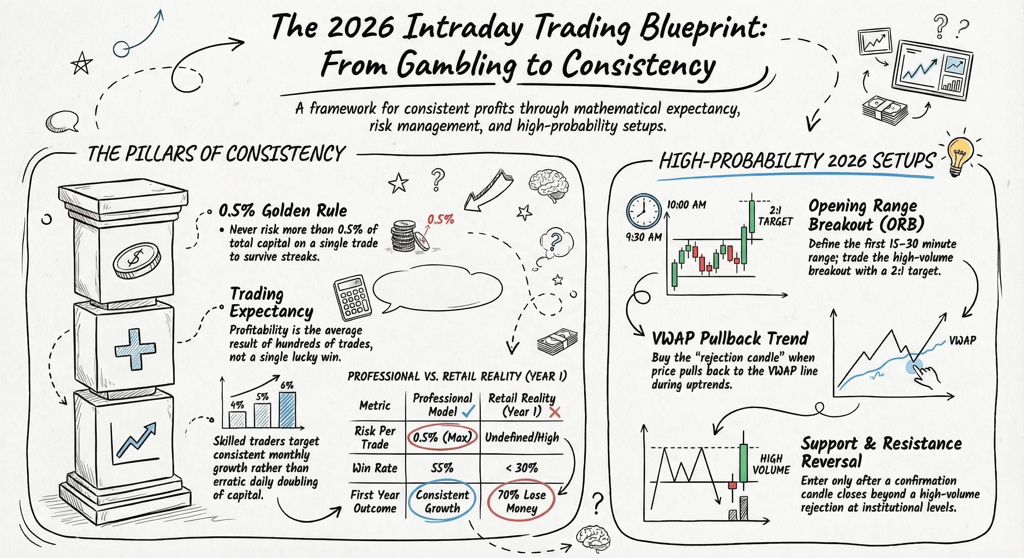
Professional traders think in terms of expectancy — the average profit or loss per trade over hundreds of trades. Here is a realistic model for an Indian retail trader in 2026. Assume a starting capital of ₹50,000, with a maximum risk of 0.5% per trade (₹250). If your average winning trade earns ₹500 (a 2:1 reward-to-risk ratio), your average losing trade costs ₹250, and your win rate is 55%, your per-trade expectancy is ₹212.50. Trading 8 to 10 setups per week, your weekly expectancy is approximately ₹1,600–₹2,100, and your monthly expectancy is around ₹6,500 — roughly 13% on deployed capital.
This is a mathematical framework, not a promise. Real results vary based on execution, slippage, and the trader's ability to follow their own rules. That said, industry surveys and trading community data consistently show that skilled retail traders in India earn between 4% and 12% monthly on their deployed capital. Beginners typically break even or lose slightly during the learning phase — this is normal, expected, and survivable if you manage risk correctly.
It is also important to acknowledge the SEBI research finding that over 70% of intraday traders in India lose money in their first year. The traders who become profitable share one trait: they treated trading as a skill-based profession, not a lottery. This guide is built for that mindset.
What Actually Drives Intraday Profitability
Most beginners search obsessively for the best indicator or the perfect strategy, but consistent intraday profitability in 2026 comes from mastering six interconnected pillars simultaneously.
The first is edge, meaning a clearly defined trading setup with a backtested win rate, defined risk-reward ratio, and specific entry and exit rules. Without a measurable edge, no amount of capital or enthusiasm will produce consistent results. The second is execution — reducing slippage, entering at precise levels, and scaling out at targets. Poor execution alone can cost a trader 15–25% of their theoretical profits on NSE.
The third pillar is risk management — position sizing, daily loss limits, and avoiding correlated trades. This is what keeps your account alive through inevitable losing streaks. The fourth is market condition awareness: momentum breakout setups work in trending markets, while reversal setups work in ranging markets. Matching your strategy to the current market environment is a skill that takes time to develop but dramatically improves results.
The fifth pillar is trading psychology — impulse control, patience, and the ability to follow your own rules even after a string of losses. Psychology is what separates the profitable 30% from the losing 70%, and it is almost never discussed enough. The sixth pillar is data and preparation: pre-market levels, FII/DII activity, global cues, and economic calendar awareness. Informed traders make fundamentally better decisions than reactive ones.
5 High-Probability Intraday Trading Setups for 2026
These are not textbook concepts. These are battle-tested strategies used by disciplined intraday traders in Indian markets — Nifty 50, Bank Nifty, NSE large-cap stocks — and adapted for global equivalents including the NASDAQ, S&P 500, FTSE 100, and ASX 200.
Setup 1: The Opening Range Breakout (ORB)
The Opening Range Breakout is one of the most reliable and widely used intraday setups globally. On NSE, you define the high and low of the first 15 to 30 minutes after market open (9:15 to 9:45 AM IST). A breakout above the range high with volume at least twice the average signals a long entry. A breakdown below the range low signals a short entry. Your stop-loss sits at the midpoint of the opening range, and your target is 1.5 to 2 times your risk. This setup works equally well on NYSE and NASDAQ (using the 9:30 to 10:00 AM EST opening range) and on ASX (10:00 to 10:30 AM AEDT). It requires patience during the first 15 to 30 minutes of the session and discipline not to chase entries after the initial breakout candle.
Setup 2: VWAP Pullback (Trend Continuation)
The VWAP Pullback is the workhorse setup for Nifty 50 and Bank Nifty intraday traders in 2026. When price is in a clear uptrend above the Volume Weighted Average Price (VWAP), you wait for a pullback into VWAP or the 8/20 EMA zone, then look for a bullish rejection candle with a volume spike confirming buyer interest. Entry is on the close of the rejection candle, stop-loss is below the swing low or VWAP, and target is 2 to 3 times your risk. This setup is best used on 3-minute to 15-minute timeframes during the first two hours of the NSE session when trends are cleanest and volume is highest.
Setup 3: Gap and Go (News-Driven Momentum)
When a stock gaps up 2% or more on earnings results, corporate news, or a sector catalyst, the Gap and Go setup captures the continuation of that momentum. Wait for the first 5-minute candle to close after the open, then enter on the first pullback with high volume confirmation. Your stop-loss is set below the pullback low, and your target is a measured move equal to the gap distance. This setup is widely used on NSE mid-cap and large-cap stocks on results days and works equally well on US stocks during the pre-market and post-earnings session. The key risk is a gap fill reversal — always have your stop-loss in place before the pullback completes.
Setup 4: Bank Nifty and Index Options Momentum Scalp
This setup is specifically for experienced traders comfortable with options mechanics. Trade near-the-money weekly expiry options on Bank Nifty or Nifty 50 during the two highest-momentum windows of the NSE session: 9:30 to 11:00 AM IST and 2:00 to 3:15 PM IST. Entry is based on a breakout structure on the underlying index chart — not on the option premium chart. Your stop-loss is defined as either a premium-based stop or a delta-equivalent level on the underlying. Target is a quick 1 to 2 times your risk. Options amplify both gains and losses, which means strict position sizing — never more than 0.5% of capital at risk per trade — is absolutely non-negotiable for this setup.
Setup 5: Support and Resistance Reversal
This is a universal setup that works across all global markets because institutional levels are respected everywhere. When price approaches a well-established daily or weekly support or resistance level, you look for price rejection signals — wicks, doji candles, engulfing patterns — combined with a volume divergence (rising price on falling volume, or vice versa). Entry is only after a confirmation candle closes beyond the rejection signal. Stop-loss is placed just beyond the support or resistance level. Target is 2 to 4 times your risk, often targeting the next significant level on the chart. This setup works on NSE large-caps, BSE mid-caps, NYSE stocks, LSE FTSE stocks, and ASX resource stocks — the principles are universal.
Intraday Trading in India vs Global Markets in 2026
Many Indian traders aspire to trade US, UK, or Australian markets alongside NSE and BSE. Understanding the structural differences is essential before committing capital to any new market.
India (NSE/BSE): The Indian session runs from 9:15 AM to 3:30 PM IST, Monday through Friday. The primary instruments are Nifty 50, Bank Nifty, Nifty Midcap 150, NSE F&O stocks, and weekly expiry index options every Thursday. A recommended starting capital is ₹50,000 to ₹1,00,000. The regulator is SEBI. India's markets in 2026 offer exceptional intraday liquidity in the top 50 NSE stocks and in Bank Nifty/Nifty weekly options. The time zone (IST) is a natural advantage for resident Indian traders.
United States (NYSE/NASDAQ): The US session runs 9:30 AM to 4:00 PM EST, which translates to 7:00 PM to 1:30 AM IST — making it a late-night session for Indian traders. Key instruments include SPY, QQQ, AAPL, TSLA, NVDA, 0DTE options, and ES/NQ futures. The PDT (Pattern Day Trader) rule requires a minimum of $25,000 in a US margin account for day trading. In 2026, the AI and semiconductor sector continues to drive strong momentum setups in US tech stocks, making gap-and-go and ORB setups particularly productive.
United Kingdom (LSE/FTSE): The London session runs 8:00 AM to 4:30 PM GMT (1:30 PM to 10:00 PM IST). Spread betting and CFD trading are popular among UK-based traders, with spread betting being tax-free for UK residents. Volume and liquidity peak at the London open and again at the US session overlap around 2:30 PM GMT. The FCA is the primary regulator.
Australia (ASX): The Australian session runs 10:00 AM to 4:00 PM AEDT, which translates to 4:30 AM to 10:30 AM IST — creating a unique opportunity for Indian traders to trade both ASX and NSE in the same day. ASX is dominated by resource and mining stocks (BHP, RIO Tinto), financial stocks, and commodity-linked plays. The regulator is ASIC. Starting capital of AUD 1,000 to 5,000 is sufficient for CFD trading on Australian indices.
For NRI Traders Globally: Indian citizens and NRIs in the US, Canada, UK, Europe, and Australia can trade on NSE/BSE through NRE/NRO demat accounts with brokers such as ICICI Direct, HDFC Securities, or Zerodha (subject to NRI compliance). The fundamentals of intraday trading are identical regardless of geography — only the instruments, session times, and regulatory frameworks differ.
Risk Management Rules That Protect Your Account in 2026
Profitable intraday trading is not about making big wins. It is about staying in the game long enough for your edge to produce results across hundreds of trades. These rules are non-negotiable for serious traders in India or globally.
Never risk more than 0.25% to 0.5% of your total capital on a single trade. For a ₹1,00,000 account, that means maximum ₹250 to ₹500 at risk per trade. This rule alone prevents the account-destroying losses that eliminate most beginners. Set a daily loss limit — most professional traders stop trading for the day when they've lost 2% of their account. This prevents the spiral of revenge trading that wipes out weeks of gains in a single bad afternoon.
Place a stop-loss on every single trade before you enter. There are no exceptions to this rule. Using GTT (Good Till Triggered) orders on Zerodha or equivalent bracket orders on other platforms ensures your stop-loss executes even if you step away from the screen. Size every position based on your stop distance, not on how confident you feel. The formula is simple: Position Size equals Capital multiplied by Risk Percentage, divided by Stop Distance per Share. For example, ₹1,00,000 multiplied by 0.5%, divided by a ₹5 stop distance, equals 100 shares. This keeps every loss predictable.
Avoid holding more than 2 to 3 open positions simultaneously, and never take correlated trades — for example, simultaneously being long on both Nifty and Bank Nifty options in the same direction is not two trades, it is effectively one concentrated bet. Keep a trade journal and review every trade after the session closes. Journaling is free, requires only 15 minutes per day, and is the single most powerful improvement tool available to any trader.
The Professional Intraday Trader's Daily Routine
The biggest differentiator between profitable traders and consistent losers is not strategy — it is routine. Here is the daily blueprint used by disciplined intraday traders on NSE and globally.
Pre-Market (8:00 to 9:00 AM IST): Review Gift Nifty (formerly SGX Nifty) futures for the day's directional bias. Check US and European market closes from the previous night. Review FII and DII provisional data. Scan for stocks with earnings, results, or high-volume catalysts using Chartink or Streak. Mark key support and resistance levels on your watchlist stocks. Select 3 to 5 high-probability setups for the session and write them down before the market opens.
Opening Phase (9:15 to 9:45 AM IST): Watch and observe. Define the opening range. Avoid entering trades in the first 5 minutes unless you are executing a Gap and Go setup with clear volume confirmation. Let the market show its hand before committing capital.
Primary Trading Window (9:45 AM to 12:00 PM IST): This is the highest-quality intraday window on NSE — maximum volume, cleanest trends, and most reliable setups. Take only setups that match your pre-defined criteria. Follow your stop-loss rules exactly. Scale out 50% of the position at 1R, move your stop to breakeven, and let the remainder run to your 2R target.
Midday Caution (12:00 PM to 2:00 PM IST): NSE volume drops significantly in the midday session. Spreads widen, false breakouts increase, and most setups fail to follow through. Experienced traders either stop trading entirely during this period or reduce position size by 50%. This is the phase where most beginners overtrade and give back all of their morning profits.
Closing Momentum (2:00 to 3:15 PM IST): Volume picks up as US pre-market activity begins and institutional traders position themselves for the close. Look for momentum continuation from the morning trend. Index options traders watch for clean directional setups in the final hour. Square off all intraday positions before 3:20 PM IST — never carry intraday positions overnight.
Post-Market Review (3:30 to 4:30 PM IST): Review every trade taken during the session. Ask yourself: Did you follow your rules? What was your actual risk-reward ratio? What emotions did you experience, and did they influence any decisions? Update your trade journal. This 15-minute daily habit is what compounds into mastery over 12 to 24 months of consistent practice.
Essential Tools for Indian Intraday Traders in 2026
The right tools improve execution speed, market analysis quality, and journaling accuracy. TradingView remains the best charting platform for Indian traders in 2026 — it supports NSE and BSE, has customisable VWAP, EMA, and volume indicators, and the free tier is sufficient for most intraday setups. For real-time stock scanning, Chartink and Streak allow you to build automated scanners that flag volume spikes, price breakouts above resistance, and other setup conditions — turning your pre-market watchlist building from a manual to a systematic process.
For execution, Zerodha (Kite) and Fyers (Fyers One) remain the most popular low-brokerage platforms with API access and reliable order execution on NSE. For international market access, Interactive Brokers offers the best combination of low cost, global coverage, and platform quality. For news and macro data, MoneyControl and ET Markets provide pre-market news flow, corporate announcements, and FII/DII data in real time. For global cues, Investing.com aggregates Gift Nifty futures, global market prices, and economic calendar events in one place.
Finally, a trade journal — whether a dedicated tool like Trademetria or a simple Excel spreadsheet — is not optional. It is the infrastructure of continuous improvement. Every trade logged, every mistake documented, and every pattern identified through journaling is free education that compounds into edge over time.
The 7 Costly Mistakes That Kill Intraday Trading Accounts
Mistake 1 — Trading without a defined setup. Entering trades based on gut feel, news headlines, or a friend's tip is not trading — it is gambling. Every trade must have a pre-defined entry, stop-loss, and target before the order is placed.
Mistake 2 — No stop-loss, or moving it wider. The most common account killer in Indian retail trading. "It will come back" is the most expensive phrase in trading. A single loss without a stop-loss can wipe out 10 disciplined winning trades.
Mistake 3 — Overtrading during low-volatility periods. Trading during the NSE midday session (12:00 to 2:00 PM) or forcing trades when conditions don't match your setup criteria. The best traders sit on their hands for 60 to 70% of the session.
Mistake 4 — Revenge trading after a loss. Doubling position size, abandoning strategy, or placing impulsive trades to recover a loss. This is where most accounts blow up, and it is exactly why a daily loss limit rule exists.
Mistake 5 — Ignoring market structure. Using momentum setups in a ranging market, or reversal setups in a strongly trending market. Always identify the dominant market condition before selecting a strategy for the session.
Mistake 6 — Trading illiquid stocks or deep out-of-the-money options. Small-cap stocks with wide bid-ask spreads, or Bank Nifty options that are 500+ points from current spot price. These create massive slippage, unpredictable exits, and outsized losses. Stick to the top 50 NSE stocks or ATM/near-ATM options.
Mistake 7 — No post-trade review. Traders who don't journal their trades never systematically improve. Without data on your own performance — your actual win rate, your average R, your most common mistakes — you repeat the same errors for years while wondering why results don't improve.
How Expert Trading Mentorship Accelerates Your Growth in 2026
Here is the uncomfortable truth that most trading courses and YouTube channels won't tell you: the majority of self-taught retail traders in India spend 2 to 5 years losing money before reaching consistency — and many quit before they get there. A structured trading mentor compresses that learning curve to 6 to 18 months, not because they have a magic strategy, but because they have already made every mistake and can show you how to recognise and avoid them before they cost you capital.
A great trading mentor provides setup clarity — helping you identify which of the dozens of available setups actually suits your personality, risk tolerance, and available trading time. They provide detailed trade reviews, analysing your actual entries and exits to identify patterns of error that you cannot see yourself. They offer live market guidance, explaining their real-time decision-making during active market hours — which is invaluable for beginners who understand theory but freeze during actual trading. They provide accountability through regular check-ins and trade journal reviews, because most self-taught traders abandon their own rules the moment no one is watching.
A good mentor also provides daily and weekly pre-market stock reports covering FII activity, sector rotation, and high-probability watchlist candidates. And they provide psychology coaching — a structured approach to handling losses, managing the emotional extremes of fear and greed, and building the mental resilience required for long-term, consistent performance.
Mentorship does not guarantee profits. Nothing does. But it guarantees clarity, structure, and accelerated improvement — which are the foundations that consistent profitability is built upon. Whether you are based in India, the US, the UK, Canada, Europe, or Australia, the fundamentals of disciplined intraday trading are identical, and structured mentorship is the fastest legitimate path to mastering them.
Amuktha Trading Services: Structured Mentorship for Serious Traders
Amuktha Trading Services offers a personalised, one-on-one coaching program designed specifically for retail intraday traders in India and globally. The program covers custom trading setups tailored to your style and capital, live market guidance during NSE trading hours, daily and weekly pre-market stock reports, detailed trade review sessions, and step-by-step strategies for NSE equities, stock options, and index options (Nifty 50 and Bank Nifty). One structured conversation with an experienced trading mentor can provide more clarity than months of self-study.
Frequently Asked Questions
How much profit can I realistically make in intraday trading per day in India? Experienced intraday traders in India typically target 0.5% to 2% return on deployed capital per day — not every day, but as an average across a month. With ₹1,00,000 capital and strict risk management, that translates to ₹500 to ₹2,000 on productive trading days. Monthly, skilled traders earn 4% to 12%. Beginners should focus on capital preservation and skill development for the first 6 to 12 months rather than setting profit targets.
Is intraday trading profitable for beginners in India in 2026? It can be, but most beginners lose money in their first year — not because the strategies don't work, but because of poor risk management, overtrading, and lack of discipline. With structured learning from a qualified trading mentor, beginners can significantly shorten this curve. Starting with paper trading or very small position sizes while building skills is strongly recommended.
What is the best intraday trading strategy for Nifty 50 and Bank Nifty in 2026? The Opening Range Breakout (ORB) and the VWAP Pullback are among the most reliable strategies for Nifty 50 and Bank Nifty in 2026. Both use volume confirmation and defined stop-losses. For Bank Nifty options specifically, near-the-money ATM calls and puts during the 9:30 to 11:00 AM and 2:00 to 3:15 PM momentum windows offer the best risk-reward ratios during trending sessions.
How much capital do I need to start intraday trading in India? You can begin with ₹10,000 to ₹25,000 in intraday equity trading on NSE. However, ₹50,000 to ₹1,00,000 is recommended for meaningful position sizing and proper risk management. For Bank Nifty or Nifty options, lot sizes typically require ₹20,000 to ₹50,000 per contract. Always start smaller than you think you need to, and scale up as consistency improves.
Can I trade NSE from the US, UK, Canada, or Australia? Yes. NRIs and Indian citizens abroad can trade on NSE/BSE through NRE/NRO demat accounts with brokers including ICICI Direct, HDFC Securities, and Zerodha (subject to NRI compliance). NSE hours (9:15 AM to 3:30 PM IST) translate to 3:45 AM to 10:00 AM in London, 10:45 PM to 5:00 AM in New York, and 12:45 PM to 7:00 PM in Sydney. Many global Indian traders use this timing to trade both NSE and their local markets in the same day.
How long does it take to become a consistently profitable intraday trader? Without structured guidance, most traders take 2 to 5 years to reach consistency — if they don't lose their capital first. With a structured mentor, disciplined journaling, and deliberate practice, the timeline can compress to 6 to 18 months. The three key milestones are: consistently following your own rules, achieving a positive expectancy across 100 or more trades, and maintaining discipline through losing streaks without reverting to revenge trading.
What is the difference between intraday trading and swing trading? Intraday trading means all positions are opened and closed within the same session — no overnight holdings. Swing trading means holding positions for 2 to 10 days to capture larger price moves. Intraday requires more active monitoring and faster decisions but eliminates overnight gap risk. Many traders begin with swing trading and progress to intraday as their execution and discipline develop.
Disclaimer:- Trading in securities markets carries substantial risk and is not suitable for everyone. Past performance is not indicative of future results. This article is for educational purposes only and should not be construed as investment advice. Please conduct your own research and consult a SEBI-registered financial advisor before making trading or investment decisions.
© 2026 Amuktha Trading. Telangana, India. Serving global traders since 2013.