
Intraday Trading: The Complete Guide to Strategies, Rules & Success in India, US, UK, Canada, Australia and Beyond
By Amuktha Trading Mentors | Updated 2026 | Est. Reading Time: 18 Minutes
The world of intraday trading captivates millions of people every year — the idea of generating income from the market within a single day is genuinely compelling. But behind every profitable day trader is something that rarely gets talked about: years of disciplined learning, repeated failures, and the gradual mastery of a craft that most people underestimate.
This guide will not sugarcoat the realities. It will also not discourage you. What it will do is give you the most thorough, honest, and actionable breakdown of intraday trading available — covering everything from the foundational definition to advanced strategies, global tax rules, and the psychological edge that separates profitable traders from the 70% who lose money.
Whether you are a beginner in India just discovering Nifty futures, an NRI in the UK or Canada looking to trade your home market remotely, or an experienced trader in the US or Australia looking to refine your edge — this guide is written for you.
What Is Intraday Trading? A Definition That Actually Makes Sense
Intraday trading — also known as day trading — is the practice of buying and selling financial instruments within the same trading session. Stocks, index futures, options, commodities, and currency pairs can all be traded intraday. The defining rule is simple: every position you open must be closed before the market session ends that day. Nothing is held overnight.
That one rule changes the entire character of trading. When you hold no overnight positions, you eliminate the risk of a stock gapping sharply against you while you sleep because of a surprise earnings miss, a geopolitical shock, or a central bank announcement in a different time zone. Your capital is freed up every evening, ready to be deployed fresh the next morning.
The instruments you trade depend on your market. In India, the most popular intraday instruments are NSE-listed equity stocks, Nifty 50 futures, Bank Nifty futures, and index options. In the United States, traders focus on individual stocks listed on the NYSE and NASDAQ, along with ETFs like SPY and QQQ, stock options, and index futures like the E-mini S&P 500. In the UK and Australia, contracts for difference (CFDs) are widely used alongside direct equity trading.
The mechanics of making money are the same everywhere: you identify a short-term price move, enter the trade, manage your risk with a stop-loss, and exit at your target. Repeat this process consistently with a positive risk-reward ratio, and profitability follows over time.
Intraday Trading vs. Delivery Trading vs. Swing Trading — Understanding the Difference
A question almost every beginner asks is how intraday trading compares to other forms of market participation. The differences are significant and choosing the wrong approach for your personality, capital, and time availability is one of the most common early mistakes.
Intraday trading means all positions are opened and closed within the same day. You rely almost entirely on technical analysis, price action, and volume to make decisions. You use leverage, which amplifies both gains and losses. Profits are frequent but typically smaller per trade, and your tax treatment in most countries classifies this as business or ordinary income rather than investment capital gains.
Delivery trading — known as swing trading or position trading in global markets — means you buy shares and hold them in your account for days, weeks, or even years. You need the full capital to own the shares outright rather than relying on margin. Your analysis leans more on company fundamentals, sector trends, and macroeconomic factors. Because you hold assets long enough to qualify for capital gains treatment in most countries, your tax liability is often lower than with intraday trading.
Swing trading sits in between. You hold trades for two to ten days, using a blend of technical and fundamental analysis to capture medium-term price moves. Overnight risk exists, but you are not watching a screen every hour.
The right choice depends on how much time you can dedicate each day, your risk tolerance, your capital size, and your psychological disposition. Many professional traders start with swing trading to build their pattern recognition and move into intraday once they are consistently profitable.
Global Market Hours — When the Best Opportunities Appear
Understanding market hours across the world is not just administrative knowledge — it is a genuine trading edge. Markets do not trade with equal energy throughout the day. Volatility, volume, and opportunity cluster around specific windows, and knowing those windows means you spend your time where the odds are highest.
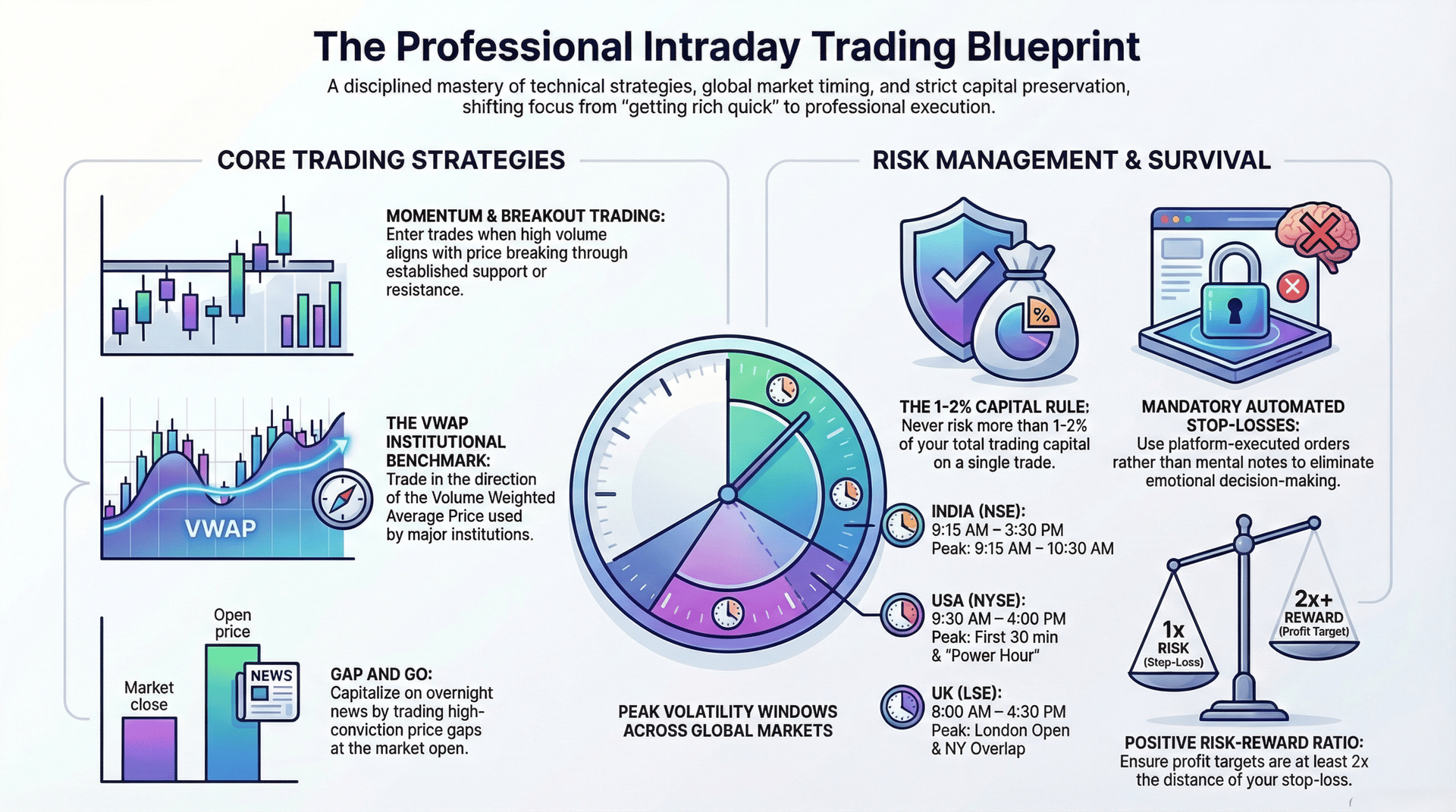
India (NSE and BSE) — The Indian equity market trades from 9:15 AM to 3:30 PM Indian Standard Time. The pre-open session runs from 9:00 to 9:15 AM and sets the reference price for the open. The first 75 minutes of the session — from 9:15 to 10:30 AM — are consistently the most volatile. Indian markets react to overnight US market movements, global commodity prices, FII (Foreign Institutional Investor) and DII activity, and domestic news. The last hour, from 2:30 to 3:30 PM IST, sees another spike in activity as traders and institutions close positions before the end of day.
United States (NYSE and NASDAQ) — US markets trade from 9:30 AM to 4:00 PM Eastern Time, with pre-market activity as early as 4:00 AM ET. The opening 30 minutes after the bell are the most critical window of the US session — high volume, sharp moves, and the day's primary trend often establishing itself. The power hour from 3:00 to 4:00 PM ET sees equally intense activity as large funds rebalance. The midday period from roughly 11:30 AM to 1:30 PM ET is often slow and choppy — many experienced traders simply avoid it.
United Kingdom (London Stock Exchange) — The LSE opens at 8:00 AM GMT and closes at 4:30 PM GMT. The London open is one of the most important events in global finance each day, particularly for forex traders. European institutional orders flood in at the open, creating sharp directional moves in FTSE 100 stocks and major currency pairs. The overlap between the London and New York sessions — roughly 1:00 PM to 4:00 PM GMT — is the highest-liquidity window in the entire global forex market.
Australia (ASX) — The Australian Securities Exchange opens at 10:00 AM and closes at 4:00 PM Australian Eastern Standard Time. Australian markets are heavily influenced by the overnight US session and Asian commodity markets, particularly iron ore and coal futures from China. Resources stocks like BHP and Rio Tinto and the major banks (CBA, NAB, ANZ, Westpac) are the most active intraday instruments.
Canada (TSX) — The Toronto Stock Exchange operates on the same hours as the US markets: 9:30 AM to 4:00 PM Eastern Time. Canadian intraday traders effectively trade alongside the US markets, and Canadian stocks are heavily influenced by US index movements and oil prices given the energy sector's weight in the TSX.
For Indian traders watching global markets: the pre-market futures activity on the Dow Jones and S&P 500 between 7:00 and 9:15 AM IST is one of the most reliable indicators of how Nifty 50 will open. Learning to read those overnight global cues before the Indian market bell is one of the first skills we develop with our students at Amuktha Trading.
Five Proven Intraday Trading Strategies — From Beginner to Advanced
A strategy is a structured, repeatable decision-making framework. Without one, you are not trading — you are reacting emotionally to random price movements, which is how accounts get destroyed. The following five strategies are the core of what we teach at Amuktha Trading. Each is applicable to Indian markets, US markets, and global markets alike.
Momentum Trading
Momentum trading is built on one of the most consistent observations in market history: assets that are moving strongly in one direction tend to continue in that direction — at least for a while. Inertia exists in markets just as it does in physics. The job of the momentum trader is to identify that inertia early, enter in alignment with it, and exit before it runs out.
The setup requires three things to align simultaneously. First, the broader market index — Nifty 50 in India, S&P 500 in the US — must be trending in the same direction as the trade you want to take. Trading a long setup in a stock while the index is collapsing is like swimming against a rip current. Second, the stock itself must be showing unusual volume compared to its recent average — at least 150% of normal. Volume is the fuel that sustains momentum. Third, technical indicators like the RSI should be in a supportive zone — not already overbought if you are buying, not already oversold if you are selling.
Entry happens on a confirmed momentum candle on a five-minute or fifteen-minute chart. The stop-loss goes just below the recent low that preceded the move. The target is typically two to three times the distance of the stop-loss, giving a clean risk-reward ratio. On major event days in India — RBI policy announcements, Union Budget, quarterly earnings from Nifty heavyweights — momentum setups can deliver five to eight times their risk within hours.
Breakout Trading
Markets spend most of their time going sideways. Stocks and indices bounce between floors (support) and ceilings (resistance) for days or weeks before finally breaking through one of those boundaries. A breakout trader studies those boundaries obsessively and positions to capture the explosive move that follows a genuine break.
The first requirement is identifying a stock that has been consolidating clearly — respecting the same support and resistance levels across at least three to five sessions. These levels represent areas where large orders from institutions are clustered, which is exactly why price keeps stopping there. When price eventually breaks through with a surge of volume, it means those orders have been absorbed and the next tier of buyers or sellers is stepping in.
Volume is the most important confirmation of any breakout. A price break on low volume is a false breakout — institutions have not committed, and the move will likely reverse. A valid breakout needs volume that is at least one-and-a-half to two times the recent average on the breakout candle. The most reliable breakout chart patterns are ascending and descending triangles, bull and bear flags, rectangular consolidation zones, and cup-and-handle formations.
Entry is placed just above the resistance level being broken (for longs) or just below the support level being broken (for shorts). The stop-loss goes just back inside the broken level — two to three ticks inside the resistance that is now becoming support. This keeps the loss contained if the breakout fails and reverses.
Scalping
Scalping is the highest-frequency intraday strategy. A scalper executes twenty to fifty trades in a session, targeting moves of just 0.1% to 0.3% per trade. The edge is not in any single trade but in the cumulative effect of dozens of small wins with tightly controlled losses.
Scalping demands specific infrastructure. Your trading platform must have extremely fast execution and a reliable connection. Brokerage costs must be minimal — flat-fee or zero-commission structures — because commissions that eat 0.05% per side on a 0.2% target move destroy the edge entirely. Reading Level 2 market depth (the order book) gives scalpers a timing advantage that chart-based traders do not have. On one-minute and three-minute charts, a scalper reads short-term order flow, micro support and resistance, and bid-ask spread behavior.
The psychological demands of scalping are also unique. You must make rapid decisions with incomplete information and accept small losses without hesitation dozens of times per day. One large loss from holding a bad trade "just a little longer" can wipe out hours of work. For most beginners, scalping is the last strategy to master rather than the first.
Gap and Go (Opening Range Breakout)
Every trading session opens with a gap — a price level either above or below the previous day's close, driven by overnight news, earnings releases, global market moves, or sector-specific catalysts. The Gap and Go strategy is about understanding whether that gap has the energy to continue or the exhaustion to fill.
A gap-up opening with strong buying volume in the first fifteen minutes often signals institutional conviction in the new price level. Traders enter long above the high of the first five-minute candle, with a stop-loss below the low of that same candle, targeting a continuation of the gap. This setup is particularly powerful in Indian F&O trading when global cues are strongly positive — Nifty and Bank Nifty frequently gap up on strong US sessions and then trend throughout the day.
The opposite scenario — a gap that lacks follow-through — often fills back to the previous day's close. If a stock gaps up 3% but immediately starts fading with declining volume, short sellers enter targeting the gap fill. This is one of the cleanest mean-reversion setups in intraday trading.
VWAP Trading
The Volume Weighted Average Price is the benchmark that institutional traders — mutual funds, foreign institutional investors, hedge funds — use to evaluate whether they got a good price on their executions. It is calculated by dividing the total rupee (or dollar) value traded by the total volume traded, updated every tick throughout the session.
Because institutions care deeply about VWAP, price tends to gravitate back to it multiple times during the day. When price moves significantly above VWAP, aggressive sellers emerge. When it drops well below VWAP, buyers accumulate. Trading in the direction of VWAP — buying dips back to VWAP in an uptrend, shorting bounces back to VWAP in a downtrend — gives retail traders alignment with the largest players in the market.
VWAP standard deviation bands extend one and two standard deviations above and below the main line. When price reaches two standard deviations above VWAP, it is statistically stretched and a reversion trade back toward VWAP has historically offered a strong probability of success. This is one of the few intraday tools with genuine institutional validation behind it.
How to Select the Right Stocks and Instruments for Intraday Trading
Strategy is only as good as the instrument it is applied to. A momentum strategy applied to an illiquid, low-volume stock will fail not because the strategy is wrong but because the instrument cannot carry the trade. Selecting the right stocks is half of the battle.
The four criteria every intraday stock must meet are liquidity, movement, volatility balance, and catalyst alignment. On liquidity: in India, focus on stocks trading at least five to ten lakh shares per day. In the US, look for average daily volume above one million shares. Liquidity ensures you can enter and exit at the prices you see on screen without slippage eating your profit. On movement: the stock must travel enough in a typical day to create an opportunity. A stock that moves 0.3% in a day offers no intraday profit potential. On volatility balance: enough movement to profit from, but not so erratic and news-sensitive that price action becomes random. This is why penny stocks and micro-caps make poor intraday instruments despite their dramatic percentage moves. On catalyst alignment: the best intraday moves are driven by news, data, or sector events. Budget announcements move banking and infrastructure stocks in India. Earnings releases move individual stocks globally. RBI and US Fed statements move the entire market.
In India, the most reliably liquid and active intraday instruments are the Bank Nifty components — HDFC Bank, ICICI Bank, Kotak Bank, Axis Bank — along with Reliance Industries, Tata Motors, Infosys, and Tata Steel. For derivatives traders, Nifty 50 and Bank Nifty weekly options offer the tightest spreads and deepest liquidity on the NSE.
In the US, the S&P 500 ETF (SPY), the NASDAQ ETF (QQQ), and large-cap technology stocks — Apple, NVIDIA, Tesla, Microsoft, Amazon — offer the most reliable intraday setups due to their extraordinary liquidity and tight bid-ask spreads. Pre-market volume on these instruments is the single best indicator of the day's directional bias.
In the UK, FTSE 100 financial stocks — HSBC, Barclays, Lloyds — and energy majors — BP, Shell — see the highest intraday activity. For Australians, Commonwealth Bank, BHP Billiton, and Rio Tinto dominate intraday volume on the ASX.
Risk Management — The Skill That Actually Determines Who Survives
If you read nothing else in this guide, read this section carefully. Studies across every major market consistently show that 70 to 80% of retail intraday traders lose money over any twelve-month period. The primary cause is almost never a bad strategy. It is almost always poor risk management — holding losses too long, using too much leverage, taking positions too large relative to account size, and making emotional decisions after a bad trade.
The stop-loss is the single most important tool in a trader's arsenal. Before you enter any trade, you must know the exact price at which you will exit if the trade moves against you. This is not a suggestion. It is the difference between an account that survives and one that does not. Set your stop-loss as an actual order in your trading platform — not a mental note that you plan to act on "if it gets there." In a fast-moving market, you will not act on the mental note. The platform order will execute automatically.
Position sizing is the second pillar of risk management. A widely used professional standard is to risk no more than one to two percent of your total trading capital on any single trade. If your account holds one lakh rupees, your maximum acceptable loss per trade is one to two thousand rupees. This sounds conservative until you experience a five-trade losing streak — which every trader does eventually — and realize that at 1% risk per trade, you still have 95% of your capital intact and can recover. At 10% risk per trade, that same five-trade losing streak leaves you with just 59% of your starting capital and a much steeper psychological hole to climb out of.
The risk-reward ratio determines whether your strategy is profitable even if you are right only half the time. If you risk 20 points on a trade, your target must be at least 40 points — a 1:2 risk-reward ratio. At 1:2, you can lose 40% of your trades and still make money. At 1:3, you can lose over 50% of your trades and still be profitable. This is why professional traders obsess over target placement as much as entry timing.
The psychological pitfalls to actively guard against are revenge trading, averaging down, and overtrading. Revenge trading is the impulse to immediately take another trade after a loss in order to "get it back." This leads to trades taken outside your strategy criteria, under emotional pressure, in unfavorable market conditions. The result is almost always a second loss. The correct response to any losing trade that hit your stop-loss correctly is to pause, review the trade objectively, and only re-enter when the next valid setup appears on its own merits. Averaging down — adding to a losing intraday position to lower your average price — works occasionally in long-term investing. In intraday trading it is one of the most dangerous behaviors possible, because the market has no obligation to reverse before the session closes and you are forced to exit at a loss anyway. Overtrading is the habit of forcing trades during low-probability periods out of boredom, impatience, or the belief that more activity means more profit. In intraday trading, doing nothing is often the highest-value decision you can make.
Intraday Trading Tax Rules — India, US, UK, Canada and Australia
Tax treatment of intraday trading profits varies significantly by country and has a material impact on your actual net returns. Understanding the tax rules in your jurisdiction is not optional — it is part of running a professional trading operation.
India: Intraday equity trading profits are classified as Speculative Business Income under Section 43(5) of the Income Tax Act. This means your net trading profit is added to your total income and taxed at your applicable income tax slab rate — 5%, 20%, or 30% plus applicable surcharge and cess. Losses from speculative intraday trading can be carried forward for four years but can only be set off against future speculative income, not against salary or other business income. Trading in Futures and Options is treated differently — as non-speculative business income — which allows F&O losses to be set off against any other business income. Allowable deductions against intraday trading income include brokerage fees, Securities Transaction Tax paid, internet and data costs, platform subscription fees, and relevant education expenses. Maintaining a detailed trade journal is essential for accurate tax filing and for claiming all eligible deductions.
United States: Day trading profits in the US are typically treated as short-term capital gains and taxed as ordinary income at federal rates ranging from 10% to 37% depending on your total income bracket. Traders in the US should be aware of the Pattern Day Trader rule enforced by FINRA — if you execute four or more day trades within any five business day period in a margin account, you are classified as a Pattern Day Trader and must maintain a minimum account balance of $25,000. The wash sale rule prohibits claiming a loss on a security if you purchase a substantially identical security within 30 days before or after the sale. Highly active US traders can elect mark-to-market accounting status under Section 475(f) of the Internal Revenue Code, converting all trading gains and losses to ordinary income and expenses — eliminating the wash sale rule and allowing full loss deductions against other income.
United Kingdom: Trading profits in the UK are generally subject to Capital Gains Tax above the annual CGT allowance (currently £3,000 — verify the current year's allowance as it has changed significantly in recent years). However, if HMRC determines that your trading activity constitutes a trade — meaning it is your primary occupation and conducted in a businesslike manner — all profits may be reclassified as trading income subject to Income Tax at rates up to 45%, which is less favorable. UK traders have a unique advantage: profits from financial spread betting are completely tax-free under current UK law, as spread bets are classified as gambling. Many retail UK traders use spread betting accounts for their intraday activity for precisely this reason.
Canada: The Canada Revenue Agency typically classifies frequent intraday trading activity as business income, meaning profits are fully taxable at your marginal income tax rate rather than receiving the preferential 50% inclusion rate that applies to capital gains. Expenses directly related to your trading business — platform fees, course costs, relevant subscriptions, and a proportion of home office costs — are deductible against business income. If your trading activity is less frequent and the CRA classifies it as investment activity, only 50% of capital gains are included in taxable income, though proposed changes to inclusion rates have been discussed and you should verify the current rules with a qualified tax professional.
Australia: The Australian Taxation Office treats active intraday traders as carrying on a business, meaning all trading profits are taxed at your marginal income tax rate — up to 45% for high earners. The 50% Capital Gains Tax discount that applies to assets held for more than twelve months does not apply to intraday trades, as positions are held for less than one day. Australian traders operating as a business may need to register for GST if their annual trading turnover exceeds $75,000. Trading losses in a business context can generally be deducted against other income, subject to the ATO's non-commercial loss rules.
In every country, the importance of maintaining comprehensive records — trade by trade, with dates, instruments, entry and exit prices, and fees — cannot be overstated. A qualified accountant or tax professional who specializes in trader taxation is one of the best investments an active trader can make.
The Essential Toolkit — Platforms, Indicators and Learning Resources
Choosing the right trading platform is more important than most beginners realize. A platform with slow execution, unreliable data feeds, or a confusing interface costs you real money — in missed entries, late exits, and the cognitive burden of fighting your tools while trying to focus on the market.
In India, Zerodha Kite is the most widely used platform among active traders and for good reason — it combines clean, fast charting with reliable execution and one of the lowest brokerage structures in the market. Upstox Pro, Fyers One, and Angel One SmartWeb are strong alternatives with their own strengths in charting depth and options analytics. For futures and options traders, platforms with built-in Greeks calculators and options chain visualization are essential.
In the United States, thinkorswim (TD Ameritrade) remains the benchmark for retail trader platforms due to its deep charting capabilities, paper trading mode, and educational resources. Interactive Brokers is preferred by professional and international traders for its access to global markets, margin rates, and execution quality. Webull and Tastytrade cater to active retail traders with commission-free structures.
In the UK, IG Group and CMC Markets are the largest spread betting and CFD providers, offering access to thousands of instruments across global markets. Saxo Bank provides direct market access with sophisticated analytics suited to more experienced traders.
For Australia, CommSec is the retail standard while Interactive Brokers and SelfWealth offer lower-cost alternatives for active traders.
On indicators, resist the temptation to load your charts with every tool available. Professional traders typically use two to four indicators consistently rather than ten poorly. The most universally applicable combination for intraday trading is VWAP for institutional price reference, RSI for momentum condition, volume for trade confirmation, and clearly marked support and resistance levels for entry and exit precision. The 9-period and 20-period exponential moving averages on a five-minute chart provide a simple, clean read of short-term trend direction.
For learning, the most valuable resources beyond formal mentorship are a small number of foundational books read deeply rather than a large number of trading books skimmed. Mark Douglas's Trading in the Zone addresses the psychological dimension of trading that almost every technical course ignores. John Murphy's Technical Analysis of the Financial Markets is the definitive technical reference. William O'Neil's How to Make Money in Stocks provides a rigorous stock selection framework that transfers well to intraday setups. In the Indian context, the NCFM (NSE Certification in Financial Markets) modules on technical analysis and derivatives provide a structured and market-specific foundation.
Paper trading — executing trades in a simulated environment without real money — for a minimum of sixty days before deploying real capital is one of the most important steps a beginner can take. It reveals exactly where your strategy breaks down, which emotional triggers affect your decisions, and whether your setup criteria are specific enough to generate consistent signals.
The 10 Most Common Mistakes Intraday Traders Make — And How to Fix Each One
Trading without a written plan. Every session should begin with a written plan: which instruments you are watching, which specific conditions must be present to enter a trade, where your stop-loss will be placed, and what your target is. Without this, every decision in the session becomes improvisational and emotionally driven. The discipline of writing the plan before the market opens forces you to think clearly before the adrenaline of live price action clouds your judgment.
Ignoring the broader market direction. Taking a long trade in an individual stock while the Nifty 50 or S&P 500 is in a sharp decline is trading against the institutional tide. The index carries the majority of stocks in its direction most of the time. Always check the index trend first. Trade with the wind at your back.
Overtrading out of boredom or impatience. Every additional trade has a transaction cost — brokerage, spread, and in India, Securities Transaction Tax. These costs accumulate quickly when you are forcing trades in low-probability conditions. Doing nothing in a choppy, directionless market is a legitimate and profitable decision. The best traders make their money from a handful of high-conviction setups per session, not from being constantly active.
Using excessive leverage before you have a track record. Leverage is the most seductive and most dangerous aspect of intraday trading for beginners. A 5x leveraged position that moves 2% against you destroys 10% of your actual capital. Use the minimum leverage necessary to achieve your position size during your first six to twelve months of trading. Preserve capital first. Amplify later.
Chasing stocks that have already made their move. If a stock has already rallied 4% from where the setup was visible, the trade has been made by the people who were prepared. Entering after a large move has already occurred means you are the exit liquidity for those who entered before you. Wait for the pullback, the re-test of the breakout level, or the next setup entirely.
Moving the stop-loss when the trade goes against you. This is the most common and costly individual behavior in retail trading. The logic in the moment sounds reasonable — "it's almost at my stop, it's about to turn" — but it is pure emotion overriding a rational pre-trade decision. A stop-loss that gets moved further away because the trade is losing converts a defined, limited loss into an undefined, unlimited one. Every trader who has blown up a trading account has done so primarily through this behavior.
Averaging down on intraday losing positions. Adding to a losing intraday position to reduce your average price is not a risk management technique — it is a compounding of a wrong decision. The market has not moved in your direction during the time available in the session. Adding more size simply increases your loss when you are ultimately forced to exit at close.
Neglecting pre-market preparation. The traders who are most consistently profitable spend thirty to sixty minutes before the market open reviewing overnight global cues, checking the economic calendar for scheduled announcements that day, identifying key levels on their watchlist instruments, and writing their session plan. This preparation replaces reactive panic during live market hours with calm, pre-analyzed response.
Trading high-impact news events without a specific strategy. RBI policy decisions, US Federal Reserve statements, quarterly GDP releases, and major earnings announcements from index heavyweights create whipsaw price movements that stop out even experienced traders. The first reaction is often wrong. The second reaction reverses the first. Unless you have a specific, tested strategy for trading these events, staying out during the announcement window and waiting for the dust to settle is the more professional response.
Skipping the trade journal. Without a systematic review of your trades — entry, exit, reason, outcome, and lesson — you will repeat the same mistakes indefinitely. Thirty minutes of journaling per week, reviewing every trade you took against your stated criteria, is one of the highest-return activities available to a developing trader. Patterns in your losses become visible. Edge in your wins becomes quantifiable.
Frequently Asked Questions About Intraday Trading
Is intraday trading profitable?
Yes, but with an important qualification: it is profitable for traders who approach it as a serious, skill-based profession with a defined strategy, strict risk management, and ongoing education. For those who approach it as a way to get rich quickly without preparation, the statistical reality is harsh — the majority lose money. The good news is that the skills required are learnable by anyone willing to put in the work.
How much capital do I need to start intraday trading in India?
You can technically begin with as little as five to ten thousand rupees using the leverage your broker provides. However, this creates extreme psychological pressure and leaves no room for proper position sizing. A more realistic starting point is fifty thousand to one lakh rupees, which gives you the flexibility to size positions appropriately and absorb early learning losses without wiping out your account. In the US, the Pattern Day Trader rule requires a minimum of $25,000 in a margin account for unlimited day trading activity.
What is the best indicator for intraday trading?
There is no single best indicator. Professional intraday traders typically combine VWAP for institutional price context, RSI for momentum assessment, raw volume for trade confirmation, and clearly identified support and resistance levels for entry and exit decisions. Using fewer indicators well is consistently more effective than using many indicators poorly.
What is the Pattern Day Trader rule and does it affect Indian traders?
The Pattern Day Trader rule is a US-specific FINRA regulation that applies to traders who execute four or more day trades within a five business day period in a US margin brokerage account. It requires a minimum account balance of $25,000. It does not apply to Indian traders trading on NSE or BSE, nor to traders in the UK, Canada, or Australia. It only applies to traders using US margin accounts.
Can intraday trading be done as a full-time career?
Many traders across India and globally do exactly this. However, building to that point responsibly typically requires two to three years of consistent practice, a growing track record of profitability, and gradually scaled capital. The transition to full-time trading is best made after at least twelve consecutive months of net profitability, with a financial cushion of six to twelve months of living expenses that is kept entirely separate from trading capital.
Is intraday trading halal?
This is a matter of personal faith and scholarly interpretation within Islamic finance. Some Islamic finance scholars permit intraday trading on the basis that it involves real ownership of assets (in equity trading) and does not inherently involve riba (interest) or excessive gharar (uncertainty). Others are more cautious, particularly regarding derivatives and leveraged products. We recommend consulting a knowledgeable Islamic finance scholar in your community for authoritative guidance specific to your circumstances and the instruments you intend to trade.
What is the difference between equity intraday trading and F&O trading in India?
Equity intraday trading means buying and selling actual shares of listed companies within the same day. Futures and Options trading involves derivative contracts — agreements to buy or sell an underlying asset at a future date (futures) or the right but not obligation to do so (options). F&O trading generally requires less capital per position due to the nature of derivatives, receives different tax treatment in India (non-speculative business income rather than speculative), and offers unique strategies like hedging and options premium selling that are not available in equity intraday trading. Nifty and Bank Nifty weekly options are among the most liquid financial instruments in the world by volume.
Why Mentorship Is the Fastest Path to Profitable Trading
The uncomfortable truth about intraday trading education is that most of it is generic. Books, YouTube videos, and free courses explain strategies in the abstract — disconnected from the psychological reality of executing those strategies with real money while the market is moving against you in real time. The gap between understanding a strategy intellectually and executing it consistently under pressure is where most traders fail.
A mentor closes that gap. Not because they have secret information that is unavailable elsewhere, but because they have gone through the learning curve themselves and can identify exactly where your specific thinking is going wrong. They review your actual trades — not hypothetical setups — and identify patterns in your decision-making that you cannot see clearly from the inside.
At Amuktha Trading, our one-on-one mentorship program is built around this reality. Every student gets a personal mentor who reviews their trades, provides real-time accountability, helps them navigate the psychological challenges that no strategy book addresses, and develops a specific improvement plan based on their individual strengths and weaknesses. We have mentored traders from across India and NRIs in the UK, US, Canada, and Australia — covering Nifty and Bank Nifty for Indian market traders and Dow Jones and S&P 500 for those trading global markets.
Our trading strategy service provides tested, specific setups with clearly defined entry criteria, stop-loss placement, and targets — not vague "momentum is building" commentary. Our daily trading tips are curated by our analysts with context explaining why a setup has merit, not just a ticker symbol and a buy call. And our trade review service allows students to submit their own trades for expert analysis — building pattern recognition through feedback on their real decisions rather than theoretical exercises.
The question is not whether mentorship accelerates results — it consistently does. The question is how much longer you want to pay the market's tuition in the form of preventable losses before seeking structured guidance.
Conclusion — Discipline, Strategy, and the Right Guidance
Intraday trading is one of the most demanding and most rewarding skills you can develop. The rewards are real — financial independence, flexibility, and the deep satisfaction of mastering something genuinely difficult. So are the demands: consistent discipline, ongoing education, emotional resilience, and the humility to keep learning even after you become profitable.
The path forward is clear. Start with a solid understanding of the markets you want to trade and the strategies that suit your personality. Build a risk management framework and commit to it before touching live capital. Paper trade until your win rate and risk-reward ratio are demonstrably positive. Keep a detailed trade journal from day one. And find a mentor who can see your blind spots and accelerate your learning in ways that solo study simply cannot match.
If you are ready to stop guessing and start building real trading skill, Amuktha Trading is here to help. Our mentors have guided traders from every experience level — absolute beginners who have never placed a trade to experienced traders who have been profitable intermittently but cannot find consistency — across Indian and global markets.
Book your free 30-minute consultation with an Amuktha Trading mentor today. One conversation will show you exactly where your current approach has gaps and what a structured improvement plan looks like for your specific situation.
WhatsApp: +91 73821 77772 Website: amuktha.com Available for traders across India, the US, the UK, Canada, Australia, and globally.
Disclaimer: Trading in financial markets involves substantial risk of loss and is not suitable for every investor. Past performance is not indicative of future results. The content in this guide is for educational and informational purposes only and does not constitute financial, investment, or tax advice. Always conduct your own research and consult with qualified financial and tax professionals before making any trading or investment decisions. Tax rules referenced in this guide are based on information available at the time of writing and are subject to change — always verify current rules with a qualified tax professional in your country. Amuktha Trading provides educational mentorship services and does not manage client funds or make investment decisions on behalf of clients.
Disclaimer:- Trading in securities markets carries substantial risk and is not suitable for everyone. Past performance is not indicative of future results. This article is for educational purposes only and should not be construed as investment advice. Please conduct your own research and consult a SEBI-registered financial advisor before making trading or investment decisions.
© 2026 Amuktha Trading. Telangana, India. Serving global traders since 2013.