
Nifty 50: Complete Guide to Stocks, Weightage, Trading and Investment
The Nifty 50 is one of India's most widely followed stock market indices. It represents 50 leading companies listed on the National Stock Exchange of India (NSE) and is widely used as a benchmark for the Indian large-cap equity market.
For investors and traders, understanding the NSE Nifty 50, Nifty 50 stocks, index weightage, sector composition, trading hours, GIFT Nifty, futures, options and investment options can provide useful context for analysing the Indian stock market.
This guide explains what Nifty 50 is, how it is calculated, how Nifty 50 stocks are selected, what affects the index, how traders analyse it and how investors can obtain Nifty 50 exposure.
Important: Nifty 50 constituents, weightages and sector allocations can change over time. Always check the latest official information from NSE Indices before making investment or trading decisions.
What Is Nifty 50?
The Nifty 50 is a diversified stock market index consisting of 50 companies listed on the National Stock Exchange of India.
The index is maintained by NSE Indices and is designed to represent a broad segment of India's large cap equity market.
Nifty 50 is used by investors, traders, mutual funds, exchange-traded funds and financial institutions for benchmarking, portfolio analysis and derivatives trading.
The index was launched on April 22, 1996, with a base value of 1,000 and a base date of November 3, 1995. Nifty 50 uses a free float market capitalization methodology.
Why Is Nifty 50 Important?
The Nifty 50 is important because it provides a widely followed benchmark for India's large-cap stocks.
Investors can use the index to compare portfolio performance, while fund managers may use it as a benchmark or as the underlying index for investment products.
Traders also closely monitor Nifty 50 because futures and options contracts are based on the index.
However, Nifty 50 does not represent every company or every sector in India's stock market. It consists of 50 constituents and should therefore be viewed as a large-cap benchmark rather than a complete representation of the entire Indian equity market.
How Many Companies Are in Nifty 50?
The Nifty 50 index contains 50 constituent companies.
The list is not permanently fixed. Companies can enter or leave the index during periodic reviews according to the eligibility requirements and methodology used by NSE Indices.
This means that an old Nifty 50 stock list may not accurately represent the current index.
Nifty 50 Stocks List
Nifty 50 stocks are the companies that form the Nifty 50 index at a particular point in time.
The index includes companies from multiple sectors of the Indian economy. This diversification allows Nifty 50 to provide exposure to different areas of the large-cap market.
The exact constituent list can change because of periodic index reviews, corporate events and changes in eligibility.
Latest Nifty 50 Constituents
The current Nifty 50 stock list should always be checked against the latest official information published by NSE Indices.
If you display the constituents on this page, add a clear date such as:
Nifty 50 constituents verified: September 2026
This is preferable to describing a historical list as a permanently "live" list.
How Companies Are Selected for Nifty 50
Nifty 50 constituents are selected according to the index methodology and eligibility criteria maintained by NSE Indices.
Factors associated with index eligibility include market representation, liquidity and other methodology requirements.
Because these requirements can change and index reviews occur periodically, investors should refer to the latest official methodology rather than relying on a static explanation.
How Often Does the Nifty 50 Stock List Change?
Nifty 50 is reviewed periodically.
A company can be removed from the index and another company can be added when the index review determines that the relevant requirements are met.
Consequently, historical Nifty 50 constituents should always be identified by their applicable period.
Nifty 50 Weightage
Nifty 50 weightage refers to the relative influence of each constituent within the index.
Nifty 50 uses a free-float market capitalization methodology. In simple terms, the methodology considers the market value of shares available for public trading, subject to the rules of the index methodology.
Companies with larger free-float market capitalization generally have higher weights in the index.
What Does Nifty 50 Weightage Mean?
Suppose one Nifty 50 company has a considerably larger index weight than another company.
If both stocks move by the same percentage, the stock with the larger weight will generally have a greater direct effect on the movement of the index.
This is why traders and investors often monitor major Nifty 50 constituents in addition to the overall index.
Top Nifty 50 Stocks by Weightage
The companies with the highest Nifty 50 weightage can change over time.
Stock prices, free-float factors and constituent changes can affect the relative weight of companies.
If you publish a list of the highest-weighted Nifty 50 stocks, clearly state the data date rather than presenting the numbers as permanent.
Why Nifty 50 Weightage Matters
Understanding Nifty 50 weightage helps explain why the index can sometimes move differently from the majority of its constituent stocks.
For example, several smaller-weight stocks may decline while a few large-weight stocks rise. Depending on their respective weights and price movements, the index can still finish higher.
This makes constituent weightage an important part of Nifty 50 analysis.
How Is Nifty 50 Calculated?
Nifty 50 is calculated using the free-float market capitalization weighted methodology.
The methodology takes the free-float market capitalization of the constituent companies into account and relates it to the index's base market capitalization.
Adjustments are made according to the index methodology when necessary, including for corporate actions and changes in constituents.
Nifty Indices states that the free-float market capitalization methodology has been used for Nifty 50 since June 26, 2009.
What Is Free-Float Market Capitalization?
Free-float market capitalization broadly represents the value of shares that are available for public trading.
Not every share issued by a company is necessarily treated as freely available to the public market for index calculation purposes.
This distinction is important because Nifty 50 is not simply calculated by adding the total market capitalization of all 50 companies.
Nifty 50 Sector-Wise Composition
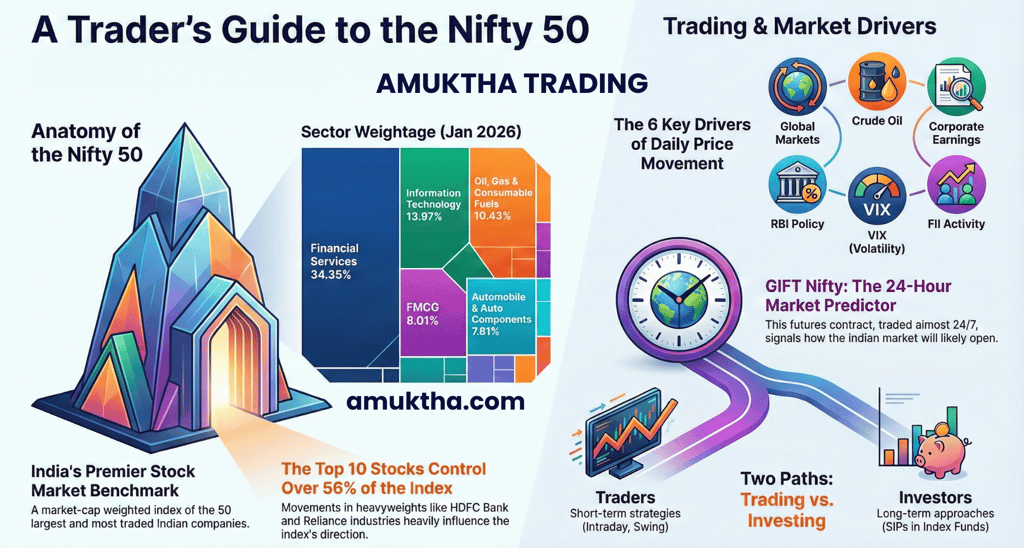
The Nifty 50 includes companies from several sectors of the Indian economy.
Its sector composition changes over time as constituent companies and their market values change.
Major sectors represented in the index can include:
Financial Services
Information Technology
Oil, Gas and Consumable Fuels
Automobile and Auto Components
Fast Moving Consumer Goods
Telecommunications
Healthcare
Metals and Mining
Construction
Power
Consumer Durables
Consumer Services
The exact percentage allocation should always be displayed with a corresponding effective date.
Why Sector Weightage Matters
Sector composition can help investors understand some of the factors that may influence Nifty 50.
For example, changes in interest rates may affect financial companies, while currency movements can influence companies with significant overseas revenue.
Changes in crude oil prices can affect energy companies and businesses with significant energy-related costs.
These relationships are not guaranteed predictions of Nifty's direction. They are factors that can be considered as part of broader market analysis.
What Moves Nifty 50?
Nifty 50 can move because of a combination of domestic, international, corporate and market-specific factors.
Nifty 50 Constituent Stocks
Large-weight companies can have a significant influence on the index.
Traders therefore often monitor major Nifty 50 constituents when analysing an index move.
Corporate Earnings
Quarterly earnings announcements can affect individual stocks and, depending on their index weight, potentially influence Nifty 50.
Revenue growth, profit margins, management guidance and future earnings expectations can all influence stock prices.
RBI Policy and Interest Rates
Reserve Bank of India monetary policy can influence borrowing costs, liquidity, financial companies and market expectations.
The impact of an interest-rate change can vary depending on the economic environment and market expectations.
FII and Institutional Activity
Foreign portfolio investor activity is frequently monitored by Indian market participants.
Large institutional flows can affect market liquidity and sentiment, although buying or selling activity by itself should not be treated as a reliable prediction of future Nifty movements.
Global Markets
Indian markets can respond to developments in global financial markets.
Traders may monitor US markets, Asian markets, global bond yields, central-bank decisions, currency movements and major economic announcements.
The relationship between international markets and Nifty can vary according to market conditions.
Crude Oil Prices
Changes in international crude oil prices can affect India's inflation, currency, corporate costs and several industries.
The effect is different for different companies depending on their business models and exposure to energy prices.
India VIX
India VIX is commonly used as an indicator of expected market volatility.
Traders may monitor India VIX alongside Nifty 50, particularly when analysing options and changing market conditions.
A higher India VIX does not automatically mean that Nifty will fall, and a lower VIX does not guarantee that Nifty will rise.
Nifty 50 Today: What Should You Check?
People searching for Nifty 50 today, Nifty today or NSE Nifty today are generally looking for current index information.
Instead of looking only at the Nifty 50 index level, traders can consider several additional factors.
These include:
Current Nifty 50 level
Percentage change
Previous close
Day's high and low
Major advancing stocks
Major declining stocks
Sector performance
Market breadth
India VIX
Institutional activity
Relevant corporate announcements
Major domestic and international events
For real-time market information, use an authorised market-data platform or official NSE resources.
Nifty 50 Trading Hours
The regular NSE equity market session generally runs from 9:15 AM to 3:30 PM IST.
The NSE also has a pre-open market session before regular trading begins.
Nifty-related futures and options have their own applicable trading hours, which may differ from the cash equity market.
Market holidays and special trading sessions can also affect market timings.
Always check the official NSE trading calendar for the relevant date.
What Is GIFT Nifty?
GIFT Nifty is a Nifty-linked derivatives market associated with GIFT City in Gujarat, India.
It trades outside India's regular equity-market session and is closely monitored by market participants before the Indian market opens.
GIFT Nifty can provide information about market sentiment before the NSE equity market begins.
However, it should not be treated as a guaranteed prediction of the Nifty 50 opening price.
GIFT Nifty vs Nifty 50
Nifty 50 is an Indian equity index representing 50 companies.
GIFT Nifty is a derivatives market linked to Nifty and is traded through the international financial services ecosystem at GIFT City.
The two should therefore not be treated as identical instruments.
How Traders Use GIFT Nifty
Traders may monitor GIFT Nifty to understand the market environment before the Indian equity session starts.
For example, a significant movement in GIFT Nifty may indicate that overnight global developments or news have affected market sentiment.
However, the actual Nifty 50 opening can differ because domestic news, order flow and other market developments can change conditions before the NSE session begins.
Nifty 50 Trading Strategies
There is no single Nifty 50 trading strategy that works in every market condition.
Different traders use different approaches depending on their timeframe, risk tolerance, capital and objectives.
Intraday Nifty Trading
Intraday traders open and close positions during the same trading session.
They may use tools such as:
Price action
Support and resistance
Volume
Moving averages
VWAP
RSI
Market breadth
Opening-range analysis
Intraday trading can involve significant risk, especially when leverage or derivatives are used.
Swing Trading Nifty
Swing traders generally attempt to capture price movements over several trading sessions.
Analysis may include daily and weekly charts, support and resistance, trend structure, moving averages, breakouts and volume.
The holding period and risk management rules should be established before entering a trade.
Nifty Futures Trading
Nifty futures provide leveraged exposure to movements in the index.
Because futures are leveraged instruments, relatively small movements in the underlying index can result in significant gains or losses relative to the margin committed.
Position sizing and risk management are therefore particularly important.
Nifty Options Trading
Nifty options provide rights associated with the underlying index according to the contract terms.
Options trading involves several variables, including:
Strike price
Expiry
Premium
Implied volatility
Time decay
Delta
Gamma
Theta
Vega
Options strategies can have significantly different risk profiles.
Traders should understand the characteristics and risks of the specific strategy before using it.
Positional Trading
Positional traders may hold Nifty-related positions for longer periods than intraday traders.
Their analysis may incorporate technical trends, macroeconomic factors, corporate earnings, sector performance and broader market conditions.
Nifty 50 Investment
Nifty 50 can also be used as a benchmark and as an underlying index for long-term investment products.
Investors can obtain Nifty 50 exposure through products such as Nifty 50 index mutual funds and Nifty 50 ETFs.
Nifty 50 Index Funds
Nifty 50 index funds are designed to track the performance of the Nifty 50, subject to expenses and tracking differences.
Before selecting an index fund, investors can review factors such as:
Expense ratio
Tracking difference
Fund size
Investment objective
Fund structure
Historical tracking performance
Nifty 50 ETFs
Nifty 50 ETFs are exchange-traded products designed to provide exposure to the Nifty 50.
ETF investors should also consider factors such as liquidity, expense ratio, tracking difference and the specific structure of the ETF.
SIP in Nifty 50 Index Funds
Some investors use systematic investment plans to invest regularly in index mutual funds.
A SIP approach can help create a disciplined investment process, but it does not eliminate market risk or guarantee returns.
The appropriate investment approach depends on an individual's financial goals, investment horizon and risk tolerance.
Nifty 50 vs Sensex
Nifty 50 and Sensex are two major Indian equity-market benchmarks.
Nifty 50 represents 50 companies associated with the National Stock Exchange of India, while Sensex tracks 30 companies associated with the Bombay Stock Exchange.
Both indices are used to understand large-cap Indian equity-market performance, but their constituents and methodologies are different.
Investors comparing the two should focus on their respective methodology, constituent composition and intended use rather than assuming that one index represents the entire Indian stock market.
Nifty 50 Historical Returns
Historical Nifty 50 performance can be measured in different ways.
Two important concepts are price return and total return.
Price return reflects changes in the index level.
Total return additionally considers dividends from the constituent stocks, according to the applicable index methodology.
This distinction is important when comparing index performance with an investment product.
Historical performance can provide context but does not guarantee future returns.
How to Analyse Nifty 50
A structured Nifty 50 analysis can combine technical, fundamental and market-related information.
Check the Index Trend
Look at multiple timeframes rather than relying only on an intraday chart.
Analyse Market Breadth
Compare advancing and declining stocks to understand how broadly an index move is supported.
Monitor Major Constituents
Large-weight Nifty 50 companies can have a greater impact on index movements.
Review Sector Performance
Understanding which sectors are contributing to an index move can provide additional context.
Monitor Volatility
India VIX and options-market information can provide insight into changing expectations around volatility.
Review Major Events
RBI decisions, economic data, corporate earnings, global market movements and significant geopolitical developments can all affect market conditions.
Define Risk Before Trading
Before entering a leveraged trade, traders should understand their maximum acceptable risk, position size and exit conditions.
Common Nifty-researched trade can result in an excessive loss if the position size is too large relative associated with GIFT City. It is commonly monitored outside India's regular equity-market hours as an indicator of market sentiment The suitability of an investment depends on factors including financial objectives, investment horizon than trying to cover every trading technique on a single Nifty capital. Past performance does not guarantee future results. Always conduct your own research and consider 50 Trading Mistakes
Treating GIFT Nifty as a Guaranteed Signal
GIFT Nifty can provide an indication of market sentiment, but it cannot guarantee the Nifty 50 opening level or direction.
Overtrading
Taking too many trades can increase transaction costs and expose traders to unnecessary risk.
Excessive Leverage
Leverage can increase both potential gains and potential losses.
Ignoring Position Size
Even a well-researched trade can result in an excessive loss if the position size is too large relative to available capital.
Using Outdated Nifty Weightages
Nifty 50 constituents and weightages change over time.
Always check the effective date of the data being used.
Confusing Investing With Trading
Long-term index investing and short-term futures or options trading have different objectives, risks and time horizons.
They should not be treated as the same activity.
Frequently Asked Questions About Nifty 50
What is Nifty 50?
Nifty 50 is a benchmark stock market index representing 50 companies listed on the National Stock Exchange of India.
How many stocks are in Nifty 50?
The Nifty 50 index contains 50 constituent companies.
What is Nifty 50 weightage?
Nifty 50 weightage represents the relative influence of each constituent within the index. The index uses a free-float market capitalization methodology.
How is Nifty 50 calculated?
Nifty 50 is calculated using a free-float market capitalization methodology, with adjustments made according to the index methodology for corporate actions and constituent changes.
What are Nifty 50 stocks?
Nifty 50 stocks are the companies that currently form the Nifty 50 index. The constituent list can change during periodic index reviews.
What time does Nifty 50 open?
The regular NSE equity market opens at 9:15 AM IST, subject to the NSE trading calendar and any special market session.
What time does Nifty 50 close?
The regular NSE equity market closes at 3:30 PM IST, subject to the NSE trading calendar and any special trading session.
What is GIFT Nifty?
GIFT Nifty is a Nifty-linked derivatives market associated with GIFT City. It is commonly monitored outside India's regular equity-market hours as an indicator of market sentiment.
Can GIFT Nifty predict the Nifty 50 opening?
GIFT Nifty can provide an indication of market sentiment before the Indian market opens, but it does not guarantee the Nifty 50 opening level or direction.
How can I invest in Nifty 50?
Investors can obtain Nifty 50 exposure through products such as Nifty 50 index mutual funds and ETFs. The suitability of an investment depends on factors including financial objectives, investment horizon and risk tolerance.
What is the difference between Nifty 50 and Sensex?
Nifty 50 and Sensex are major Indian equity-market benchmarks with different exchanges, constituent numbers and methodologies.
Nifty 50: Key Takeaways
The NSE Nifty 50 is a major benchmark for India's large-cap equity market.
The most important things to understand are:
Nifty 50 contains 50 constituent companies.
The index uses a free-float market capitalization methodology.
Nifty 50 weightage determines the relative influence of individual constituents.
Constituents and weightages can change over time.
Sector composition can influence how the index responds to economic developments.
GIFT Nifty can provide market context before the Indian equity market opens but is not a guaranteed prediction.
Nifty futures and options provide leveraged exposure and involve significant risk.
Nifty 50 index funds and ETFs provide ways for investors to obtain index exposure.
Historical performance does not guarantee future returns.
Current constituent and weightage information should always be checked against official sources.
Related Nifty 50 and Trading Resources
If you want to learn more about trading and market analysis, explore our guides on Nifty 50 trading strategies, intraday trading, price action trading, trading psychology, and stock market research and analysis.
These resources can help you explore individual concepts in greater depth rather than trying to cover every trading technique on a single Nifty 50 page.
Disclaimer:- Trading in securities markets carries substantial risk and is not suitable for everyone. Past performance is not indicative of future results. This article is for educational purposes only and should not be construed as investment advice. Please conduct your own research and consult a SEBI-registered financial advisor before making trading or investment decisions.
© 2026 Amuktha Trading. Telangana, India. Serving global traders since 2013.