
Options Trading in India: Complete Guide for Nifty & Bank Nifty Beginners (2026)
If you've been following the Indian stock market, you've probably heard traders talking about "writing calls," "buying puts," or "making weekly gains" from options trading. While it sounds complex, options trading has become one of the most accessible ways for retail traders in India to participate in the derivatives market—especially with Nifty and Bank Nifty options.
But here's the truth: most beginners lose money in their first few months of options trading. Not because options are inherently risky, but because they jump in without understanding the fundamentals. This guide will walk you through everything you need to know about options trading in India, from basic concepts to practical strategies you can start implementing today.
What Exactly Are Options in the Indian Market?
Let's start with a simple analogy. Imagine you're interested in buying a flat in Hyderabad that's currently priced at ₹50 lakhs. The builder offers you a deal: pay ₹50,000 today, and you have the right (but not the obligation) to buy that flat at ₹50 lakhs anytime in the next three months, regardless of what happens to property prices.
If property prices shoot up to ₹60 lakhs, you can still buy at ₹50 lakhs—you've made a smart move. If prices drop to ₹45 lakhs, you simply walk away, losing only your ₹50,000. You're not obligated to buy.
This is essentially how options work in the stock market.
Call Options vs Put Options
In the Indian derivatives market, there are two types of options:
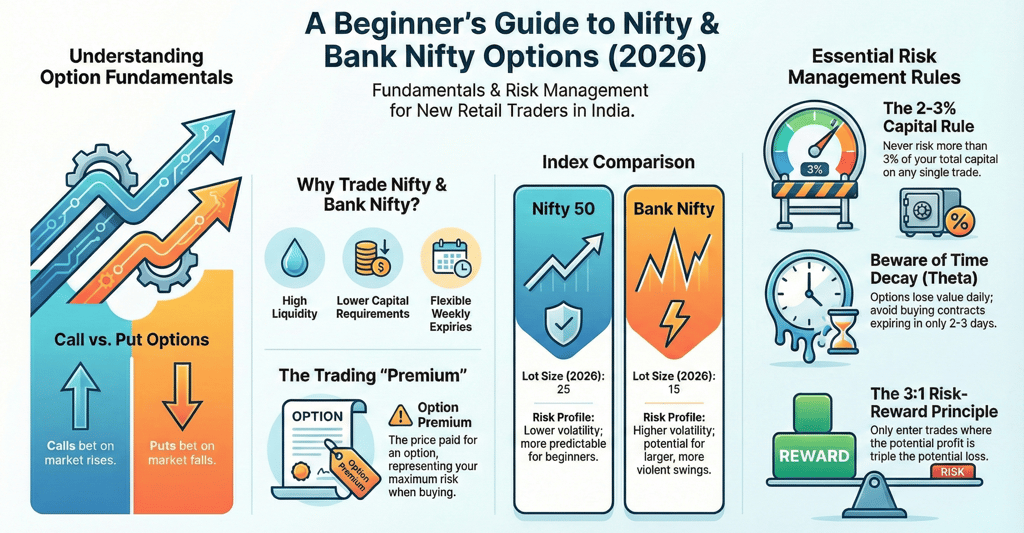
Call Options give you the right to buy an underlying asset (like Nifty or Bank Nifty) at a predetermined price (strike price) before a specific date (expiration). Traders buy calls when they believe the market will go up.
Put Options give you the right to sell an underlying asset at the strike price before expiration. Traders buy puts when they expect the market to fall.
The price you pay to buy an option is called the premium. This is your maximum risk if you're buying options. Even if the market moves completely against you, you can only lose the premium you paid.
Why Indian Traders Love Nifty and Bank Nifty Options
Nifty 50 and Bank Nifty are the two most actively traded index options in India. Here's why they're popular:
High Liquidity: You can enter and exit positions quickly without significant price slippage. On any given day, lakhs of contracts trade hands.
Lower Capital Requirement: Unlike buying stocks in cash market, you can take substantial positions in options with relatively smaller capital. A Nifty option lot size is 25, and Bank Nifty is 15 (as of 2026).
Weekly Expiries: Both indices now have weekly expiries, giving traders more opportunities and flexibility. You're not stuck waiting for monthly expiry.
Defined Risk for Buyers: When you buy options, your maximum loss is limited to the premium paid, regardless of how much the market moves against you.
Leverage: Options provide leverage, meaning you can control a large position with a smaller amount of capital. However, leverage is a double-edged sword—it amplifies both gains and losses.
Understanding Key Options Trading Terms
Before you place your first trade, you need to understand the language of options:
Strike Price: The price at which the option can be exercised. For example, if you buy a Nifty 23,000 Call option, 23,000 is your strike price.
Expiration Date: Indian index options expire every Thursday for weekly options, and the last Thursday of each month for monthly options. After expiration, the option becomes worthless if not exercised.
Premium: The current market price of the option. This fluctuates based on market movement, time remaining until expiry, and volatility.
In the Money (ITM): A call option is ITM when the market price is above the strike price. A put option is ITM when the market price is below the strike price.
At the Money (ATM): When the strike price is closest to the current market price.
Out of the Money (OTM): A call option is OTM when the market price is below the strike price. A put option is OTM when the market price is above the strike price.
Intrinsic Value: The actual value of the option if exercised right now. For a call, it's the difference between the market price and strike price (if positive).
Time Value: The additional premium traders are willing to pay beyond intrinsic value, based on the time remaining until expiry.
Implied Volatility (IV): A measure of expected market movement. Higher IV means higher premiums. During events like budget announcements or RBI policy meetings, IV typically spikes.
Setting Up for Options Trading in India
Choosing the Right Broker
To trade options in India, you need a trading account with a SEBI-registered broker that offers derivatives trading. Popular brokers include Zerodha, Upstox, Angel One, ICICI Direct, and Groww.
When selecting a broker, consider these factors:
Brokerage Structure: Some brokers charge per trade (₹20 per order is common), while others charge a percentage. For active options traders, flat-fee brokers are usually better.
Margin Requirements: Different brokers have different margin policies. Understand how much capital you need to hold positions.
Trading Platform: The platform should be fast, reliable, and easy to use. During market hours, especially near expiry, every second counts.
Educational Resources: Good brokers provide learning materials, webinars, and market analysis to help you improve.
Account Activation Process
Opening an options trading account involves:
Completing the standard demat and trading account opening (now fully online via Aadhaar)
Filling out a derivatives segment activation form
Providing details about your trading experience and financial background
Signing additional risk disclosure documents
Completing any required quizzes or assessments
The entire process typically takes 24-48 hours. Once activated, you'll need to transfer funds to your trading account to start.
Understanding Margin Requirements
Unlike equity trading where you pay the full amount, options trading requires margins:
For Option Buyers: You only pay the premium amount. No additional margin is blocked.
For Option Sellers: SEBI requires you to maintain SPAN + Exposure margins. This can be substantial—typically 60-80% of the contract value for Nifty and even higher for Bank Nifty.
Many beginners are surprised by margin requirements when they try to sell options. Always check the margin calculator on your broker's platform before placing orders.
Beginner-Friendly Options Trading Strategies
Let's explore practical strategies suitable for those starting their options trading journey:
1. Long Call (Buying Call Options)
When to use: You expect Nifty or Bank Nifty to rise significantly before expiry.
Example: Nifty is at 23,000. You believe it will cross 23,500 by next week. You buy a 23,200 Call option for a premium of ₹100.
Maximum Risk: ₹100 × 25 (lot size) = ₹2,500
Breakeven: 23,300 (Strike + Premium paid)
Profit Potential: Unlimited as market goes up
What happens: If Nifty reaches 23,600, your option is worth at least ₹400 (intrinsic value). You can sell it for ₹400, making ₹300 profit per share, or ₹7,500 total profit.
Key Learning: Time decay works against you. If Nifty stays at 23,000, your option loses value every day, eventually becoming worthless at expiry.
2. Long Put (Buying Put Options)
When to use: You expect the market to fall.
Example: Bank Nifty is at 51,000, and you're bearish. You buy a 50,800 Put for ₹150.
Maximum Risk: ₹150 × 15 = ₹2,250
Breakeven: 50,650
Profit Potential: Substantial as market falls (limited to strike price going to zero)
This is a pure directional bearish bet, similar to Long Call but in the opposite direction.
3. Covered Call (For Stock Holders)
When to use: You own stocks and want to generate additional income.
Example: You hold 100 shares of Reliance at ₹2,800. You sell one lot of Reliance 2,900 Call and collect ₹50 premium.
Income: ₹50 × 100 = ₹5,000 immediately
Risk: If Reliance goes above 2,900, your shares will be called away, but you still profit from ₹2,800 to ₹2,900 plus the premium
This strategy works well in sideways markets and generates steady income, though it caps your upside.
4. Protective Put (Portfolio Insurance)
When to use: You own stocks but want protection against a market crash.
Example: You hold ₹10 lakhs worth of stocks that mirror Nifty. To protect against a market crash, you buy Nifty Put options.
If the market crashes, your puts gain value, offsetting losses in your stock portfolio. This is like buying insurance for your portfolio.
5. Bull Call Spread
When to use: You're moderately bullish but want to reduce the cost of buying calls.
Example: Nifty at 23,000
Buy 23,200 Call at ₹150
Sell 23,400 Call at ₹80
Net Cost: ₹70 per share
Maximum Risk: ₹70 × 25 = ₹1,750 Maximum Profit: (23,400 - 23,200 - 70) × 25 = ₹3,250
This limits both your risk and profit but increases your probability of success. It's excellent for beginners as it reduces the impact of time decay.
6. Bear Put Spread
When to use: You're moderately bearish.
Example: Bank Nifty at 51,000
Buy 50,800 Put at ₹200
Sell 50,500 Put at ₹100
Net Cost: ₹100 per share
Similar risk/reward profile to Bull Call Spread, but for downward movement.
Common Mistakes That Cost Beginners Money
After observing hundreds of new traders in the Indian market, certain patterns emerge in losing trades:
1. Trading Without a Plan
Many beginners open their trading platform and decide what to trade based on "market feeling" or tips from Telegram groups. Successful traders have a written plan before the market opens, including entry points, exit points, and maximum loss limits.
2. Ignoring Time Decay (Theta)
Options lose value as expiry approaches. This time decay accelerates in the final week. Beginners often buy options on Tuesday or Wednesday of expiry week and watch them lose money even when they're right about direction.
Lesson: If you're buying options, give yourself time. Don't buy options expiring in 2-3 days unless you're very experienced.
3. Overleveraging Positions
The temptation to use maximum buying power is strong, especially after a winning trade. One bad trade can wipe out weeks of profits.
Lesson: Never risk more than 2-3% of your capital on a single trade. If you have ₹1 lakh, your maximum loss per trade should be ₹2,000-3,000.
4. Selling Options Without Understanding Risk
YouTube videos make selling options look like "free money collection." While selling options can be profitable, the risk is substantial. As a seller, your profit is limited to the premium collected, but your loss can be unlimited (for naked calls) or very substantial.
Lesson: If you sell options, always use defined risk strategies like spreads, or have robust stop-losses and risk management.
5. Chasing Losses
After a losing trade, emotional traders immediately enter another trade to "win back" the money. This rarely works and often leads to bigger losses.
Lesson: After a loss, step back. Review what went wrong. Sometimes the best trade is no trade.
6. Trading Illiquid Options
Not all strike prices have good liquidity. Trading deep OTM or ITM strikes can result in wide bid-ask spreads, meaning you pay more to buy and receive less when selling.
Lesson: Stick to ATM and near-ATM strikes where liquidity is highest, especially for Bank Nifty and Nifty.
7. Ignoring Volatility
Buying options when IV is very high means you're paying inflated premiums. When volatility contracts, you lose money even if you're right about direction.
Lesson: Check the India VIX before trading. If it's unusually high, be cautious about buying options. Consider selling strategies instead.
Risk Management: The Foundation of Profitable Trading
Here's an uncomfortable truth: in options trading, being right about market direction isn't enough. You can be right 70% of the time and still lose money if you don't manage risk properly.
Position Sizing
Never put all your capital into one trade. A common framework:
Conservative: Risk 1% per trade (₹1,000 on ₹1 lakh capital)
Moderate: Risk 2% per trade (₹2,000 on ₹1 lakh capital)
Aggressive: Risk 3% per trade (₹3,000 on ₹1 lakh capital)
Going beyond 5% per trade is gambling, not trading.
Stop Loss Rules
Every trade needs a predetermined exit point. For options buyers:
Time-based stop: Exit if the trade hasn't worked by a certain time (e.g., by 2 PM if entered in the morning)
Price-based stop: Exit when option premium falls by a certain percentage (e.g., 50% of entry price)
Underlying stop: Exit when Nifty/Bank Nifty hits a specific level
For options sellers, stops are even more critical since potential losses can be large.
The 3:1 Risk-Reward Principle
Before entering any trade, ask: "If my stop loss is hit, I lose X. If my target is hit, I make 3X or more." If the trade doesn't offer at least 3:1 reward-to-risk, it's probably not worth taking.
Mental Capital Management
Less talked about but equally important: protect your emotional capital. Take breaks after losses. Don't trade when angry, depressed, or overly excited. Your mental state directly impacts decision-making quality.
Using Practice Accounts Effectively
Most brokers now offer paper trading or virtual trading accounts where you can practice with fake money. This is invaluable for beginners.
However, many traders misuse paper trading:
Wrong approach: Trading carelessly because "it's not real money," taking huge risks you'd never take with actual capital.
Right approach: Treat the virtual account exactly like a real account. Follow your position sizing rules, maintain a trading journal, and track performance seriously.
Use paper trading to:
Learn how the platform works
Test different strategies
Understand how options pricing changes with market movements
Build confidence before risking real money
Spend at least 1-2 months in paper trading, executing at least 30-50 trades before going live.
Market Analysis for Options Trading
Successful options trading requires understanding both technical and fundamental factors:
Technical Analysis Basics
For intraday options trading, technical analysis is crucial:
Support and Resistance: Identify key levels where Nifty or Bank Nifty tends to reverse. These become logical points for entries and exits.
Trend Analysis: Is the market in an uptrend, downtrend, or sideways? Options strategies differ based on market regime.
Volume Analysis: Rising volume confirms price movements. Low volume moves are often false signals.
Indicators: RSI, MACD, and Moving Averages can help identify overbought/oversold conditions and trend changes.
Understanding Open Interest
Open Interest (OI) shows how many contracts are currently open. Analyzing OI data reveals where traders are positioned:
High Call OI: Suggests resistance at that strike (many traders betting market won't go above) High Put OI: Suggests support at that strike (many traders betting market won't go below)
OI Build-up: When price rises with increasing Call OI, it's bullish. When price falls with increasing Put OI, it's bearish.
This OI data is freely available on NSE's website and most trading platforms.
Event-Driven Volatility
Certain events cause volatility spikes in the Indian market:
Union Budget (February 1st)
RBI Monetary Policy (every 2 months)
Company Earnings (for stock options)
Global Events (Fed decisions, geopolitical tensions)
Options premiums increase before these events due to uncertainty. Many traders avoid holding positions through major events unless specifically trading the event itself.
Tax Implications of Options Trading in India
Understanding tax treatment is essential for calculating your actual returns:
For Speculation (F&O) Transactions
Options trading is classified as "Speculative Business Income" under Indian tax law:
Profits: Added to your total income and taxed according to your income tax slab (up to 30% plus surcharge and cess)
Losses: Can be carried forward for 4 years but can only be set off against speculative business income (not against salary or other income)
Turnover Calculation: Sum of favorable differences (not total of buy and sell values). This determines if you need a tax audit (audit required if turnover exceeds ₹10 crores without digital transactions, ₹5 crores otherwise)
Record Keeping
Maintain detailed records:
Contract notes from broker
Bank statements showing fund transfers
Profit & Loss statements
Trading journal
Consider using accounting software or hiring a CA familiar with F&O taxation, especially if you're an active trader.
Building a Sustainable Trading Practice
Options trading shouldn't be treated as gambling or quick money. Building sustainable success requires:
Maintaining a Trading Journal
Document every trade:
Date and time
Market conditions
Reason for entry
Entry price
Exit price
Profit/Loss
What went right/wrong
Emotional state
Review your journal weekly. You'll notice patterns—certain setups that work well for you, times when you trade best, and situations to avoid.
Continuous Education
Markets evolve. What worked last year may not work this year. Stay updated through:
Reading: Books like "Option Volatility and Pricing" by Sheldon Natenberg Webinars: Many brokers and educational platforms offer free sessions Market Analysis: Daily reading of business news, understanding policy changes Peer Learning: Joining trading communities (but being selective about advice)
Many traders find that structured learning through mentorship programs accelerates their growth significantly. Having an experienced guide helps you avoid costly mistakes and builds your confidence systematically.
Developing Your Trading Edge
What makes one trader successful while another fails? Often, it's about finding your edge—a specific skill, strategy, or approach that works consistently for you.
Your edge might be:
Deep understanding of a specific sector (like banking stocks, making you better at Bank Nifty trades)
Technical analysis skills
Ability to read order flow and OI data
Patience to wait for high-probability setups
Discipline to follow rules strictly
Finding your edge takes time. It comes from honest self-assessment and specialization.
Questions Beginners Frequently Ask
Is options trading legal in India?
Yes, absolutely. Options trading on recognized exchanges (NSE, BSE) is completely legal and regulated by SEBI. Millions of Indians trade options daily. What's illegal is unregistered trading platforms or apps.
How much money do I need to start options trading?
Technically, you can start with as little as ₹5,000-10,000 for buying options. However, for sustainable trading with proper risk management, starting with ₹50,000-1,00,000 is more realistic. This gives you enough capital to:
Take multiple smaller positions
Withstand a few losing trades
Practice different strategies
Not feel pressured to make quick profits
Which is better for beginners: Nifty or Bank Nifty options?
Nifty options are generally better for beginners. Here's why:
Lower volatility compared to Bank Nifty
Smaller lot size (25 vs 15), but Bank Nifty point value is much higher
More predictable movement
Less violent swings
Bank Nifty can move 500-1000 points in a day, which is exciting but dangerous for beginners. Start with Nifty, gain experience, then move to Bank Nifty if you want more action.
Can I trade options with a full-time job?
Yes, many successful options traders have day jobs. Strategies include:
Positional trading: Hold positions for several days
End-of-day analysis: Analyze charts after market hours, place orders for next day
Weekly options: Take positions on Monday/Tuesday, close by Thursday
Use GTT (Good Till Triggered) orders for automatic entry/exit
Intraday scalping requires watching the screen constantly, which isn't feasible with a job. But strategic options trading is very possible.
Should I buy options or sell options?
Both have pros and cons:
Buying Options (Pros): Limited risk, unlimited profit potential, requires less capital Buying Options (Cons): Time decay works against you, requires being right about direction AND timing
Selling Options (Pros): Time decay works for you, higher probability of small profits, income generation Selling Options (Cons): Unlimited or large risk, requires significant margin, one big loss can wipe out many small wins
Most experts recommend beginners start by buying options with defined risk, then learn selling through defined-risk spreads, before attempting naked selling.
What's the success rate in options trading?
Statistics suggest 80-90% of retail options traders lose money. However, this includes people who:
Never learned properly
Trade emotionally
Don't follow risk management
Give up after first losses
With proper education, practice, and discipline, your odds improve dramatically. It's not about getting rich quick; it's about building skills over time.
How do I handle losses?
Losses are part of trading. Even the best traders have 40-50% losing trades. What matters is:
Keeping losses small through stops
Letting winners run
Learning from each loss
Not emotional trading after losses
If you're losing consistently, stop trading with real money. Go back to paper trading, analyze what's going wrong, and address the root cause.
Real-World Example: A Week in Options Trading
Let's walk through a realistic week for a moderately experienced trader with ₹1 lakh capital:
Monday Morning:
Nifty opens at 23,150
Analysis suggests upward bias based on global cues and technical support
Decision: Buy 23,300 Call expiring this Thursday for ₹90
Position: 1 lot (25 shares) = ₹2,250 investment
Stop loss: Exit if premium falls to ₹45 (50% loss = ₹1,125)
Monday EOD:
Nifty closes at 23,280
Option premium at ₹125
Unrealized profit: ₹875
Decision: Hold, trailing stop at ₹90 (breakeven)
Tuesday:
Nifty reaches 23,450
Option premium touches ₹220
Decision: Book partial profit, sell at ₹200
Profit: (₹200-₹90) × 25 = ₹2,750
Wednesday:
Market consolidates, trader stays out
No trade
Thursday (Expiry):
Bank Nifty shows weakness
Decision: Buy 50,500 Put for ₹130 (Bank Nifty at 50,850)
1 lot (15 shares) = ₹1,950 investment
Stop: ₹65 (₹975 loss if triggered)
Thursday End:
Bank Nifty closes at 50,600
Put premium at ₹110
Small loss: ₹300
Decision: Accept the small loss, strategy didn't work
Week Result:
Win: +₹2,750
Loss: -₹300
Net: +₹2,450 (2.45% on capital)
Trades: 2
Win rate: 50%
This is realistic: not every trade wins, but winners are larger than losers, resulting in net profit.
Your Path Forward
Options trading in India offers genuine opportunities for those willing to learn and practice disciplined trading. The key is approaching it as a skill to develop, not a lottery ticket.
If you're serious about options trading:
Phase 1 (Month 1-2): Education and paper trading
Learn fundamentals thoroughly
Practice with virtual money
Study market behavior
Develop a basic strategy
Phase 2 (Month 3-4): Small live trades
Start with minimal capital
Focus on execution and psychology
Track every trade meticulously
Refine your strategy
Phase 3 (Month 5-6): Building consistency
Increase position size gradually
Develop your edge
Work on weak areas
Consider advanced strategies
Phase 4 (Month 7+): Sustainable trading
Consistent profits
Emotional control
Continuous improvement
Possibly mentoring others
Remember, the goal isn't to get rich overnight. It's to build a skill that generates consistent returns over years and decades.
Many traders find that structured guidance accelerates this journey significantly. While self-learning is possible, having experienced mentors who've navigated these waters can help you avoid expensive mistakes and build confidence systematically. Whether you choose to learn independently or seek guidance, the principles remain the same: education, practice, discipline, and patience.
The Indian derivatives market is sophisticated, liquid, and full of opportunities. With the right approach, options trading can become a valuable skill in your financial toolkit.
Start small, learn continuously, and trade wisely. Your future self will thank you for the disciplined approach you take today.
Disclaimer:- Trading in securities markets carries substantial risk and is not suitable for everyone. Past performance is not indicative of future results. This article is for educational purposes only and should not be construed as investment advice. Please conduct your own research and consult a SEBI-registered financial advisor before making trading or investment decisions.
© 2026 Amuktha Trading. Telangana, India. Serving global traders since 2013.