
Complete Guide to Options Trading in India 2026: Strategies, Tools & Training for Traders
Master options trading with proven strategies, tools & expert coaching in India & Global. Get practical training, live market analysis & personalized mentorship. Start your journey today!
Are You Ready to Master Options Trading in 2026?
Options trading offers Indian investors powerful opportunities to generate income, hedge portfolios, and capitalize on market movements—but only when approached with the right knowledge, strategy, and guidance.
If you're in Hyderabad or anywhere in Telangana and searching for practical, results-driven options trading education, you've come to the right place.
At Amuktha Trading, we specialize in transforming beginners into confident, disciplined traders through hands-on training, real-time market analysis, and continuous mentorship. Our approach combines time-tested strategies with cutting-edge tools tailored specifically for Indian markets.
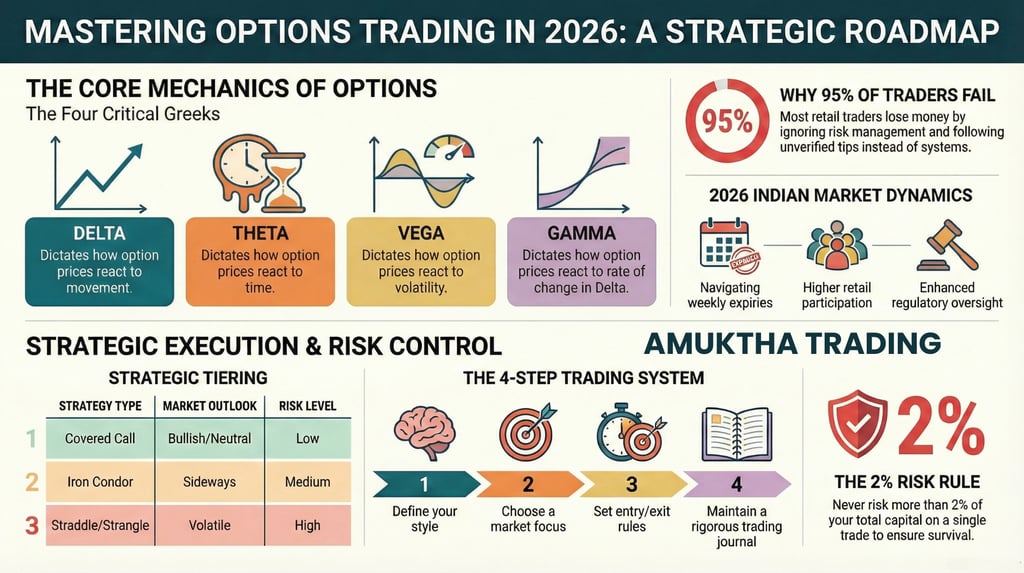
Why 95% of Options Traders Lose Money (And How You Can Be in the 5%)
The harsh reality: most retail traders fail at options trading because they:
Jump into trades without understanding Greeks (Delta, Theta, Vega, Gamma)
Follow random tips from unverified sources
Lack a systematic entry and exit strategy
Don't practice proper risk management
Trade emotionally instead of following a disciplined plan
The solution? Professional training that focuses on strategy, psychology, and practical execution—not just theory.
What Makes Options Trading Different in 2026?
The Indian options market has evolved significantly:
Market Dynamics in 2026
Weekly expiries across multiple indices (Nifty, Bank Nifty, Fin Nifty)
Higher retail participation requiring sophisticated strategies
Enhanced regulatory oversight ensuring safer trading environments
Advanced trading platforms with better analytics and execution
Tax regulations requiring proper documentation and planning
Understanding these changes is critical for sustainable success in options trading.
Understanding Options Trading: Essential Foundations
What Are Options?
An option is a contract that gives you the right, but not the obligation, to buy or sell an underlying asset (like Nifty or Bank Nifty) at a predetermined price (strike price) before a specific date (expiry).
Two Types of Options:
Call Options - The right to BUY
Profit when markets go UP
Limited loss (premium paid)
Unlimited profit potential
Put Options - The right to SELL
Profit when markets go DOWN
Limited loss (premium paid)
Substantial profit potential
The Four Critical Components (Greeks) You MUST Understand
Delta - How much option price changes with ₹1 movement in underlying
Theta - Time decay—how much value you lose each day
Vega - Impact of volatility changes on option price
Gamma - Rate of change of Delta
Without understanding Greeks, you're trading blind.
Proven Options Trading Strategies for Indian Markets (2026)
For Beginners: Low-Risk Strategies
1. Covered Call Strategy
When to use: You own stocks and want to generate extra income
Risk level: Low
Profit potential: Limited but consistent
Best for: Portfolio investors in Telangana looking for additional returns
2. Protective Put Strategy
When to use: You own stocks and want downside protection
Risk level: Low (insurance strategy)
Profit potential: Unlimited on stocks, limited loss protection
Best for: Conservative investors during uncertain times
For Intermediate Traders: Defined-Risk Strategies
3. Bull Call Spread
When to use: Moderately bullish on Nifty/Bank Nifty
Risk level: Medium
Profit potential: Limited but higher probability
Capital required: Lower than buying naked calls
4. Bear Put Spread
When to use: Moderately bearish outlook
Risk level: Medium
Profit potential: Defined risk-reward ratio
Best for: Trending down markets
5. Iron Condor
When to use: Expecting sideways/range-bound market
Risk level: Medium
Profit potential: Premium collection strategy
Best for: Low volatility environments
For Advanced Traders: Complex Strategies
6. Straddle & Strangle
When to use: Expecting big move but unsure of direction
Risk level: High (due to time decay)
Profit potential: Substantial in volatile moves
Best for: Event-driven trading (budget, RBI policy)
7. Calendar Spread
When to use: Taking advantage of different expiry time decay
Risk level: Medium-High
Profit potential: Limited but strategic
Best for: Experienced traders understanding theta decay
8. Butterfly Spread
When to use: Expecting minimal movement in underlying
Risk level: Low
Profit potential: High reward-to-risk in specific scenarios
Best for: Consolidating markets
Essential Tools Every Options Trader Needs in 2026
1. Trading Platform Selection Checklist
When choosing your trading platform, ensure it offers:
✅ Real-time Options Chain with Greeks display ✅ Multi-leg order entry for executing spreads in one click ✅ Strategy builder tools for backtesting ideas ✅ Margin calculator to plan capital requirements ✅ Mobile + Desktop access for flexibility ✅ Low brokerage costs (especially for multi-leg strategies) ✅ Reliable customer support during market hours ✅ API access if you plan automated trading
Key factors for Indian traders:
UPI/IMPS integration for instant fund transfers
Support documentation in regional languages
Local customer service hours aligned with Indian markets
2. Market Analysis Tools You Must Use
Real-Time Data & Charts
Professional charting platforms with Indian market data
Real-time option chain updates
Volume analysis and open interest tracking
Implied volatility indicators
Options Analysis Software
Greeks calculators for position analysis
Profit/loss graphing for visual risk assessment
Volatility scanners for identifying opportunities
Max pain analysis for expiry predictions
3. Risk Management Tools
Position Sizing Calculators
Never risk more than 2-3% per trade
Calculate appropriate lot sizes based on capital
Stop-Loss Automation
Set alerts for exit points
Auto-square-off features for risk management
Portfolio Trackers
Monitor overall exposure across positions
Track P&L in real-time
Analyze win rate and expectancy
How to Learn Options Trading: Education Pathways
Self-Learning vs. Professional Training
Self-Learning Approach
Pros:
Flexible timing
Lower initial cost
Learn at your own pace
Cons:
Risk of misinformation
No personalized feedback
Longer learning curve
Miss critical nuances
No accountability
Professional Training (Recommended)
Pros:
Structured curriculum from basics to advanced
Learn from experienced traders with proven track record
Avoid costly beginner mistakes
Hands-on practice with guidance
Community support and networking
Ongoing mentorship and updates
Cons:
Upfront investment (pays for itself quickly with proper application)
What to Look for in an Options Trading Course
✅ Comprehensive curriculum covering theory + practice ✅ Real market examples and case studies ✅ Live trading demonstrations (not just recorded videos) ✅ Risk management emphasis (not just profit strategies) ✅ Post-training support and community access ✅ Verified instructor credentials and track record ✅ Practical assignments and strategy templates ✅ Indian market specific (tax, regulations, platforms) ✅ Small batch sizes for personalized attention ✅ Money-back guarantee or trial period
Red flags to avoid: ❌ Promises of "guaranteed returns" ❌ No verifiable track record ❌ Purely theoretical content without practice ❌ Pushy sales tactics ❌ No student testimonials or reviews ❌ Unclear refund/support policy
Paper Trading: Your Risk-Free Practice Ground
Before risking real capital, you must practice extensively with paper trading (virtual trading).
Benefits of Paper Trading
Test strategies without financial risk
Build confidence in execution
Understand platform features thoroughly
Develop emotional discipline and routine
Track performance and refine approach
Paper Trading Best Practices
Treat it seriously: Trade as if using real money
Track every trade: Maintain detailed logs
Practice for 2-3 months minimum before going live
Test multiple market conditions: Trending, ranging, volatile
Include realistic costs: Factor in brokerage and slippage
Identify emotional patterns: Note when you break rules
Common mistake: Many traders succeed in paper trading but fail with real money because they don't account for emotional pressure. Start with very small real capital to bridge this gap.
Building Your Trading System: The 7-Step Framework
Step 1: Define Your Trading Style
Are you a:
Day trader (intraday positions, closed by day-end)
Swing trader (positions held 2-7 days)
Position trader (longer-term options strategies)
Choose based on your available time, capital, and temperament.
Step 2: Choose Your Market Focus
Nifty 50 options (broader market, lower volatility)
Bank Nifty options (higher volatility, bigger moves)
Fin Nifty options (financial sector focus)
Stock options (individual companies)
For beginners in Telangana: Start with Nifty for more stable learning.
Step 3: Select 3-5 Core Strategies
Don't try to learn everything at once. Master a few strategies:
1 bullish strategy
1 bearish strategy
1 neutral/range-bound strategy
1 high-volatility strategy
1 low-risk income strategy
Step 4: Set Clear Entry & Exit Rules
Entry criteria:
Technical indicators confirming direction
Volatility conditions favorable
Risk-reward ratio minimum 1:2
Capital availability and position sizing
Exit criteria:
Target profit reached
Stop-loss triggered
Time-based exit (before expiry)
Changing market conditions
Step 5: Implement Strict Risk Management
The 2% Rule: Never risk more than 2% of total capital on a single trade
Position sizing formula:
Position Size = (Account Size × Risk %) / (Entry Price - Stop Loss)
Maximum exposure: Don't deploy more than 30-40% of capital at once
Step 6: Maintain a Trading Journal
Record for every trade:
Date and time
Strategy used
Entry and exit prices
Profit/loss
Market conditions
What worked / what didn't
Emotional state
Review weekly to identify patterns and improve.
Step 7: Continuous Learning & Adaptation
Review trades monthly
Study market changes
Update strategies based on performance
Learn from mistakes
Stay updated on regulatory changes
Common Mistakes to Avoid in Options Trading
1. Buying Deep Out-of-the-Money (OTM) Options
Why it fails: Very low probability of profit, high time decay Better approach: Trade at-the-money or slightly OTM options
2. Ignoring Time Decay (Theta)
Why it fails: Options lose value every day, accelerating near expiry Better approach: Sell options to collect premium or use spreads
3. Over-Trading
Why it fails: High brokerage costs, emotional exhaustion, poor decisions Better approach: Quality over quantity—wait for high-probability setups
4. Not Having a Plan
Why it fails: Emotional decisions, no exit strategy, panic selling Better approach: Write your plan before entering any trade
5. Risking Too Much Per Trade
Why it fails: One bad streak can wipe out your account Better approach: Follow the 2% rule religiously
6. Following Tips Blindly
Why it fails: No understanding of rationale, bad timing, different risk profiles Better approach: Learn to analyze yourself or verify signals thoroughly
7. Ignoring Market Volatility (Vega)
Why it fails: Volatility crush after events can destroy option value Better approach: Trade volatility-appropriate strategies
8. Holding Till Expiry
Why it fails: Extreme time decay, high risk of total loss Better approach: Exit 3-5 days before expiry or roll positions
Tax Implications for Options Trading in India (2026)
Understanding tax treatment is crucial for net profitability.
Tax Treatment Based on Trading Style
For Frequent Traders (Business Income)
Options profits treated as Business Income
Taxed according to your income slab (up to 30%)
Can claim trading expenses as deductions
Losses can be carried forward for 8 years
Must file ITR-3 or ITR-4
For Occasional Traders (Speculative Income)
Options trading considered Speculative Business Income
Taxed at slab rates
Losses can only be set off against speculative income
Carry forward for 4 years
Key Points for Telangana Traders
STT (Securities Transaction Tax) already deducted
Maintain detailed trade records
Consider consulting CA for optimal tax planning
Factor in GST on brokerage charges
Pro tip: Keep 30-35% of profits aside for tax obligations
Why Choose Amuktha Trading for Your Options Trading Education?
Our Unique Advantages for Telangana Traders
1. Local Presence, Global Standards
Based in Hyderabad—meet us in person
Understand local market participant psychology
Conduct regular meetups and workshops
Available during IST market hours for support
2. Practical, Not Just Theoretical
Live market demonstrations daily
Real trade reviews (wins AND losses)
Hands-on practice with guidance
Strategy templates you can use immediately
3. Personalized Mentorship
Small batch sizes (maximum 15 students per batch)
One-on-one doubt clearing sessions
Customized strategy development based on your capital and goals
Personal risk assessment and position sizing guidance
4. Comprehensive Curriculum
Module 1: Foundations (Weeks 1-2)
Understanding options basics
Greeks explained with examples
Platform navigation and order types
Setting up your trading workspace
Module 2: Strategies (Weeks 3-5)
10+ proven strategies with step-by-step execution
When to use each strategy
Risk-reward analysis
Position adjustments
Module 3: Technical Analysis (Weeks 6-7)
Chart patterns for options traders
Key indicators and signals
Volatility analysis
Open interest interpretation
Module 4: Risk Management (Week 8)
Position sizing formulas
Portfolio heat management
Hedging techniques
Disaster recovery strategies
Module 5: Live Trading (Weeks 9-12)
Paper trading with instructor review
Gradual transition to small live positions
Weekly performance analysis
Psychology and discipline training
5. Ongoing Support After Course Completion
6 months of WhatsApp/Telegram support for doubt clearing
Weekly market analysis and trade ideas
Monthly group sessions for strategy updates
Lifetime access to course materials and updates
Alumni community for networking and shared learning
6. Real-Time Market Alerts
Get actionable insights via:
SMS alerts for high-probability setups
WhatsApp daily market analysis
Pre-market strategy discussions
Real-time position adjustment recommendations
7. Track Record & Transparency
Verified student testimonials with contact details
Public trade logs showing performance
No unrealistic profit claims
Focus on sustainable, risk-managed returns
8. Flexible Learning Options
Weekend batches for working professionals
Weekday batches for full-time traders
Online sessions for remote Telangana participants
Recorded sessions for revision
Hybrid model (in-person + online combination)
Success Stories: Transforming Traders
Rajesh K., Software Engineer, Hyderabad
"Before Amuktha Training, I was losing money following random tips. Now I have a systematic approach with proper risk management. My win rate improved from 35% to 68% in 6 months."
Priya M., Homemaker, Thrissur
"I started with zero trading knowledge. The patient guidance and practical teaching style helped me become confident. I now generate consistent monthly income with conservative strategies."
Venkat R., Business Owner, Coimbatore
"What I appreciated most was the focus on NOT losing money rather than just chasing profits. The risk management module alone was worth the course fee."
Swathi D., Accountant, Bangalore
"As a finance professional, I thought I knew about trading. But options Greeks and strategy execution were completely new. The hands-on practice made all the difference."
Getting Started: Your Next Steps
Free Resources to Begin Your Journey
Download our FREE Options Trading Starter Guide (PDF)
20 pages covering basics
Common mistakes to avoid
Checklist for getting started
Ask your Q&A FREE on weekend
Every Saturday, 11 AM - 13 PM IST
Live market examples
No obligation, pure education
Ready for Professional Training?
Special Offer for Indian Residents (February 2026)
✅ 12-week comprehensive course ✅ Personal mentorship ✅ 6 months post-training support ✅ Trading strategy templates ✅ Risk management calculator ✅ Position sizing spreadsheet ✅ Course material access
Course Fee: ₹41,999
Limited students per batch to ensure quality
100% Money-Back Guarantee if you're not satisfied after the first 2 weeks
Frequently Asked Questions
Q1: How much capital do I need to start options trading?
A: You can start with as little as ₹50,000, but we recommend ₹1-2 lakhs for comfortable position sizing and proper risk management. Start small and scale as you gain confidence.
Q2: Can I learn options trading while working full-time?
A: Absolutely! Our weekend batches are designed for working professionals. You can also practice with position trading strategies that don't require constant monitoring.
Q3: Is options trading gambling?
A: No. When done with proper knowledge, strategy, and risk management, it's a calculated skill-based activity. Gambling is random; trading is probability-based decision making.
Q4: How long before I can trade profitably?
A: Most students become comfortable with basic strategies in 2-3 months of training + practice. Consistent profitability typically comes after 6-12 months of disciplined execution. There's no shortcut.
Q5: Do you provide trading signals or tips?
A: We provide educational alerts showing what strategies we're watching and why—but our focus is teaching you to analyze markets independently. We want you to become self-sufficient, not dependent.
Q6: What if I don't have a technical background?
A: No problem! We start from absolute basics. Many of our successful students came with zero finance knowledge. We explain everything in simple terms with real-life examples.
Q7: Can I get refund if I'm not satisfied?
A: Yes, we offer a 100% refund if you're not satisfied after attending the first 2 weeks (4 sessions). No questions asked.
Q8: Do you help with broker and platform setup?
A: Yes! We guide you through selecting the right broker for your needs, opening accounts, platform setup, and connecting analysis tools.
Q9: What makes your training different from free online content?
A: Structured curriculum, personalized feedback, live market practice, accountability, mistake correction, and ongoing support. Free content is scattered and lacks application guidance.
Q10: I'm from a small town in Telangana. Can I still join?
A: Yes! We offer online sessions with full interactivity. Many of our students join from across Telangana and other states. Location is not a barrier.
Important Disclaimers
Risk Warning: Options trading involves substantial risk and is not suitable for all investors. You can lose some or all of your invested capital. Never trade with money you cannot afford to lose.
No Guaranteed Returns: Past performance does not guarantee future results. We teach strategies and risk management, but market outcomes are never guaranteed.
Educational Purpose Only: This content is for educational purposes and should not be construed as personalized investment advice. Always conduct your own research and consider consulting with registered financial advisors before making trading decisions.
Regulatory Compliance: Ensure you comply with all SEBI regulations and tax obligations when trading in derivatives.
Take Action Today: Transform Your Financial Future
The difference between successful traders and those who fail isn't luck—it's knowledge, strategy, and discipline.
You have two choices:
Choice 1: Continue trying to learn on your own, making expensive mistakes, and hoping for the best.
Choice 2: Invest in proper education, learn from experienced traders, and build a solid foundation for sustainable success.
Don't Wait—Markets Reward Preparation
Every day you delay learning proper options trading strategies is a day of missed opportunities or potential losses.
Contact Us Now
📞 Phone: +91 738-217-7772 (Call between 9 AM - 6 PM IST)
💬 WhatsApp: Click here to chat with us
📧 Email: contact@amuktha.com
📍 Office: Hyderabad, Telangana, India
🌐 Website: www.amuktha.com
Schedule Your FREE Consultation Call
Discuss your trading goals
Get personalized guidance on where to start
Understand our curriculum in detail
Ask any questions you have
No sales pressure—just honest advice
Next Batch Starting Soon
February 2026 Batch:
Weekend Batch: Saturdays & Sundays, 10 AM - 1 PM
Weekday Batch: Tuesday & Thursday evenings, 7 PM - 9 PM
Limited students per batch
Seats filling fast—reserve yours today!
Final Thoughts: Your Journey Begins Now
Options trading mastery is not achieved overnight. It requires dedication, practice, and the right guidance. But with the proper foundation, realistic expectations, and disciplined approach, you can develop a valuable skill that serves you for a lifetime.
At Amuktha Trading, we're committed to your success—not just during the training, but throughout your trading journey.
Join hundreds of successful traders from Telangana who transformed their financial futures with us.
Your trading success story starts with one decision.
Make it today.
👉WhatsApp Us Now to Get Started
Disclaimer:- Trading in securities markets carries substantial risk and is not suitable for everyone. Past performance is not indicative of future results. This article is for educational purposes only and should not be construed as investment advice. Please conduct your own research and consult a SEBI-registered financial advisor before making trading or investment decisions.
© 2026 Amuktha Trading. Telangana, India. Serving global traders since 2013.