
Stock Market Course vs Mentorship (2026): Which One Actually Makes You a Profitable Trader?
By Amuktha Trading & Investments | Est. 2013 | Updated April 2026
Every year, lakhs of Indians — and thousands more across the US, UK, Canada, and Australia — search for the same question: Should I take a stock market course or join a mentorship program?
In 2026, this question has never been more important. The Indian retail trading community has grown explosively, with crores of demat accounts now active. New traders are entering Nifty, Bank Nifty, and F&O markets every week — many without a clear roadmap. And globally, the democratisation of trading means anyone with a smartphone can access markets from Mumbai to Manchester.
But access is not the same as education. And education is not the same as profitable trading.
Most traders don't fail because they lacked information. They fail because no one taught them how to think in the markets. This guide gives you a clear-eyed, honest answer — based on real trading experience, not marketing language. Whether you're a beginner in Kerala, a working professional in Delhi, an NRI in Dubai, or a retail trader in London, this comparison is built for you.
What Is a Stock Market Course?
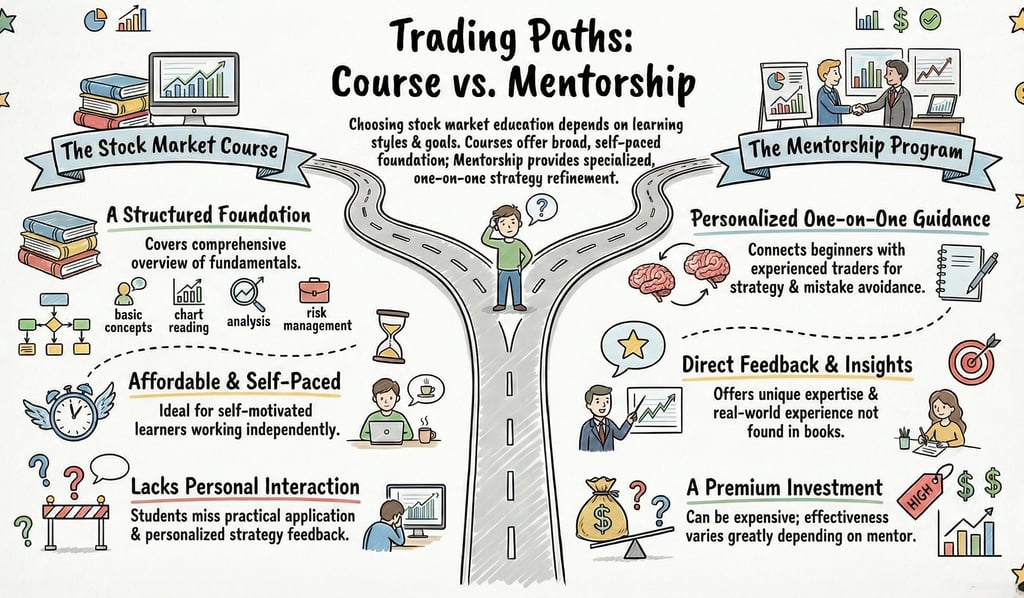
A stock market course is a structured, pre-built educational program — delivered online, offline, or in a hybrid format — that teaches trading and investing concepts in a defined curriculum. Think of it like a textbook brought to life.
Courses typically cover the fundamentals of equity, derivatives, options, and commodities. They introduce technical analysis including chart patterns, candlesticks, and support and resistance levels. They touch on fundamental analysis such as balance sheets, earnings, and valuation. Risk management frameworks are usually included, along with trading psychology basics and platform tutorials for tools like Zerodha, Upstox, and TradingView.
Courses are largely one-to-many. The same material is delivered to hundreds or thousands of students simultaneously, with little to no personalisation. You learn at your own pace, on your own schedule — which is both the biggest strength and the biggest limitation of a course.
What Is a Stock Market Mentorship?
A stock market mentorship is a personalised, ongoing learning relationship between an experienced trader and a student. It goes far beyond a curriculum — it is dynamic, responsive, and built around you: your capital, your risk tolerance, your schedule, your blind spots, and your goals.
A quality mentorship program includes one-on-one or small-group live sessions, real-time trade review and feedback, and genuine accountability — someone who actually tracks your progress and calls you out when you drift. It covers emotional and psychological coaching for trading discipline, strategy customisation to your specific trading style, and live market analysis discussions rather than pre-recorded lectures.
The key distinction is this: a course teaches you what to know. A mentorship teaches you how to act — in real markets, with real money, under real pressure.
The Honest Pros and Cons
Stock Market Course — What Works
Courses offer an affordable entry point with low financial risk. They are self-paced, which fits working professionals and students who cannot commit to scheduled sessions. A good course builds a strong theoretical foundation and is available in multiple languages including Hindi, Malayalam, and Tamil. Many courses provide a completion certificate that adds credibility, and they are useful for understanding regulatory frameworks and SEBI guidelines.
Stock Market Course — What Doesn't Work
The fundamental problem with a course is that it offers no personalisation — the same content is delivered to a beginner and an intermediate trader alike. There is little or no live trading experience involved, which means the psychological gaps remain completely unaddressed. Nobody sees your specific fears, your specific mistakes, your specific blind spots. High dropout rates are a persistent problem because there is no accountability built in. And course content can become outdated quickly in fast-moving markets — what worked in Nifty in 2023 may not be the optimal approach in 2026.
Most critically: you learn about trading. You do not learn how to trade.
Stock Market Mentorship — What Works
Mentorship is personalised to your capital, your style, and your goals from day one. You receive real-time feedback on actual trades — not hypothetical scenarios. It dramatically shortens the learning curve because you stop repeating the same mistakes and start building on what actually works for you. Mentorship addresses trading psychology directly — which SEBI's own data confirms is the primary reason most retail traders in India's F&O market lose money. You get ongoing support that evolves as the market evolves. And critically, accountability creates the consistency that creates profitability.
Stock Market Mentorship — What Doesn't Work
The higher upfront investment puts mentorship out of reach for some beginners. It requires a scheduled time commitment that not everyone can manage. The quality of mentorship varies enormously — it depends entirely on the mentor's actual trading experience and teaching ability. Not all mentorship programs in India are regulated or independently verified. And for absolute beginners with no foundational knowledge at all, jumping straight into mentorship can feel overwhelming without some baseline course content first.
Who Should Choose What?
The right answer depends entirely on where you are in your trading journey.
If you are a complete beginner with no trading knowledge whatsoever, start with a course. Build your foundation first — learn the vocabulary, understand how markets work, get comfortable with charts and basic technical analysis. Prepare yourself to make the most of mentorship when you're ready.
If you are a struggling trader who has taken courses, read books, watched hours of YouTube content, and still keeps losing money consistently — this is the mentorship gap. More content will not solve your problem. A good mentor will identify in real time what you are doing wrong in live market conditions and help you correct it before it costs you more capital.
If you are a busy working professional in IT, medicine, finance, or any other field — start with a self-paced course to build foundational knowledge, then seek mentorship for targeted swing or positional trading strategies that fit your available time and schedule.
If you are an NRI or global trader based in the US, UK, UAE, Canada, or Australia — and you want to invest in Indian markets via an NRI demat account or trade global indices like the Dow Jones and Nasdaq — you need a mentor who understands both ecosystems. Online mentorship makes this entirely possible regardless of where in the world you are.
If you are an options or F&O trader — mentorship is not optional, it is non-negotiable. F&O and options trading carry high risk that theory alone cannot prepare you for. You need live guidance on entry and exit, the Greeks, implied volatility, and position sizing from someone who actively trades options in real market conditions.
If you are a homemaker or retiree looking to generate supplementary or passive income from markets — a guided mentorship program helps you build a low-stress positional or long-term investment strategy suited to your lifestyle, without exposing yourself to unnecessary intraday risk.
The Indian Market Context in 2026
India's stock market landscape has transformed dramatically. With over 17 crore demat accounts active and retail participation in Nifty 50, Bank Nifty, and the options market at historic highs, the need for quality, personalised trading education has never been greater.
Most online courses — even expensive internationally produced ones — are built for global audiences. They do not address the specific, unique dynamics of Indian markets. They miss the nuance of Nifty 50 and Bank Nifty expiry trading, with its weekly and monthly cycles unique to the NSE. They do not cover SEBI's evolving regulations including the significant margin rule and position limit changes of 2024 through 2026. They are not built around Indian trading hours — 9:15 AM to 3:30 PM IST — and the specific volatility windows within that session. They do not explain how Indian options pricing behaves differently from US options. And they are not delivered in the languages that Indian traders actually think in.
This last point matters more than most people acknowledge. When you are making a split-second trading decision under market pressure, thinking in your mother tongue — whether that is Hindi, Malayalam, Tamil, or any other Indian language — leads to clearer, faster, more confident decisions.
SEBI's own published data shows that a significant majority of retail F&O participants book losses year after year. This is not because trading is impossible. It is because most traders enter the options market armed only with YouTube knowledge and no personalised guidance on risk management, position sizing, and emotional discipline. This is precisely the gap that mentorship fills — and that no course can fully replace.
For Global Traders: US, UK, Canada, Australia and Europe
If you are a trader based outside India — or an NRI managing investments across borders — the course versus mentorship question carries an additional layer: which markets are you trading, and does your mentor understand both?
Many NRIs in North America invest simultaneously in NSE via their NRI demat accounts and in US markets including the S&P 500, Nasdaq, and options. Understanding how global cues from the Dow Jones impact Nifty's opening each morning — and vice versa — is a genuinely valuable cross-market skill that only an experienced, globally-aware mentor can teach.
For traders in the UK and Europe, online mentorship sessions can be scheduled to align with their time zone. Evening sessions in IST correspond comfortably with early morning slots in the UK, making live Nifty pre-market analysis sessions highly practical.
Traders in Australia and Southeast Asia benefit from weekend review sessions, recorded mentorship walkthroughs, and asynchronous trade reviews — getting personalised feedback without needing to be present during specific market hours.
And for all global traders regardless of location: the psychology of markets, the discipline of risk management, and the principles of technical analysis are universal. A strong mentor teaches you to read any market, not just one index.
How to Choose: A 5-Step Framework
Before spending money on any trading education — whether a course or mentorship — answer these five questions honestly.
Step 1 — What is your current knowledge level? If you cannot explain what a candlestick, a support level, or a stop loss is, start with a structured course. If you understand these concepts but still lose money consistently, you need mentorship — not more theory.
Step 2 — What is your primary goal? Learning about markets as a hobby or general financial literacy? A course is sufficient. Building a supplementary income stream or a full-time trading career? Mentorship is the accelerator that gets you there faster and with fewer costly mistakes.
Step 3 — How much time can you commit each week? Less than three hours per week? A self-paced course works well. Can you commit five to ten hours including live sessions and trade reviews? Mentorship will deliver far greater returns on that time investment.
Step 4 — What is your trading capital? With smaller capital — say under ₹1 lakh — start with a course, paper trade, and build your foundation before risking significant funds. With larger capital at stake, the cost of mentorship is trivial compared to the losses you will avoid with proper, personalised guidance.
Step 5 — Have you tried going it alone — and lost? If yes, stop repeating the same approach. More YouTube videos, more indicators, more courses — these will produce the same results. What you need is a mentor who can see what you cannot see about your own trading behaviour, psychology, and decision-making patterns.
How Amuktha Bridges Both Worlds
At Amuktha Trading and Investments — established in Hyderabad in 2013 — we have always believed that education without application is incomplete. Our programs are not a course or a mentorship in isolation. They are a complete trading development ecosystem, designed to take you from foundational knowledge to consistent, profitable market participation.
For beginners, our structured trading courses cover Nifty 50, Bank Nifty, and F&O from the ground up — including risk management, chart reading, and practical technical analysis. They are available in English, Hindi, and Malayalam, in a fully online, self-paced format.
For serious traders, our one-on-one mentorship delivers personalised sessions with experienced mentors, real-time trade review, live market analysis, strategy development tailored to your trading style, psychological coaching, and ongoing support that continues long after the formal program ends.
For all levels, we provide daily and weekly market analysis covering Nifty, Dow Jones, and Nasdaq — along with portfolio advisory services and a community of serious traders across India and globally.
For NRIs and global traders, our programs are fully online, accessible from anywhere in the world, and schedulable around US, UK, and Australian time zones. We provide cross-market insights for traders managing positions across Indian and international markets.
Our goal has never been to sell you a course. It has always been to help you become a consistently profitable trader — whatever market you trade, wherever in the world you are.
Frequently Asked Questions
Is a stock market course better than mentorship in 2026?
Neither is universally better — they serve different purposes at different stages of a trader's journey. A course builds your knowledge base. Mentorship builds your ability to act profitably in live markets. For serious traders aiming at consistent income from Nifty, F&O, or global markets, mentorship delivers far greater long-term value. The ideal approach is to combine both: course first, mentorship second.
Which is better for beginners in India — a course or mentorship?
Start with a structured course to understand the basics — market structure, technical analysis, candlestick patterns, order types, and SEBI regulations. Once you have that foundation, move into mentorship to apply those concepts in live Nifty and Bank Nifty markets with personalised, real-time guidance.
How much does stock market mentorship cost in India in 2026?
Stock market mentorship in India varies widely. Group-based programs start around ₹10,000 to ₹25,000. One-on-one premium mentorship with experienced, active traders ranges from ₹50,000 to ₹1,50,000 or more. Amuktha offers tiered packages to suit different budgets — contact us for a free consultation to find the right fit for your goals and capital.
Can I learn stock market trading online in 2026?
Absolutely. Online trading education — both courses and mentorship — is the standard in 2026. Live session recordings, real-time chart sharing, and community support via WhatsApp or Telegram make online learning as effective as in-person programs. Amuktha's programs are fully online and designed for traders across India and globally.
What is the difference between a trading coach and a trading mentor?
A trading coach typically focuses on fixing specific short-term problems — overtrading, poor stop-loss discipline, or a specific pattern of mistakes. A trading mentor provides a longer-term relationship that guides your entire development as a trader: strategy, psychology, capital management, and adaptation to changing market conditions. Think of a coach as a specialist appointment — and a mentor as the doctor who knows your complete trading history.
Is stock market mentorship worth it for F&O traders?
For F&O and options traders, mentorship is arguably non-negotiable. SEBI's published data consistently shows high loss rates among retail F&O participants. The difference between those who profit and those who do not is rarely knowledge — it is guided application, real-time discipline, and personalised risk management. A mentor who actively trades options provides insights that no recorded course can replicate.
Can NRIs in the US, UK, or Australia take online mentorship from India?
Yes. Amuktha's mentorship is fully online. NRIs in the US, UK, Canada, Australia, UAE, and Europe regularly participate in sessions. We accommodate different time zones through flexible scheduling, recorded session access, and asynchronous trade review. If you invest in Indian markets via NRI demat or trade global indices, our mentors provide relevant cross-market analysis for your specific situation.
Is mentorship available in Hindi or Malayalam?
Yes. At Amuktha, sessions are available in English, Hindi, and Malayalam. Trading in the language you naturally think in dramatically improves comprehension, retention, and live market decision-making — especially under the pressure of real trading conditions.
How long does it take to become a profitable trader with mentorship?
There is no honest guaranteed timeline. However, most traders who combine a structured course with quality mentorship see meaningful improvement in consistency and risk management within three to six months of active engagement. The key variables are how regularly you trade, how seriously you implement feedback, and how effectively you manage your emotions during drawdowns.
How do I know if a stock market mentorship program is genuine in India?
Look for mentors who are SEBI-registered advisors or who have a verifiable, transparent trading track record. Avoid anyone promising guaranteed returns — that is illegal under SEBI regulations. Check for genuine testimonials, free introductory sessions, and whether the mentor actively trades the markets they teach. Amuktha has been operational since 2013 — over a decade of verified, trusted market experience.
Disclaimer:- Trading in securities markets carries substantial risk and is not suitable for everyone. Past performance is not indicative of future results. This article is for educational purposes only and should not be construed as investment advice. Please conduct your own research and consult a SEBI-registered financial advisor before making trading or investment decisions.
© 2026 Amuktha Trading. Telangana, India. Serving global traders since 2013.