
Trading Mentor in India — Nifty, Bank Nifty & Options Coaching for Beginners to Intermediate Traders (2026)
By Amuktha Trading Services | Updated: 2026 | Covers India, US, UK, Canada, Europe & Australia
Whether you are sitting in Hyderabad, Kochi, Mumbai, Delhi, Dubai, or Toronto — if you want to learn to trade Indian markets with discipline, a proven process, and real mentor support, you are in the right place.
At Amuktha Trading, we mentor beginners and intermediate traders through every stage of their journey — from opening your first demat account to executing your own live Nifty and options trades with a clear risk framework. Our sessions are available in English, Hindi, and Malayalam, so language is never a barrier to learning.
This page answers every question a serious trader in India — or an NRI abroad — might have before choosing a mentor in 2026. Read it end to end, or jump to the section most relevant to you.
Book a Free Trial Session View Course Modules WhatsApp Us Available in English · Hindi · Malayalam India + Global Online & Offline
1. Why Indian Retail Traders Struggle — and How Mentorship Changes Everything in 2026
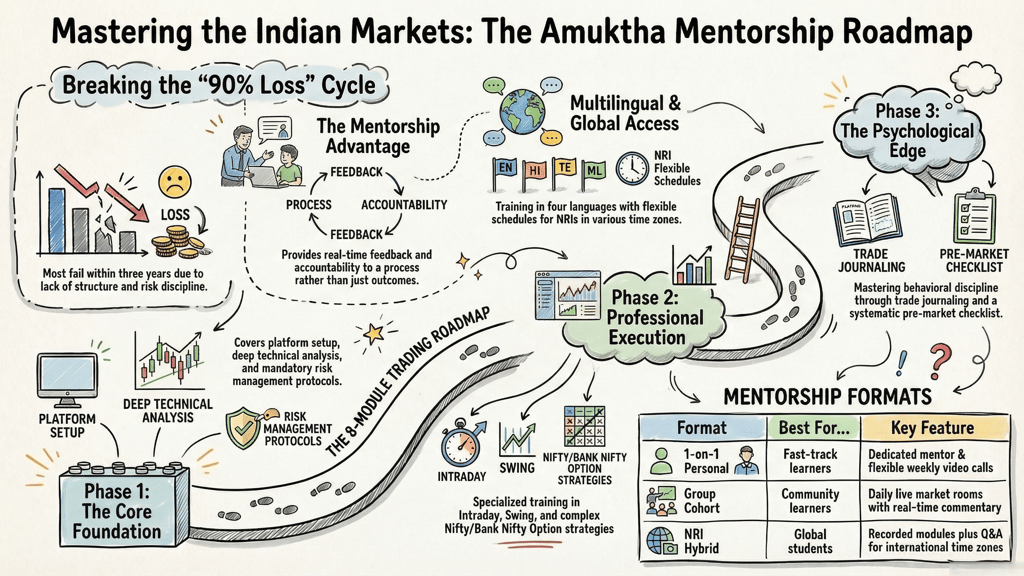
India's retail trading population crossed 11 crore registered investors by early 2026, yet SEBI data consistently shows that over 90% of F&O traders lose money in their first three years. The reason is not intelligence — it is the absence of a structured learning path, live feedback, and enforced risk discipline.
Most new traders in India make the same five mistakes. They copy tips from Telegram channels and YouTube without understanding the context behind the trade. They over-leverage on Nifty or Bank Nifty options without knowing the Greeks or understanding expiry risk. They have no written trading plan and no trade journal. They treat intraday losses as an "adjustment" and refuse to cut positions when the trade has clearly failed. And they switch strategies every week after a few losing trades, never giving any single approach enough time to show whether it actually works.
A good trading mentor breaks this cycle by providing three things that self-study simply cannot: a structured curriculum with measurable milestones, real-time feedback on actual trades, and accountability to a process rather than just outcomes.
For traders in Telangana, Andhra Pradesh, Kerala, Maharashtra, Karnataka, and across India — a mentor who is genuinely familiar with NSE/BSE/MCX products, the Indian options microstructure, local broker platforms like Zerodha, Groww, Angel One, and Upstox, and the specific dynamics of Indian market timings provides irreplaceable practical context.
For NRIs in the United States, United Kingdom, Canada, UAE, Australia, or Europe — the same Indian market expertise, delivered in flexible evening sessions that fit your time zone, is what bridges the gap between passively following market news and actually knowing how to trade profitably and independently.
2. About Amuktha Trading — Who We Are, What We Teach, and Who We Teach It In
Our Mission
To produce independent, disciplined, profitable traders — not followers. Every student who completes our programme should be able to open a chart, build a trade plan, manage risk, and execute without needing to ask anyone for a "call". We measure our success not by how many students we enrol but by how many leave able to trade on their own.
Languages We Teach In
We offer full trading mentorship in English across all programmes. Our Hindi-medium sessions cover the core modules and daily live market commentary, making structured trading education accessible to students across North India, Maharashtra, Gujarat, Rajasthan, and Madhya Pradesh. Our Malayalam-medium batches are dedicated to students from Kerala, the Malabar region, and the large Malayali diaspora worldwide — making Amuktha Trading one of very few services in India to offer structured Nifty and options coaching in Malayalam. Our Telugu-medium sessions are designed specifically for students from Andhra Pradesh and Telangana, delivering the same core modules and live market insights in a language that ensures clarity and confidence in learning.
Instruments We Focus On
Our curriculum is built around the instruments that Indian retail traders actually trade. This includes Nifty 50 and Bank Nifty index options on the NSE — which form the backbone of Indian F&O trading — as well as stock options on NSE-listed equities. We cover intraday equity trading on both NSE and BSE, swing trading and positional strategies for traders who cannot watch screens all day, index and stock futures, and MCX commodities for intermediate and advanced students who want broader market exposure.
Who Our Students Are
Our beginners in India include students, working IT and finance professionals, homemakers, and retirees who want a structured second income source from the market and need to start from absolute scratch. Our intermediate Indian students are typically self-taught traders with some market experience but inconsistent results — they know enough to be dangerous to their own capital, and they come to us to build the system and discipline they never had. Our global and NRI students are Indians living in the US, UK, Canada, UAE, Australia, Singapore, and Europe who hold NRE or NRO demat accounts and want to actively trade Indian markets with a mentor who understands both the instruments and their specific regulatory constraints as non-residents.
3. Our Course Modules — What You Will Learn Step by Step
Every student begins with a free assessment call to determine their current level and goals. From there, your mentor maps a personalised learning path. You do not pay for modules you do not need — our modular pricing means you only enrol in what is relevant to your current stage.
Module 1 — Foundation: Market Basics and Platform Setup
This module is for traders who are starting from zero. You learn how to open and use a demat and trading account, understand the different order types available on Indian exchanges, navigate the structure of NSE, BSE, and MCX, read live quotes and market depth, and set up your trading platform — specifically TradingView and Zerodha Kite — so you are not fumbling with the interface when markets are moving. You also get your first introduction to candlestick charts, which form the visual language of every trading decision you will ever make.
Module 2 — Technical Analysis: Chart Reading and Pattern Recognition
This is where most trading courses begin — and where most of them stay too shallow. We go deep on support and resistance zones, trend lines and trend channels, and the major chart patterns that repeat in Indian markets: head and shoulders, triangles, flags, wedges, and double tops and bottoms. We cover the key indicators — RSI, MACD, Bollinger Bands, and multiple moving averages — with specific attention to how they work (and frequently fail) in the Indian intraday context. Multi-timeframe analysis is taught from the beginning, because reading a 5-minute chart without knowing what the daily chart is doing is one of the most common reasons traders take losing trades.
Module 3 — Risk Management: Capital Protection and Position Sizing
This module is compulsory. No student at Amuktha Trading skips it, regardless of experience level. Risk management is what separates traders who survive long enough to get good from traders who blow their accounts and quit. You learn the 1–2% risk-per-trade rule and exactly how to apply it in the Indian F&O context with lot sizes. You learn stop-loss placement based on technical structure rather than arbitrary rupee amounts. You build and begin using a position sizing calculator for every trade. You learn how to calculate risk-reward ratios before entering any position, how to think about drawdown and portfolio-level risk, and — critically — how to set up a trade journal that will become your single most important improvement tool over the coming months.
Module 4 — Intraday Trading: Day Trading Indian Indices and Stocks
India's intraday market has its own rhythms and its own traps. This module teaches you how to read and trade the opening range (9:15–9:45 AM IST), use VWAP as a dynamic support and resistance reference, manage gap-up and gap-down openings, and set up a pre-market scanner to identify the day's best setups before the bell. You attend live intraday market sessions with the mentor so you can see the decision-making process in real time — not in a recorded video, but in a live market with actual risk on the line.
Module 5 — Swing and Positional Trading: Multi-Day Holding Strategies
Not every trader can watch screens from 9:15 to 3:30 every day. This module is designed for working professionals, NRIs trading across time zones, and anyone who wants to participate in Indian markets without being glued to the intraday feed. You learn trend-following setups, breakout trading with volume confirmation, overnight and weekend risk management, how to use sector rotation to identify the next strong movers, and how to structure earnings-season trades with defined risk.
Module 6 — Options Fundamentals: Understanding the Options Chain
India's options market — particularly Nifty and Bank Nifty weekly expiry options — is one of the most active in the world. It is also one of the most misunderstood. This module teaches you the difference between Calls and Puts, how to select strikes intelligently based on your view and risk tolerance, how Indian options expiry mechanics work (including the weekly Thursday expiry), lot sizes and margin requirements under the SPAN system, and how to read the NSE options chain to extract information about where the market's big players are positioned. Open Interest analysis and Put-Call Ratio interpretation are covered in full.
Module 7 — Options Strategies: Practical Strategy for Indian Markets
This is where options trading becomes genuinely powerful — and where most self-taught traders get into trouble. You learn to distinguish between buying and selling options and understand when each is structurally advantageous. We cover the strategies that work in Indian markets: Iron Condors and Iron Butterflies for range-bound expiry weeks, Bull and Bear Credit Spreads for directional views with defined risk, Straddles and Strangles around major events and RBI announcements, and calendar spreads for premium harvesting. You learn how implied volatility drives premium, how theta decay works against buyers and for sellers, and how to select the right strategy based on the current market regime.
Module 8 — Trading Psychology: Mindset and Behavioural Discipline
The biggest edge most retail traders need is not a better strategy — it is better behaviour around an existing strategy. This module examines the specific psychological traps that destroy profitable traders: FOMO entries after a missed move, revenge trading after a loss, position size inflation after a winning streak, and the paralysis that follows a drawdown. You build a journaling protocol, a pre-trade checklist, and a post-session review process that make your decision-making systematic rather than emotional. Consistency — not genius — is what compounds over time.
4. Our Mentorship Formats — Choose What Fits Your Life
Format 1 — One-on-One Personalised Mentorship
The most intensive and most effective way to learn trading. You get your own dedicated mentor, your own schedule, and a curriculum built specifically around your starting point and your goals. Sessions are held weekly as one-on-one video calls, supplemented by trade reviews, screen-share sessions where we work through your charts together, and WhatsApp support between sessions. Programmes typically run 8 to 12 weeks depending on your starting knowledge level. All time slots are flexible — morning, evening, and weekend sessions are available — and sessions can be conducted in English, Hindi, or Malayalam based on your preference. This format is ideal for serious learners who want to progress as fast as possible with the highest level of individual attention.
Format 2 — Small Group Cohort with Live Market Rooms
Learn alongside a small batch of no more than 10 to 12 students, with live market commentary every trading day. The mentor trades and explains decisions in real time — before the trade, during the trade, and after the close. The day is structured around a pre-market preparation session from 9:00 to 9:20 AM IST, live intraday commentary from 9:20 AM to 3:30 PM, and an end-of-day debrief from 3:45 to 4:30 PM where we review every significant trade, explain what went right and wrong, and discuss adjustments for the next session. Weekly recorded topic sessions supplement the live sessions, and a group WhatsApp channel provides peer learning and market discussion between sessions. This format is ideal for learners who benefit from daily market exposure and community-driven accountability.
Format 3 — Online Recorded and Live Hybrid for NRI and Global Students
Designed specifically for students outside India who cannot attend IST daytime sessions. The full curriculum is delivered via recorded modules that you can watch at any time, on any device, with lifetime access. These are supplemented by weekly live Q&A sessions scheduled in time zones compatible with US Eastern Standard Time, UK Greenwich Mean Time, and Gulf Standard Time — so you are not forced to choose between your job and your education. One-on-one review sessions can be booked as add-ons for students who want additional individual attention. Malayalam-medium batches are available specifically for Malayali NRIs in the Gulf, UK, North America, and Australia. This format is ideal for NRI traders, Indian diaspora investors, and international students who want full curriculum access without being constrained by IST.
Format 4 — Intensive Weekend Bootcamp in Hyderabad (Offline)
A two-day intensive face-to-face programme held in Hyderabad for traders who prefer learning in a classroom environment. Live charts, live trading on screen, and direct Q&A with the mentor throughout the weekend. Batches are kept small — a maximum of 15 students — to ensure every attendee gets real attention and their specific questions answered. The bootcamp covers Modules 1 through 5 across two full days, with hands-on platform practice built into both sessions. All bootcamp students receive 30 days of online follow-up support after the event. Sessions are conducted in Telugu and English. This format is ideal for traders based in Hyderabad, Secunderabad, and the broader Telangana and Andhra Pradesh region who want an immersive start to their trading education.
5. What Separates Amuktha Trading from Other Mentors in India
The trading education market in India is crowded and, in places, deeply misleading. Before you pay anyone — including us — you deserve to know exactly what you are getting and how it compares to the alternatives.
Most Indian trading courses teach in a single language. Amuktha Trading teaches in English, Hindi, and Malayalam, giving you the option to learn in the language where you genuinely think fastest and understand most deeply. Most Indian cohort programmes enrol 50 to 200 students per batch, making individual attention functionally impossible. Our group cohorts cap at 12 students, and one-on-one mentorship is always available. Most Indian trading programmes are designed entirely around Indian Standard Time with no accommodation for students abroad. Our NRI batches are specifically scheduled for US, UK, and Gulf time zones, with recorded content available for any hour.
Very few Indian trading programmes include structured trade review as a standard component — most courses deliver content and leave you to apply it alone. At Amuktha, trade review is built into every format. Your actual trades — not hypothetical examples — are examined and discussed with your mentor. Most programmes mention risk management as one topic among many. We treat it as a compulsory standalone module that every student must complete before progressing to any live trading. And most programmes offer post-course support for 30 days or nothing at all. Our alumni community, monthly live Q&A sessions, and evolving resource library mean your learning does not stop when your paid course ends.
The instruments we cover also set us apart. Many courses focus on equity trading alone and treat F&O as advanced and optional. We teach equity, Nifty and Bank Nifty options, stock options, futures, and MCX commodities as a connected ecosystem — because in 2026, any Indian retail trader who wants to grow needs to understand derivatives, not just equities.
6. Frequently Asked Questions (2026)
Who is the best trading mentor for beginners in India in 2026?
The best mentor for a beginner in India is one who teaches in a language you are fully comfortable in, uses a graded curriculum rather than overwhelming you all at once, insists on paper trading before you touch live capital, and makes risk management non-negotiable. At Amuktha Trading, beginner programmes start with a personal assessment call, move through structured modules at your pace, and introduce live trading only after a student demonstrates consistent decision-making on a demo account. If you are looking for trading mentorship available in Telugu, Malayalam, or Hindi alongside English — Amuktha is one of very few services in India to offer all three meaningfully, not just as a token option.
Is there a trading mentor who teaches in Malayalam?
Yes. Amuktha Trading offers dedicated trading mentorship in Malayalam for students in Kerala, the Malabar and Konkan belt, and the large Malayali NRI community in the Gulf — UAE, Qatar, Kuwait, Oman, Bahrain — as well as the UK, US, Canada, and Australia. Malayalam-medium batches cover the full curriculum from NSE/BSE basics through live Nifty and Bank Nifty options trading, taught by a mentor who is fluent in both the language and the specific nuances of Indian market trading. If you have been struggling to find a reliable stock market course in Malayalam that goes beyond YouTube basics and actually teaches you how to trade live markets with discipline, contact us to check the next batch schedule.
Can NRIs in the US, UK, or Australia learn to trade Indian markets with Amuktha?
Absolutely. A significant portion of our students are NRIs — Non-Resident Indians — who hold NRE or NRO demat accounts and want to actively trade NSE and BSE instruments from abroad. We offer dedicated NRI batches with live sessions scheduled for US Eastern Standard Time evenings, UK Greenwich Mean Time evenings, and Gulf Standard Time evenings, so you do not need to take a day off work or wake up at 4 AM to attend. Recorded modules give you lifetime access to the full curriculum on your own schedule. Monthly live Q&A sessions keep you connected to the market and the mentor community even when you miss a live session. Whether you are in New York, New Jersey, California, Texas, London, Birmingham, Toronto, Vancouver, Dubai, Abu Dhabi, Sydney, Melbourne, or anywhere else in the world — if you want to trade Indian markets with a structured mentor who understands your specific situation as a non-resident, we can help.
What is the difference between intraday trading mentorship and options trading mentorship?
Intraday trading mentorship teaches you to buy and sell equity shares or index futures within the same trading day, between 9:15 AM and 3:30 PM IST. You learn chart reading, pre-market preparation, order execution, and same-day risk management. Options trading mentorship goes significantly deeper — into the options chain, the Greeks (Delta, Theta, Gamma, Vega), strike selection logic, expiry risk and time decay, margin mechanics under the SPAN system, and multi-leg strategies like Iron Condors, Bull Spreads, and Straddles. Most students begin with intraday equity basics and progress to options over 6 to 10 weeks. Our curriculum teaches both in sequence, which means you never arrive at complex options strategies without a solid technical and risk management foundation underneath you.
How much does trading mentorship cost in India in 2026?
Our pricing is tiered so that quality mentorship is accessible across different budgets. Group cohort pricing is the most affordable entry point. One-on-one mentorship packages reflect the personalised time and individual trade review involved and are priced accordingly. Modular pricing means you pay only for the modules relevant to your current stage — you do not need to buy a full programme if, for example, you only need the options strategies module as an add-on to knowledge you already have. Contact us directly for current batch pricing, available instalment plans, and early-enrolment discounts. We do not publish fixed fees online because we customise packages to each student's needs — but we are fully transparent about all costs before you commit to anything.
Do you offer a free trial session before I join?
Yes. We offer a free trial session for every prospective student — no payment required and no commitment necessary. The trial session gives you a genuine look at our teaching style, the live market environment, and the level of interaction you can expect. We actively encourage you to ask tough questions during the trial: ask to see how a trade review actually works, ask what happens when a student has a bad week, ask what post-course support looks like. A mentor who cannot answer those questions confidently before you pay is not ready to take your fees. Book your free trial via the contact page or WhatsApp — details are at the bottom of this page.
What trading platforms and brokers do you support?
We use TradingView for all charting and technical analysis work — it is free, browser-based, updated in real time, and works identically whether you are in Hyderabad, Kochi, London, or New York. For Indian broker platforms, we have hands-on experience with Zerodha Kite, Upstox Pro, Angel One, Groww, and 5Paisa, and we can walk you through any of these in your opening session if needed. NRI students typically use Zerodha NRI accounts or HDFC Securities NRI — we guide you through the account opening process if you have not yet set one up. For MCX commodity trading, we work with platforms compatible with Angel One Commodities and Motilal Oswal.
Is SEBI registration required for a trading mentor in India?
Under SEBI regulations, providing personalised investment advice for a fee — telling someone specifically what to buy or sell — typically requires registration as a SEBI-Registered Investment Adviser or Research Analyst. Amuktha Trading operates as an educational and mentorship service. We teach you how to analyse markets, build your own trade plans, and make your own decisions independently. We do not provide stock tips, buy or sell recommendations, or any form of portfolio management. Every student is taught to develop and execute their own trade plans. If you are evaluating any trading service in India — including ours — you should always ask clearly whether they are providing education or regulated investment advice, and check their registration status accordingly on the SEBI website.
How long does it take to become a consistently profitable trader?
This is the most important question you can ask a mentor — and we will give you the honest answer rather than the comfortable one. Most students who follow the structured programme, maintain their trade journal, and attend live sessions consistently begin to see measurable improvement in their decision-making quality within 8 to 12 weeks. Consistent profitability sustained over a 3-month period typically develops over 6 to 18 months for most retail traders, depending on starting knowledge, time commitment, and the market conditions they encounter during their learning period. We do not promise profits and we never will. We promise that if you follow the process — manage your risk, journal every trade, review your own decisions honestly, and trade with discipline — you give yourself a vastly higher chance of being in the small percentage of retail traders who actually make money from Indian markets over the long term. Any mentor who guarantees specific profits is either misleading you or in violation of SEBI guidelines. Walk away from both.
Do you teach F&O trading for beginners who have never traded derivatives before?
Yes, and this is actually the most common starting point for our options students. Most people who come to us for F&O mentorship have either never traded derivatives at all, or they have dabbled in options on the basis of YouTube videos and lost money without understanding why. Our Module 6 (Options Fundamentals) starts from the very beginning — what a Call option is, what a Put option is, how they are priced, what the Greeks actually mean in plain language — and builds methodically to live options chain reading and strategy execution. Nobody is thrown into Iron Condors before they understand why a 200 CE is priced the way it is on an expiry morning. That sequencing is exactly what self-study cannot give you, and it is what prevents the costly beginner mistakes that drive most new F&O traders out of the market.
7. Trading Mentor Services by Location — India and Worldwide (2026)
Trading Mentor in Hyderabad, Telangana | AP
Hyderabad is one of India's most active retail trading cities, driven by the large IT and finance professional population in Gachibowli, HITEC City, Madhapur, Kondapur, Banjara Hills, and Jubilee Hills, and the long-standing trading culture around Ameerpet and Secunderabad. We offer both offline weekend sessions in Hyderabad and fully live online sessions accessible from anywhere in Telangana and Andhra Pradesh. Our weekend bootcamp is designed specifically for the working professional in Hyderabad who cannot commit to weekday market hours but wants structured, hands-on training. If you have been searching for trading classes near Ameerpet, Kukatpally, LB Nagar, Dilsukhnagar, Miyapur, or anywhere else in the Hyderabad metro area, reach out to check our next offline batch schedule.
Trading Mentor for Kerala Traders in English and Malayalam
Kerala has an extraordinarily financially literate retail trading community, and a Malayali diaspora spread across the Gulf, UK, North America, and Australia that actively invests in Indian markets from abroad. We offer Malayalam-medium trading mentorship for both Kerala-based students and Malayali NRIs worldwide. Whether you are in Kochi, Thiruvananthapuram, Kozhikode, Thrissur, Kannur, Palakkad, or Malappuram — or in Dubai, Abu Dhabi, Riyadh, Doha, Muscat, London, Toronto, Melbourne, or Houston — our Malayalam-medium batches cover the full curriculum from NSE market basics through live Nifty options trading. Language should never be the reason a bright, motivated person cannot access quality trading education.
Online Trading Mentor for Students Across India — Hindi and English
Students from across Maharashtra (Mumbai, Pune, Nagpur), Karnataka (Bengaluru, Mysuru), Tamil Nadu (Chennai, Coimbatore), Gujarat (Ahmedabad, Surat), Rajasthan (Jaipur, Jodhpur), Delhi NCR, Punjab (Chandigarh, Ludhiana, Amritsar), Uttar Pradesh (Lucknow, Kanpur, Varanasi), Madhya Pradesh (Bhopal, Indore), and all other Indian states join our online batches in English and Hindi. Our live market rooms run on Indian Standard Time, and all recorded modules can be accessed at any hour of the day. If you are in a smaller city and have been unable to find structured, live trading mentorship locally — Nagpur, Visakhapatnam, Coimbatore, Surat, Jaipur, Lucknow, Bhopal, Patna, Ranchi, Guwahati — our fully online programme gives you exactly the same live market access and mentor interaction as a student in Hyderabad or Mumbai.
Trading Mentor for NRIs — US, UK, Canada, UAE, Australia, and Europe
If you are an NRI holding an NRE or NRO demat account and want to actively trade Indian markets, you face a specific combination of challenges that India-based courses rarely address: significant time zone differences, limited access to mentors who understand Indian markets deeply, the complexity of NRI account regulations and repatriation rules, and the need for sessions that do not conflict with a full working week in your country of residence. Amuktha Trading's NRI programme is built around all four of these constraints. Sessions are scheduled to work around your time zone, not ours. Our mentors are familiar with NRE and NRO account restrictions, FEMA guidelines, and the broker platforms NRIs commonly use — Zerodha NRI, HDFC Securities NRI, ICICI Direct NRI, and others. And because we teach in English, Hindi, and Malayalam, you learn in the language where you are sharpest. We currently serve NRI students across the United States (New York, New Jersey, California, Texas, Illinois, Georgia, Washington), United Kingdom (London, Birmingham, Leicester, Manchester, Glasgow), Canada (Toronto, Vancouver, Calgary, Ottawa, Brampton), UAE (Dubai, Abu Dhabi, Sharjah, Ajman), Australia (Sydney, Melbourne, Perth, Brisbane, Adelaide), Singapore, and across Europe (Germany, Netherlands, France, Ireland, Italy, Sweden).
8. Tools and Resources Included with Every Amuktha Trading Programme
Every enrolled student receives access to the following resources at no additional cost, regardless of which programme format they choose.
You receive a structured trade journal template in both Excel and Google Sheets format, designed to capture every relevant variable of each trade: entry and exit price, rationale, market context, emotional state at entry, outcome, and R-multiple result. This journal becomes your most important improvement tool within weeks of starting to use it.
You get a position sizing calculator pre-configured for Indian lot sizes and F&O margin requirements, which calculates the correct quantity for any trade based on your account size and your chosen risk percentage per trade. This removes the guesswork and the temptation to over-size.
You receive a 15-point pre-market preparation checklist to run before every trading day — covering global market signals, SGX Nifty, previous day's key levels, news events, and your personal trading rules for the session.
You get an options chain reading guide that walks through NSE's options chain step by step — Open Interest interpretation, Put-Call Ratio calculation, implied volatility levels, and what each of these tells you about the market's positioning ahead of expiry.
You receive curated sector-sorted watchlists, updated weekly, covering the strongest setups across Nifty 50 stocks, midcap movers, and F&O-eligible equities — so you spend your pre-market time making decisions, not building lists from scratch.
You also get a complete TradingView setup guide: recommended indicator configurations, multi-timeframe chart layouts, alert setups for key levels, and a workspace design that mirrors how the mentor's own screen is arranged during live sessions.
Finally, every student is added to the private alumni community — a WhatsApp and Telegram group for post-course market discussions, peer learning, trade sharing, and open questions to the mentor. Monthly live review webinars are held exclusively for alumni, covering current market conditions, strategy adjustments for the prevailing regime, and a live open Q&A session.
9. How to Choose the Right Trading Mentor in India — Your 2026 Checklist
Use this checklist before committing to any trading mentorship programme — ours included. A mentor who cannot pass this checklist does not deserve your fees or your time.
Does the mentor teach in a language you are fully comfortable in? Partial understanding in a second language costs you accuracy when markets are moving fast and decisions need to be crisp.
Is there a free trial or demo session available? Any mentor confident in the quality of their teaching should offer one without hesitation.
Does the curriculum have measurable milestones — not just a list of topics? You should be able to see what you will be able to DO after each module, not just what you will have heard.
Is risk management a compulsory module — or skippable? If a mentor lets you skip risk management, leave immediately. That is a guaranteed path to account destruction.
Does the mentor review your actual trades? Watching someone else trade is useful. Having your own trades reviewed and challenged is where real learning happens.
Are there verifiable student outcomes? Ask for Google reviews, dated video testimonials, or references from past students at a similar level to yours — not cherry-picked P&L screenshots with no context.
Is there a structured demo-to-live transition path? You should be able to demonstrate consistent, disciplined decision-making on paper or demo before you touch real capital.
What does post-course support look like? Markets change. A mentor who disappears after your final paid session is a content seller, not a mentor.
Is the fee structure fully transparent before you pay? Know exactly what is included, what the refund policy is, and what happens if life interrupts your programme.
Does the mentor distinguish between education and regulated investment advice? If anyone is giving you specific buy/sell calls as part of your "mentorship", ask for their SEBI RIA or Research Analyst registration number. If they cannot produce one, that is a red flag with serious legal implications.
10. Start Your Trading Journey — Book Your Free Trial Session with Amuktha Trading
The gap between a trader who loses money consistently and a trader who grows their account over time is rarely a gap in intelligence. It is almost always a gap in process — a clear plan, a tested strategy, a non-negotiable risk framework, and a mentor who reviews your decisions and holds you accountable to your own rules.
If you are a complete beginner in Hyderabad who has been meaning to "learn trading properly" for the last two years — now is the time to stop meaning to and start. If you are an intermediate trader anywhere in India who is making money some months and giving it all back other months, the problem is almost certainly structural, and a programme built around your specific weaknesses will fix it faster than any number of additional YouTube videos. If you are an NRI in London, Toronto, Dubai, or Sydney who wants to actively manage your Indian portfolio rather than leave it to luck and tips from relatives — we have the format, the time zone flexibility, and the language support to make that happen.
Take the first step. Book a free trial session, see exactly how we teach, ask every question you have, and make your decision from a position of full information.
Book a Free Trial Session with Amuktha Trading
No payment. No commitment. See exactly how we teach before you decide.
📍 Hyderabad, India (Online) | Available Globally for NRIs
🌐 amuktha.com/contact-us | WhatsApp available
🗣️ Sessions available in English · Hindi · Telugu · Malayalam
Also Available From Amuktha Trading
Beyond this core mentorship programme, Amuktha Trading offers a growing library of supplementary resources for enrolled students and alumni. These include deep-dive live webinars on specific topics — expiry day trading strategy, RBI announcement plays, earnings season options setups, and sector rotation frameworks — scheduled throughout the year. We also run periodic batch intakes for group cohorts, with new batches for beginner and intermediate students starting on a rolling schedule. For students who complete the core programme and want to take their options trading further, an advanced options module covering more complex structures, volatility trading, and portfolio-level hedging is available as a separate enrolment.
All of these resources are communicated first to enrolled students and alumni. The fastest way to stay informed about new batches, webinars, and resources is to join our WhatsApp broadcast list — details on the contact page.
Disclaimer:- Trading in securities markets carries substantial risk and is not suitable for everyone. Past performance is not indicative of future results. This article is for educational purposes only and should not be construed as investment advice. Please conduct your own research and consult a SEBI-registered financial advisor before making trading or investment decisions.
© 2026 Amuktha Trading. Telangana, India. Serving global traders since 2013.