
Build Your Trading Setup Like Algo Trading: A Complete Guide for Indian Retail Traders
If you're tired of losing money in the markets and wondering why some traders seem to trade with machine-like precision — this article is for you.
What Is Algo Trading?
Before we dive into building your setup, let's answer a question many traders ask: algo trading what is it, exactly?
Algo trading meaning: Algorithmic trading (algo trading) is the use of computer programs and pre-defined rules to automatically execute trades in the financial markets — without any human emotion or manual intervention.
In simple terms, an algo trading software scans the market, identifies setups based on a fixed set of rules, and places trades automatically — at a speed and discipline no human trader can match consistently.
In India, algo trading has grown rapidly. Institutional players, hedge funds, and proprietary trading firms have been using algo trading platforms for years. Today, even retail traders are exploring algo trading India opportunities. But here's the real question most people don't ask:
Is it the automation that makes algo trading profitable — or is it the rules behind it?
The answer is: the rules.
And that's exactly what this guide is about.
Algo Trading vs Manual Trading: The Real Difference
Most traders assume the difference between algo trading and manual trading is purely technical — one uses code, the other doesn't. But the deeper difference is behavioral.
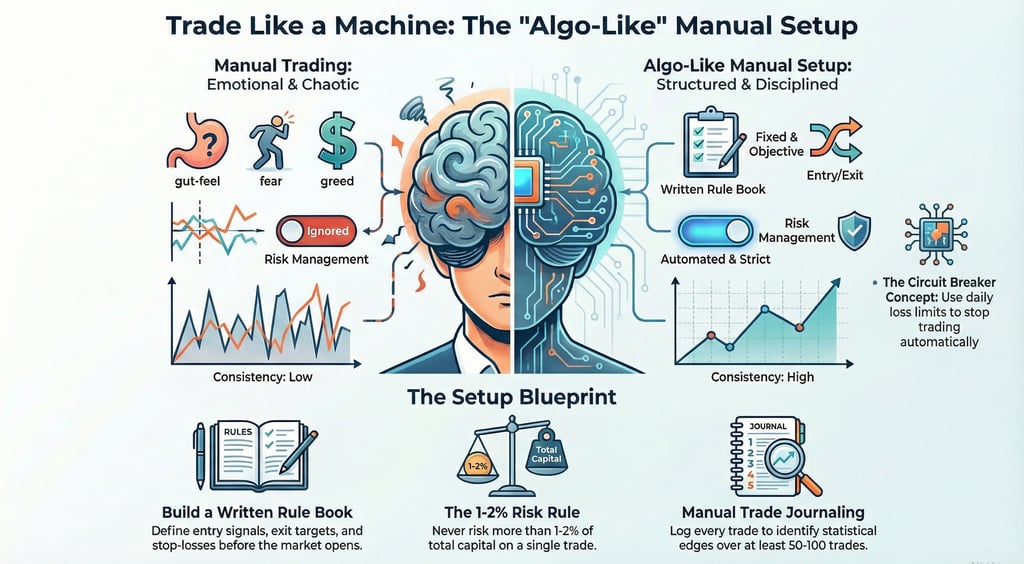
FactorAlgo TradingManual Trading (Most Traders)Entry RulesFixed, objectiveGut feel, inconsistentExit RulesPre-definedEmotion-drivenRisk ManagementAutomated, strictOften ignoredTrade JournalAuto-loggedRarely maintainedEmotionZeroVery highConsistencyHighLow
The algo trading benefits come not just from speed — but from removing human bias from the trading process entirely.
Manual traders who consistently lose money aren't losing because they lack intelligence. They're losing because they don't have a system. They trade on impulse, change their rules mid-trade, skip stop-losses, and revenge-trade after losses.
The solution? Build a manual trading setup that behaves like an algorithm.
Why Most Traders Lose Money
Before we build anything, let's be honest about why most retail traders in India are unprofitable.
No written trading plan — They decide entries and exits in the moment.
Emotional trading — Fear and greed override logic.
Poor risk management — They risk too much on a single trade.
No trade journal — They never analyze what went wrong.
Strategy hopping — They switch strategies after a few losses.
Overtrading — They feel compelled to be in the market constantly.
No edge — They trade patterns without statistically testing them.
The irony? A well-built algo trading platform does none of these things. It doesn't feel fear. It doesn't revenge trade. It follows its rules — every single time.
You don't need to code an algorithm. You need to think like one.
Introducing the Algo-Like Manual Trading Setup
Here's the core concept of this entire guide:
An algo-like manual trading setup is a structured, rule-based trading framework that a human trader executes manually — but with the same discipline, consistency, and objectivity as an algorithmic system.
Think of it as being your own trading robot. You write the code (your rules). You execute the code (your trades). You review the output (your journal).
This approach is what separates consistently profitable traders from the rest. Let's build it step by step.
Step-by-Step: Building Your Trading Setup at Home
Step 1: Hardware — Your Home Trading Setup
Your trading setup at home doesn't need to be expensive. It needs to be functional and distraction-free.
Minimum requirements:
A reliable desktop or laptop with at least 8GB RAM
A stable internet connection (primary + backup)
At least 2 monitors (one for charts, one for order management and news)
A UPS (Uninterruptible Power Supply) — critical for Indian traders facing power cuts during market hours
Nice to have:
A third monitor for watchlists or option chain data
A dedicated trading space where you won't be disturbed
A noise-cancelling headset if you attend trading rooms or webinars
Your physical home trading setup sets the foundation. A cluttered, noisy environment leads to impulsive decisions.
Step 2: Software — Your Algo Trading Platform Alternative
You don't need to buy an expensive algo trading software to trade systematically. What you need is:
A charting platform — Choose one with clean interface, multiple timeframe support, and the ability to draw levels and set alerts. Most modern platforms offer this.
An option chain tool — For options traders, this is non-negotiable.
An alert system — Set price alerts so you don't stare at the screen all day. Your alerts act like the "scanner" in an algo trading platform.
A spreadsheet (Google Sheets or Excel) — This is your manual trade journal and performance tracker.
Pro tip: Use your charting software's alert feature to notify you when price reaches a key level. Only then do you evaluate the setup using your rules. This mimics how an algo trading software "watches" the market without emotional bias.
Step 3: Build Your Rule Book — The Heart of Algo-Like Trading
This is where most traders skip steps and pay the price later.
Your rule book should answer these questions — before the market opens:
Entry Rules:
What pattern or signal triggers a trade? (e.g., breakout above resistance with volume confirmation)
What timeframe do you trade on?
What market conditions must exist? (trending vs. ranging)
What is your confirmation indicator, if any?
Exit Rules:
Where is your stop-loss? (Always pre-defined)
Where is your target? (Fixed R:R or trailing stop)
Do you have a time-based exit? (e.g., close all positions 30 minutes before market close)
Filter Rules:
What days do you NOT trade? (e.g., expiry days, major economic events)
What is your maximum number of trades per day?
What is your daily loss limit?
Write these down. Print them. Put them on your desk. These rules are your "code."
Step 4: Risk Management Framework (Inspired by Algo Trading)
One of the top algo trading benefits is ruthless, automated risk management. You need to replicate this manually.
The 1-2% Rule: Never risk more than 1-2% of your total trading capital on a single trade.
For example: If your capital is ₹2,00,000:
Maximum risk per trade = ₹2,000 to ₹4,000
Your position size is calculated from your stop-loss distance, not your conviction
Daily Loss Limit: If you lose 3-5% of your capital in a single day, stop trading. No exceptions. Algorithms have circuit breakers — you need one too.
Weekly Review: Every weekend, review your trades. Calculate your win rate, average R:R, and identify patterns in your losses.
This disciplined approach mirrors the risk management protocols built into every serious algo trading strategy.
Step 5: Trade Journaling — Your Performance Engine
An algo trading system logs every trade automatically. You must do this manually — and it's just as powerful.
Your journal should capture:
Date and time of entry/exit
Instrument traded
Setup type (e.g., breakout, reversal, trend continuation)
Entry price, stop-loss, and target
Actual exit price
Result (profit/loss in ₹ and R-multiples)
Notes: Did you follow your rules? If not, why?
After 50-100 trades, your journal becomes a goldmine. You'll see which setups work, which don't, and where your discipline breaks down.
Building Strategies: Intraday, Options, and Forex
Trading Strategy Intraday
A strong trading strategy intraday built on algo-like principles follows these components:
Define your session: Focus on the first 30-60 minutes (9:15 AM to 10:15 AM) and/or the 1:00 PM to 2:30 PM window when momentum often picks up.
Use a fixed setup: For example, breakouts of the first 15-minute candle high/low with volume filter.
Set hard rules: Entry only after confirmation, stop-loss below the signal candle, target of 1.5x to 2x risk.
The key is repetition. Trade the same setup, in the same conditions, day after day. This consistency is what creates an edge.
Trading Strategy Options
A structured trading strategy options approach requires extra layers of rules because options have time decay and implied volatility to contend with.
Choose a defined-risk strategy: Spreads (bull call spread, bear put spread) limit your maximum loss.
Define your IV environment: Are you buying options (low IV) or selling them (high IV)?
Set expiry rules: What DTE (days to expiry) do you trade? Avoid holding short options through unexpected events.
Theta awareness: If you're an option buyer, define when you'll exit even without hitting your stop — e.g., if the option loses 30% of its value with no movement.
Options trading without rules is like driving at night with no headlights. Structure saves your capital.
Trading Strategy in Forex
For traders interested in building a trading strategy in forex, the algo-like approach works especially well because forex markets run 24 hours — making emotional, un-structured trading even more dangerous.
Session-based trading: Define which session you trade (London, New York, or the overlap). Never trade every hour of the day.
Pair selection rules: Trade 2-3 pairs maximum. Know the behavior of each.
Economic calendar rule: Mark high-impact news events and avoid trading 15 minutes before and after.
Use higher timeframes for bias: Get your directional bias from the daily/4H chart. Enter on the 15M or 1H.
The discipline required for forex success is exactly why algorithmic systems dominate forex trading globally. Your manual rule book replicates this.
Common Mistakes to Avoid
Even with a structured setup, traders fall into predictable traps:
Writing rules but not following them — Your setup has zero value if you override it based on "feel."
Changing the strategy after 5 losing trades — Every strategy has drawdown periods. Evaluate over 50+ trades, not 5.
Skipping journaling — You can't improve what you don't measure.
Trading without a daily prep routine — Spend 20-30 minutes before market open reviewing key levels, news, and your watchlist.
Mistaking activity for profitability — Fewer, higher-quality trades beat constant trading every time.
Ignoring the psychology side — Your rules are only as good as your ability to follow them under pressure.
Is Algo Trading Profitable? What It Really Teaches Us
Traders often ask: is algo trading profitable?
The answer is: it can be — for the same reason a disciplined manual system can be. Profitability comes from having a statistically tested edge, applying it consistently, and managing risk strictly. Algo trading enforces this automatically. Manual trading requires you to enforce it yourself.
The good news? Human traders who adopt an algo-like mindset often outperform those chasing the next "hot strategy" — because they understand their edge deeply and trust their system.
Profitability in trading is not about prediction. It's about process.
Conclusion: You Don't Need Code — You Need a System
Building a trading setup like algo trading doesn't require programming skills, expensive software, or complex technology.
It requires:
A clear, written set of entry and exit rules
A disciplined risk management framework
A proper home trading setup that supports focused execution
A trade journal to measure and improve performance
The mental strength to follow your rules — especially when it's hard
The principles that make algo trading strategies effective are available to every manual trader. The only variable is whether you're willing to trade like a machine — with your own intelligent judgment guiding the rules.
Start small. Build your system. Test it. Refine it. Repeat.
Ready to Build Your Trading Setup the Right Way?
If you've read this far, you're serious about becoming a profitable trader — and that's the most important first step.
At Amuktha Trading, our mentors work with retail traders at every level — from those just starting to those who've been losing money for years and want to turn things around with structure and discipline.
Whether you want to understand how to design your first rule-based trading strategy, build a proper home trading setup, learn how to apply algo trading principles to your manual trading, or simply get honest, no-nonsense guidance from experienced market professionals — Amuktha Trading is here to help.
📩 Contact Amuktha Trading today and speak directly with a mentor who will guide you in building a trading system that fits your schedule, capital, and risk profile.
Because in trading, the right guidance at the right time can save you years of losses — and put you on the path to consistent, disciplined profitability.
Your trading transformation starts with one decision. Make it today.
Disclaimer:- Trading in securities markets carries substantial risk and is not suitable for everyone. Past performance is not indicative of future results. This article is for educational purposes only and should not be construed as investment advice. Please conduct your own research and consult a SEBI-registered financial advisor before making trading or investment decisions.
© 2026 Amuktha Trading. Telangana, India. Serving global traders since 2013.