
Why Do I Always Lose in Day Trading? The Truth No One Tells You
You wake up at 9:00 AM, open your trading terminal, and tell yourself: today will be different. You've read the charts, you've set your stop losses, you've promised yourself you won't overtrade. But by 3:30 PM, your account is down again. Not by a little. Enough to sting. Enough to make you question everything.
You sit there, staring at the screen, asking the same question you've asked a hundred times before: why do I keep losing in day trading?
You're not alone. And more importantly—you're not the problem. At least, not in the way you think.
The Indian stock market has opened its doors to millions of retail traders in the last few years. Discount brokers, easy access to leverage, YouTube gurus promising lakhs per month—it all looks so simple from the outside. But behind the glamour of screenshots and success stories lies a brutal truth: most day traders lose money. Not sometimes. Almost always.
If you've been bleeding capital in intraday trading, this article is for you. Not to shame you. Not to sell you another course. But to help you understand why you're losing, what's really going on beneath the surface, and how a shift in approach—and the right mentorship—can change everything.
Let's start from the beginning.
What Is Day Trading and How Does It Work in India?
Day trading, or intraday trading, is the practice of buying and selling stocks within the same trading session. You enter a position after 9:15 AM and exit it before 3:30 PM. No overnight risk. No delivery charges. Just you, the market, and a very short window to make a profit.
In India, intraday trading comes with a few unique features:
Leverage (margin): Brokers offer you 5x to 20x leverage depending on the stock. This means with ₹10,000, you can take positions worth ₹50,000 or more.
Square-off rules: If you don't close your position by 3:20 PM, your broker will automatically square it off.
High frequency: Many traders take multiple trades in a single day—sometimes 5, 10, even 20 trades.
No delivery intention: You're not buying to hold. You're speculating on small price movements.
It sounds attractive. Low capital requirement. High leverage. Quick results. But here's the catch: the very features that make day trading accessible are the same ones that destroy accounts.
Can You Lose Money in Day Trading? Absolutely. Here's How Much.
Let's address the elephant in the room: yes, you can lose money in day trading. In fact, statistically, you're more likely to lose than win.
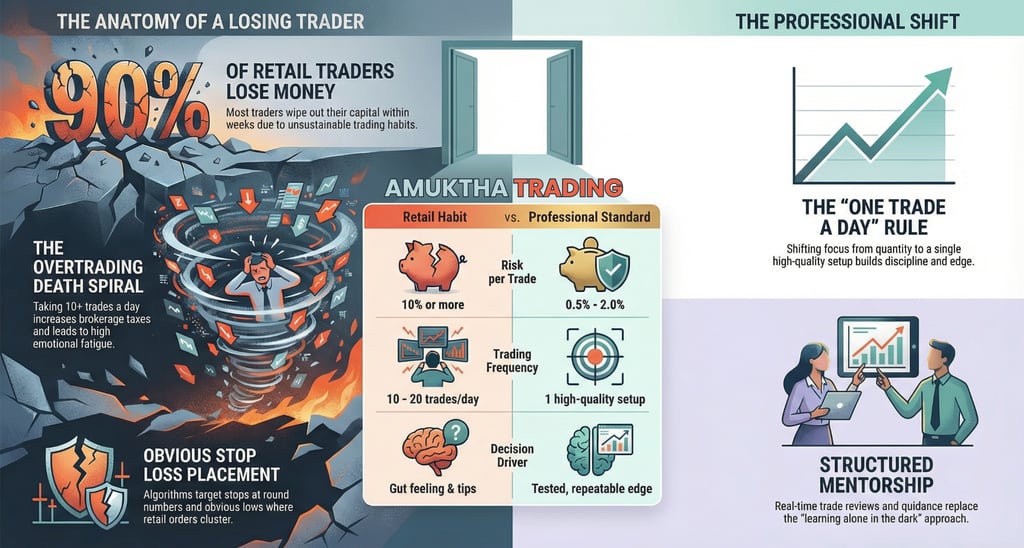
Studies and data from SEBI, global brokers, and independent research consistently show that 80% to 90% of day traders lose money over time. In India, this number is no different. Some traders wipe out their entire capital in weeks. Others bleed slowly over months, telling themselves they're "learning."
How often do day traders lose?
Not just sometimes. Most day traders lose on more than 50% of their trades. And even those who win more often than they lose still end up negative because their losses are bigger than their wins.
How much money do people lose day trading?
There's no official figure, but anecdotal and brokerage data suggest that the average losing trader in India loses anywhere from ₹50,000 to ₹5 lakhs before they either quit or change their approach. Some lose more. Some lose everything.
The question isn't can you lose. The question is: why do people lose money in day trading?
Why Am I Losing in Trading? The Real Reasons Behind Your Losses
If you're reading this, you've probably tried everything. You've watched videos, followed "experts," used indicators, set stop losses. And still, you lose. Let's break down the real reasons—not the surface-level ones.
1. You're Trading Without an Edge
An edge is a repeatable advantage that gives you a higher probability of winning over a large number of trades. Most traders don't have one. They trade based on gut feeling, tips, news, or patterns they think they understand but haven't tested.
Without an edge, you're gambling. And the house (market makers, algorithms, institutional players) always wins.
2. Your Risk Management Is Broken
You might be setting stop losses, but are you respecting them? Are they placed based on logic or fear? Most traders set stops too tight (so they get stopped out on normal volatility) or too wide (so when they're hit, the loss is devastating).
And here's the kicker: if you're risking 5% or 10% of your capital per trade, just a few bad trades will cripple your account. Professional traders risk 0.5% to 2%. Retail traders? Often 10% or more without realizing it.
3. Why Your Stop Loss Always Gets Hit
This is one of the most frustrating experiences in trading. You set a stop loss, the stock reverses, hits your stop, then moves in your original direction. It feels personal. It feels like the market is hunting you.
And sometimes, it is—but not in the way you think.
What's really happening:
You're placing stops at obvious levels (round numbers, recent lows) where everyone else is placing theirs. Market makers and algorithms know this.
You're entering trades too early without waiting for confirmation, so normal volatility takes you out.
You're not accounting for slippage and spread in illiquid stocks.
This isn't about conspiracy. It's about structure. If you don't understand how liquidity and order flow work, your stops will keep getting hit.
4. Overtrading: How Many Times Can You Day Trade in a Day?
Technically? As many times as you want. But should you? Absolutely not.
Most struggling traders take 10, 15, even 20 trades a day. They think more trades = more opportunities. But here's what really happens:
More trades = more brokerage and taxes
More trades = more emotional fatigue
More trades = lower quality setups
Overtrading isn't a strategy. It's a symptom of impatience, boredom, or trying to "recover" losses. And it's one of the fastest ways to blow up an account.
5. Trading Psychology: The Silent Killer
Let's talk about what really happens inside your head when you trade:
You take a loss and immediately want to recover it (revenge trading).
You take a win and get overconfident (trade too big on the next one).
You see others making money and feel FOMO (enter trades you don't understand).
You hold losing trades too long hoping they'll turn around.
You exit winning trades too early because you're afraid of giving back profits.
This is normal. This is human. But this is also why you lose.
Trading psychology isn't some soft skill you can ignore. It's the foundation. Without emotional discipline, even the best strategy will fail.
6. You're Learning Alone in the Dark
Here's the uncomfortable truth: you don't know what you don't know.
You watch YouTube videos. You read blogs. You try strategies. But without a trading mentor who can review your trades, correct your mistakes in real time, and guide you through the emotional ups and downs, you're learning the hard way—by losing money.
Most traders spend years (and lakhs of rupees) trying to figure it out on their own, when six months of structured mentorship could have saved them everything.
Why Do I Keep Losing in Day Trading? It's Not About Effort. It's About Structure.
You're disciplined. You show up every day. You follow your plan (most of the time). So why do you keep losing?
Because discipline without direction is just expensive persistence.
You need:
A tested, profitable strategy
A mentor who's been where you are
A system that limits emotional decision-making
A community of traders holding you accountable
And most importantly, you need to stop thinking that more trades = more money.
The Mindset Shift: 1 Trade a Day Can Change Your Life
What if, instead of taking 10 trades a day, you waited for one high-quality setup?
What if, instead of chasing the market, you let the market come to you?
This is the shift that separates consistent traders from those who are always losing in intraday trading.
One trade a day—done right—can change your life. Not because it'll make you rich overnight. But because it trains you to:
Wait for your edge
Execute with discipline
Manage risk properly
Detach emotionally from outcomes
This isn't about trading less because you're afraid. It's about trading better because you're intentional.
How Many Traders Lose Money in India? And Why Most Never Recover
SEBI studies and broker reports consistently show that 8 to 9 out of 10 retail traders lose money in the stock market. In day trading specifically, that number may be even higher.
Why?
Lack of education
Overconfidence from a few lucky wins
Emotional trading
No mentor or guide
Treating trading like gambling instead of a skill
The traders who survive and thrive aren't luckier. They're not smarter. They just had the right guidance at the right time.
What If You Could Stop Losing and Start Learning?
Imagine this:
You open your terminal in the morning. But this time, you're not anxious. You're not hoping. You know your edge. You know your setup. You wait. The market gives you a signal. You enter. You follow your rules. Whether you win or lose, you learn something. You review. You improve.
This isn't a fantasy. This is what structured learning and mentorship can do.
Amuktha Trading was built for traders like you—not the ones who've already figured it out, but the ones who are tired of losing and ready to learn the right way.
Why Amuktha Trading?
Here's what makes Amuktha Trading different:
Real mentorship, not pre-recorded videos. You get access to experienced traders who review your trades, answer your questions, and guide you through live market conditions.
Focus on risk management and psychology, not just technical analysis. Because strategy without discipline is useless.
Community of serious traders who are on the same journey, sharing insights and holding each other accountable.
No hype. No promises of quick riches. Just honest, structured learning that builds your skill over time.
If you're serious about stopping the cycle of loss and starting the process of growth, Amuktha Trading is where that journey begins.
Final Thoughts: It's Not Too Late
You've lost money. Maybe a lot. Maybe more than you want to admit. But that doesn't mean you're a bad trader. It means you've been learning in the hardest way possible—without a map.
The question isn't why do I always lose in day trading. The question is: what am I willing to do differently?
If you're ready to stop guessing, stop hoping, and start building real skill with the guidance of someone who's been there—then take the next step.
Visit Amuktha Trading and discover how the right mentor can turn your losses into lessons, and your lessons into consistency.
Because 1 trade a day, done right, can change your life. But only if you're learning from someone who knows the way.
Are you ready to stop losing and start learning?
Connect with Amuktha Trading today and take the first step toward becoming the trader you know you can be.
Disclaimer:- Trading in securities markets carries substantial risk and is not suitable for everyone. Past performance is not indicative of future results. This article is for educational purposes only and should not be construed as investment advice. Please conduct your own research and consult a SEBI-registered financial advisor before making trading or investment decisions.
© 2026 Amuktha Trading. Telangana, India. Serving global traders since 2013.