
What is Intraday Trading? A Complete Guide for Indian Traders (2026)
Last Updated: March 2026 | Reading Time: ~12 minutes
By Amuktha Trading Services | SEBI-Compliant Educational Content
Intraday trading is one of the most searched topics in India's growing retail investor community — and for good reason. With over 23 million NSE trading accounts opened as of July 2025, more Indians than ever are exploring the stock market as an active income source. But before you place your first trade, you need to understand exactly what intraday trading is, how it works in India's regulatory framework, and what separates consistently profitable traders from the 90% who lose money.
This guide covers everything — from the basics to advanced strategies, updated SEBI 2025 rules, tax implications, and how to choose the right setup to get started.
What is Intraday Trading? (Simple Definition)
Intraday trading, also called day trading, means buying and selling financial instruments — stocks, index futures, or options — within the same trading session. All positions must be closed before the market shuts at 3:30 PM IST. No trade is carried overnight.
The goal is to profit from short-term price movements within a single day, rather than holding stocks for weeks or years like a long-term investor would.
Example:
You buy 100 shares of Tata Steel at ₹150 at 9:30 AM. By 1:15 PM, the price rises to ₹155. You sell at ₹155. Your gross profit = ₹500 (before brokerage and taxes). That entire cycle — open and close — happened in one day. That's an intraday trade.
If you don't square off your position before 3:20 PM, your broker will automatically close it for you — often at an unfavourable price.
Intraday Trading vs. Delivery Trading — Key Differences
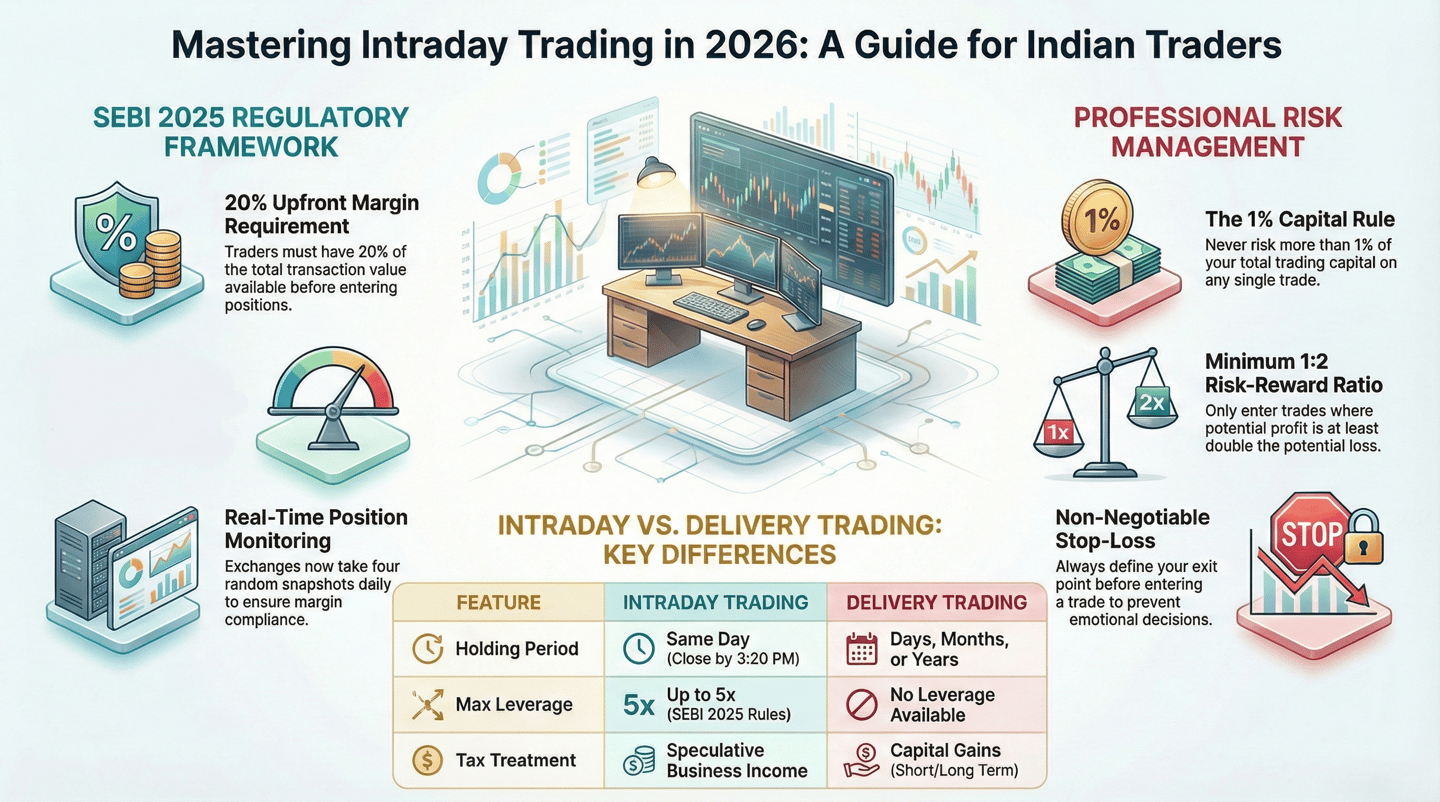
FeatureIntraday TradingDelivery TradingHolding periodSame day onlyDays, months, or yearsOvernight riskNoneYesLeverage availableYes (up to 5x, SEBI 2025)NoShares transferred to Demat?NoYesTax treatmentSpeculative business incomeShort/long-term capital gainsSuitable forActive, disciplined tradersInvestors with a longer horizon
How Intraday Trading Works in India (Step-by-Step)
Step 1 — Open a Trading + Demat Account You need both a trading account and a demat account with a SEBI-registered broker. Popular platforms include Zerodha, Groww, Upstox, and Angel One.
Step 2 — Fund Your Account Deposit sufficient capital. Under SEBI's 2025 peak margin rules, you must have the full margin amount available upfront before entering any trade — not just a token deposit.
Step 3 — Select Your Stocks Focus on stocks with high liquidity and volume — typically large-cap NSE stocks like Reliance, HDFC Bank, Infosys, or Nifty 50 index components. Low-volume stocks are dangerous for intraday because they're hard to exit quickly.
Step 4 — Analyse the Trade Use technical analysis — chart patterns, candlestick signals, indicators like RSI, MACD, or EMA crossovers — to identify a high-probability entry point.
Step 5 — Set Stop-Loss and Target Before Entering This is non-negotiable. Define your risk before you enter the trade. A typical risk-reward ratio should be at least 1:2 (risk ₹1 to potentially make ₹2).
Step 6 — Square Off Before 3:20 PM Close all positions before the market close. Brokers begin auto-squaring off at 3:20 PM on NSE and BSE.
SEBI's 2025 Intraday Trading Rules — What Every Trader Must Know
SEBI has significantly tightened intraday rules in 2025. Ignoring these can result in penalties, forced position closures, or margin shortfalls.
🔴 Minimum 20% Upfront Margin
SEBI now mandates a minimum 20% upfront margin of the total transaction value before entering any intraday position. If you want to trade ₹1,00,000 worth of stock, you need at least ₹20,000 in your account.
🔴 Maximum 5x Leverage
Brokers are no longer permitted to offer leverage beyond 5 times your available capital for intraday equity trades. Anything more is illegal under current SEBI norms.
🔴 Real-Time Position Monitoring
Stock exchanges now take at least four random intraday snapshots of open positions during every trading session. This is to catch traders who breach position limits during the day, not just at end-of-day.
🔴 T+1 Margin Collection
Effective April 28, 2025, all applicable margins must be collected by the T+1 settlement day (next working day), aligning with India's T+1 settlement cycle.
⚠️ Restrictions on Certain Stocks
Stocks under ESM (Enhanced Surveillance Measure) or T2T (Trade-to-Trade) categories cannot be used for intraday trading. Always verify before placing an intraday order.
5 Proven Intraday Trading Strategies
1. Breakout Trading
Identify stocks that are consolidating near a strong resistance level with rising volume. When the price breaks above resistance convincingly, enter the trade.
Entry signal: Price closes above resistance with volume 2x the 20-day average
Stop-loss: Just below the breakout level
Best tools: Chartink intraday scanner, volume indicators
2. EMA Crossover Strategy
One of the most reliable mechanical strategies for beginners.
Use EMA 9 and EMA 21 on a 5-minute or 15-minute chart
Buy signal: EMA 9 crosses above EMA 21
Sell signal: EMA 9 crosses below EMA 21
Works best in trending markets, not in sideways price action
3. Momentum / High Beta Trading
Trade stocks that are showing strong directional momentum early in the session (9:15–10:30 AM). High beta stocks on NSE tend to amplify market moves, creating fast profit opportunities — but also fast losses if momentum reverses.
4. Candlestick Pattern Trading
Master a handful of high-probability candlestick patterns:
Bullish Engulfing — strong reversal signal at support
Doji — indecision; often precedes a reversal
Hammer / Shooting Star — reversal at key levels
Inside Bar — breakout setup
Combine candlestick signals with support/resistance levels for higher accuracy.
5. News-Based Trading
Major announcements — RBI rate decisions, quarterly earnings, Union Budget updates, global cues — create sharp intraday moves. If you can act within seconds of a news release with a clear thesis, this strategy can be highly profitable. However, it requires very fast execution and a deep understanding of how the market typically reacts to each type of news.
Best Indicators for Intraday Trading
IndicatorWhat It MeasuresBest Used ForRSI (14)Momentum / overbought-oversoldSpotting reversalsMACDTrend direction and momentumTrend confirmationBollinger BandsVolatility and price rangeRange trading setupsEMA 9 / EMA 21Short-term trend directionEntry/exit signalsVWAPVolume-weighted average priceInstitutional level reference
Important: No indicator works 100% of the time. The best traders use 2–3 indicators together for confluence, not as standalone signals.
How to Select Stocks for Intraday Trading
Not every stock is suitable for intraday. Use these filters when screening:
✅ High liquidity — Minimum 10–15 lakh shares traded daily on NSE
✅ Large-cap or Nifty 50 stocks — Easier to enter and exit quickly
✅ Volatility in the 1–3% daily range — Enough movement to profit, not so wild you can't manage risk
✅ No T2T or ESM flag — These can't be squared off intraday
✅ Strong pre-market signals — Stocks with high pre-open interest often set up clean intraday trades
Reliable NSE stocks frequently used for intraday:
Reliance Industries
HDFC Bank
Infosys
Tata Steel
ICICI Bank
Adani Enterprises
Bajaj Finance
Intraday Trading Charges in India (2026)
Understanding your true cost per trade is crucial. Commissions eat into thin intraday margins faster than most beginners realise.
ChargeZerodhaGrowwBrokerage₹20 per order (flat)₹20 per order (flat)STT0.025% (buy + sell)0.025%Exchange transaction charges0.00345% (NSE)0.00345%GST18% on brokerage18% on brokerageSEBI turnover charge₹10 per crore₹10 per crore
Rule of thumb: On a ₹50,000 intraday trade, your all-in transaction cost is roughly ₹50–70 both ways. Your trade needs to move enough to clear this before you profit.
Intraday Trading Tax in India — What You Need to Know
This is one of the most overlooked topics by new traders.
Intraday profits are classified as "Speculative Business Income" under Section 43(5) of the Income Tax Act — not as capital gains.
Key tax rules:
Intraday profits are added to your total income and taxed at your applicable income tax slab rate
Intraday losses can only be set off against other speculative income — not against salary or capital gains
If your annual intraday turnover exceeds ₹2 crore, a tax audit is mandatory
Maintaining proper books of accounts is required if income exceeds ₹2.5 lakh
STT paid can be claimed as a business expense
Always consult a CA familiar with trader taxation. Incorrect filing can result in penalties.
Risk Management — The Skill That Separates Winners from Losers
A SEBI study found that 89–93% of individual F&O traders lose money. The primary reason is not a lack of strategy — it's poor risk management.
The Golden Rules of Intraday Risk Management
1. The 1% Rule Never risk more than 1–2% of your total trading capital on a single trade. If your capital is ₹2,00,000 — your maximum loss per trade should be ₹2,000–4,000.
2. Always Use Stop-Losses Set your stop-loss before entering the trade, not after. Emotional decisions mid-trade almost always lead to larger losses.
3. Risk-Reward Minimum 1:2 Only enter a trade if your potential profit is at least twice your potential loss. This means you can be right only 40% of the time and still be profitable overall.
4. Don't Average Down on Losing Positions Adding to a losing intraday position is one of the fastest ways to blow up your account. If your stop-loss is hit, exit — don't double up.
5. Fixed Daily Loss Limit Decide in advance: "If I lose ₹X today, I stop trading for the day." Stick to it without exception.
Trading Setup for Intraday — What You Need
You don't need an expensive setup to begin, but you do need reliable infrastructure.
Minimum requirements:
Fast, stable internet (fibre preferred — 25 Mbps minimum)
Laptop or desktop with a dedicated screen for charts
Reliable broker platform — Kite (Zerodha) and Dhan are popular for their speed and charting tools
TradingView or Chartink for advanced screening and charting
A distraction-free workspace during market hours (9:15 AM – 3:30 PM)
Nice to have for serious traders:
Dual monitors (one for charts, one for order book)
Backup internet (mobile hotspot)
A dedicated trading journal (even a spreadsheet works)
Common Intraday Trading Mistakes to Avoid
❌ Trading in the first 15 minutes — The market is extremely volatile right at 9:15 AM. Wait for the dust to settle.
❌ Trading without a stop-loss — Hope is not a strategy. Every trade needs a defined exit if it goes wrong.
❌ Overtrading — More trades = more brokerage + more emotional decisions. Focus on 2–3 high-quality setups per day.
❌ Revenge trading — Trying to recover a loss immediately with a bigger, impulsive trade. This is how small losses become large ones.
❌ Ignoring the broader market — If Nifty is falling sharply, most intraday long positions will struggle. Always trade with the trend.
❌ Using money you can't afford to lose — Intraday trading involves real risk of capital loss. Only trade with dedicated risk capital.
Is Intraday Trading Right for You?
Intraday trading is not for everyone. Ask yourself honestly:
QuestionIntraday May Suit You If...Time availabilityYou can watch the market from 9:15 AM – 3:30 PM dailyEmotional temperamentYou can take losses calmly without panicFinancial situationYou have dedicated risk capital (not emergency savings)Learning commitmentYou're willing to study charts, strategies, and review your tradesPatienceYou can wait for the right setup rather than trading out of boredom
If you answered "no" to most of these, positional trading or investing may be a better fit while you build your knowledge base.
Frequently Asked Questions (FAQ)
Is intraday trading profitable in India?
It can be — but statistically, the majority of retail intraday traders lose money, particularly in F&O. Profitability comes from consistent strategy application, strict risk management, and continuous learning. It takes most traders 1–2 years of dedicated practice before becoming consistently profitable.
What is the minimum capital needed for intraday trading in India?
Technically, you can start with as little as ₹5,000–10,000. However, with SEBI's 20% upfront margin requirement and the need to absorb some initial losses while learning, a more realistic starting capital is ₹50,000–₹1,00,000 to have meaningful flexibility.
What are the trading hours for intraday in India?
NSE and BSE equity intraday trading hours are 9:15 AM to 3:30 PM IST, Monday to Friday (excluding market holidays). Most brokers begin auto-squaring off open intraday positions at 3:20 PM.
What is the maximum leverage for intraday trading in 2026?
Under SEBI's 2025 rules, brokers cannot offer more than 5x leverage for intraday equity trades, with a minimum 20% upfront margin required.
Can I short-sell in intraday trading?
Yes. Intraday trading allows you to short-sell stocks — meaning you can sell first and buy back later in the same session to profit from falling prices. This is a key advantage over delivery trading.
How are intraday profits taxed?
Intraday gains are treated as speculative business income and taxed at your income tax slab rate — not as capital gains. Consult a tax advisor for proper filing.
Start Your Intraday Trading Journey with Amuktha
Learning to trade profitably is a skill — and like any skill, it's best learned with proper guidance rather than expensive trial-and-error in live markets.
At Amuktha Trading Services, we offer:
Structured intraday trading courses — from fundamentals to advanced strategies
Live market sessions with real trade walk-throughs on Nifty and individual stocks
Personalized mentorship — one-on-one guidance from experienced traders
Intraday stock screeners — find the day's best setups without spending hours on manual analysis
Trading psychology coaching — because mindset is as important as strategy
Whether you're just starting out or want to sharpen an existing strategy, we'll help you build a disciplined, process-driven approach to intraday trading.
Explore Our Courses → | Book a Free Consultation →
Disclaimer:- Trading in securities markets carries substantial risk and is not suitable for everyone. Past performance is not indicative of future results. This article is for educational purposes only and should not be construed as investment advice. Please conduct your own research and consult a SEBI-registered financial advisor before making trading or investment decisions.
© 2026 Amuktha Trading. Telangana, India. Serving global traders since 2013.