

Amuktha Trading Strategies 2026: Your Complete Roadmap to Financial Success in Global Stock Markets
Updated: April 2026 | Markets: NSE · BSE · NYSE · Nasdaq · LSE | Languages: English · हिंदी · മലയാളം
What Are Amuktha Trading Strategies? India's Most Trusted Trading System Explained
In 2026, global stock markets are faster, more algorithm-driven, and more interconnected than at any point in history. Retail traders who rely on tips, gut feeling, or outdated one-indicator methods are consistently outpaced by institutional players and smart money. Amuktha Trading Strategies exist to change that — permanently.
Developed through years of live market research across Indian exchanges (NSE and BSE) and global indices including NYSE, Nasdaq, and the London Stock Exchange, Amuktha is a fully structured trading ecosystem. It is not a tip service. It is not a single course. It is a complete, rules-based decision-making framework that gives every trader — beginner or experienced — a repeatable and sustainable edge in the markets.
Whether you are an intraday trader scalping Nifty 50 from Mumbai, a swing trader tracking Nasdaq from Kochi, a working professional in Bengaluru managing a part-time portfolio, or an NRI investor analysing Dow Jones from Toronto or Dubai — Amuktha Trading Strategies give you the tools, the discipline, and the psychological foundation to trade with genuine confidence.
The markets covered include Nifty 50, Nifty Bank, BSE Sensex, Dow Jones Industrial Average, Nasdaq 100, S&P 500, FTSE 100, Nikkei 225, ASX 200, DAX, CAC 40, and the TSX. If it trades on a regulated exchange anywhere in the world, the Amuktha framework applies to it.
The Four Pillars of Amuktha Trading Strategies
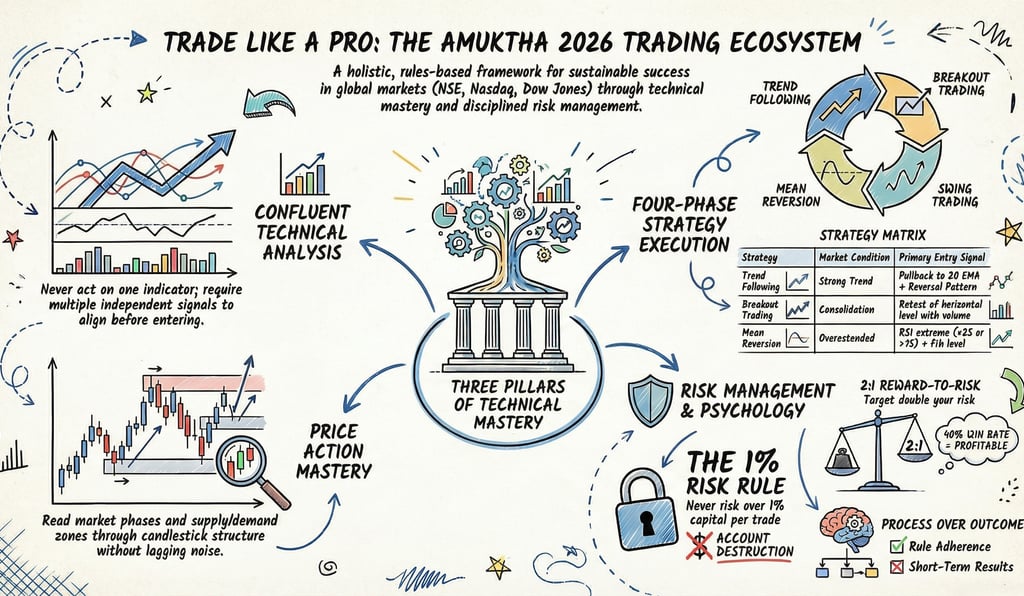
Every successful trading system rests on four interconnected pillars. Remove any one of them and the system collapses. Amuktha Trading Strategies are built on price action mastery, confluent technical analysis, strict risk management, and trading psychology — in equal measure.
Price action mastery means reading markets the way professionals do: through candlestick structure, market phases, supply and demand zones, and order flow. There is no lag, no noise, and no reliance on lagging indicators as the primary signal. Price tells you everything — if you know how to read it.
Confluent technical analysis means never acting on a single indicator in isolation. Amuktha strategies require multiple independently-derived signals to align before any trade is considered valid. When RSI, EMA, MACD, and a price action pattern all agree — that is a high-probability trade. When only one signals — that is noise.
Strict risk management means that capital preservation comes before profit generation. Every single trade has a defined risk amount, a defined stop-loss, and a defined minimum reward target before the trade is entered. This is non-negotiable in the Amuktha system.
Trading psychology means acknowledging that the greatest threat to a trader's account is not the market — it is the trader's own emotional response to the market. Fear, greed, FOMO, revenge trading, and overconfidence have destroyed more trading accounts than any bad strategy ever has. Amuktha directly addresses and systematically eliminates each of these psychological failure modes.
Mastering Technical Analysis for Nifty 50, Nasdaq and Global Markets in 2026
Technical analysis in 2026 is not the same as it was even five years ago. Algorithms have eroded many of the simplistic signals that once worked reliably. The traders who succeed today use indicators intelligently, contextually, and in combination — never in isolation. Here is how Amuktha Trading Strategies apply each core tool.
Moving Averages and EMAs — Reading Trend Direction
Moving averages smooth out price fluctuations and reveal the underlying trend direction. Amuktha uses the 20 EMA for short-term momentum on intraday timeframes, the 50 EMA for swing trade bias on daily charts, and the 200-day moving average for overall position trade direction. Crucially, an EMA crossover alone is never enough. Volume confirmation is always required. A golden cross (50 EMA crossing above 200 MA) accompanied by expanding volume and a higher-low structure in price gives a genuinely high-probability long signal on Nifty 50, Nasdaq, and Dow Jones.
RSI — Reading Momentum Without Being Misled
The Relative Strength Index is one of the most misused indicators in retail trading. Standard RSI thresholds — sell above 70, buy below 30 — generate enormous numbers of false signals in strongly trending markets. Amuktha recalibrates RSI interpretation based on market regime. In a ranging market, RSI below 30 is a reliable buy signal and RSI above 70 is a reliable sell signal. But in a strong uptrend, RSI routinely stays above 60 and readings above 70 represent trend continuation rather than reversal. The most powerful RSI signal of all is divergence — when price makes a new high but RSI makes a lower high, a reversal is likely imminent. This works consistently on Nifty Bank, S&P 500, and FTSE 100.
MACD — Confirming What Price Is Already Telling You
The Moving Average Convergence Divergence indicator is the backbone of Amuktha's trend-confirmation process. Rather than using MACD as a standalone entry trigger, it is used to confirm entries already identified through price action and RSI analysis. A bullish MACD crossover combined with RSI above 50 and a higher-low price structure creates a strong buy signal. A shrinking MACD histogram signals that the existing trend is losing momentum — a warning to tighten stops or reduce position size. MACD divergence from price, similar to RSI divergence, is one of the highest-probability reversal signals available to any trader on any timeframe or any market.
Fibonacci Retracement — Finding the Optimal Entry Zone
Fibonacci retracement levels identify high-probability entry zones within existing trends. The 38.2% level is the first retracement target in very strong trends and often acts as the entry point for aggressive trend traders. The 61.8% golden ratio level is the strongest and most reliable support and resistance zone and is the primary entry zone in Amuktha trend-following strategies. The 78.6% level is the last-chance zone — if price holds here within an uptrend, it is a powerful signal. When a Fibonacci level coincides with a key EMA, a volume node, or a prior price structure level, that cluster becomes a maximum-confidence entry zone. This is particularly effective on Nifty 50 daily charts and Nasdaq swing setups.
Volume Analysis — Understanding Who Is Moving the Market
Volume reveals institutional intent, and in 2026 this matters more than ever. High-volume breakouts confirm institutional participation. Low-volume rallies are weak and likely to fail. When On-Balance Volume (OBV) rises while price consolidates sideways, it signals accumulation — institutions are quietly buying before the next move up. Volume nodes from volume profile analysis identify key support and resistance zones that price respects far more reliably than arbitrary indicator levels. This approach is particularly powerful on BSE midcap stocks and Dow Jones blue-chip components.
Bollinger Bands and ATR — Volatility as an Edge
Volatility measurement is critical for both position sizing and stop-loss placement. Bollinger Bands identify squeeze setups — periods of extreme low volatility that precede explosive directional moves. When the bands contract to their tightest in months, a major breakout is building. The Average True Range (ATR) is used to dynamically size stop-losses and position sizes. A stop placed at 1.5 times ATR from entry respects the instrument's natural volatility, avoiding the common mistake of placing stops too tight and being stopped out by normal market noise. ATR-based position sizing is the cornerstone of the Amuktha capital preservation framework.
Four Core Trading Strategies for Every Market Condition
Markets cycle constantly through different phases — trending, ranging, breaking out, and reversing. Profitable traders have a specific, rules-based approach for each phase. Amuktha Trading Strategies provide exactly this: four distinct strategies that cover every market environment so you always know what to do regardless of market conditions.
Strategy One: Trend Following — Go With the Flow
The highest-probability trades in any market are in the direction of the dominant trend. The trend-following strategy identifies the trend direction early and enters on pullbacks rather than at breakouts, maximising reward potential while minimising entry risk. This strategy is the core of Amuktha's approach to Nifty 50 in uptrend phases, Nasdaq during bull runs, and Dow Jones recovery cycles.
The execution begins on the daily chart by identifying trend direction through the alignment of the 50 EMA and 200 MA — both sloping upward confirms a bullish trend. The trader then waits patiently for price to pull back to the 20 EMA during an uptrend, or rally back to the 20 EMA during a downtrend. Entry is confirmed only when a bullish or bearish reversal candlestick pattern forms at that zone, with RSI turning upward from the 40 to 50 range. The stop loss is placed below the most recent swing low, and the minimum profit target is twice the stop distance. As the trade progresses, the stop is trailed behind each new higher low, allowing the position to capture the full trend move.
Strategy Two: Breakout Trading — Catch the Move Before the Crowd
Breakouts from key consolidation zones generate the most powerful single-direction moves in any market. The challenge is that most breakouts visible to retail traders are false — price breaks out, traps buyers or sellers, then reverses sharply. The Amuktha breakout method uses volume and retest confirmation to eliminate the vast majority of false breakouts, filtering trades to only the highest-probability genuine breakout setups. This strategy is particularly powerful on Nifty Bank during weekly expiry weeks and on Nasdaq during sector rotation.
The setup requires identifying a clear horizontal resistance level with at least three prior price touches — more touches mean stronger validation. Volume is monitored as price approaches the level; expanding volume signals that institutional interest is growing. The most critical rule is that entry never happens on the initial breakout candle itself. Instead, the trader waits for price to pull back and retest the broken level from above. When that retest holds — confirmed by a bullish engulfing candle or pin bar on the 15-minute or hourly chart — entry is made at the close of that confirmation candle. Stop is placed below the retest candle low and the target is calculated using the measured move technique: the height of the prior consolidation range projected upward from the breakout level.
Strategy Three: Mean Reversion — Profit from Extremes
Markets that move too far, too fast have a persistent tendency to snap back toward their average. Mean reversion strategy exploits those snap-backs with precision timing and very tight risk parameters. This approach is particularly powerful for Nifty Bank intraday trades and for index options plays around major data releases such as RBI policy announcements, US CPI prints, and US Federal Reserve meeting outcomes.
Entry requires identifying extreme RSI readings — below 25 or above 75 — on the 15-minute or hourly timeframe. This extreme reading must coincide with price sitting at a major Fibonacci level of 61.8% or 78.6%, or at a known volume node. A reversal candlestick pattern — hammer, doji, or shooting star — then acts as the trigger for entry. The trade is entered counter to the recent move with a tight stop of one times ATR. The target is the mean: the 20 EMA on the same timeframe. The trade is exited at the mean or when RSI normalises back to 50, regardless of whether price has reached the EMA. This is not a trend-reversal strategy — it is a short-duration reversion play only.
Strategy Four: Swing Trading — Capture Multi-Day Moves
Swing trading is ideal for working professionals across India, the UK, Canada, and Australia who cannot watch live market screens during trading hours. By holding positions for two to ten trading days, swing trading captures the substantial middle section of a trend move while managing overnight risk through carefully placed stop-losses and position sizing. This strategy works equally well on Nifty 50 weekly charts, Nasdaq growth stocks, FTSE 100 components, and ASX 200 blue chips.
The setup begins with market structure analysis on the daily chart — confirming a consistent pattern of higher highs and higher lows for a bullish bias. The entry zone is planned in advance: typically a pullback to the 50 EMA or the 38.2% to 61.8% Fibonacci retracement of the prior impulse move. An alert is set at the entry zone, allowing the trader to check the 4-hour chart the following morning for a valid entry signal. Entry is made after opening price confirmation with stop below the relevant swing low. Once the trade gains one times the initial risk, the stop is moved to break-even, making the trade risk-free. The position is then held toward a three times risk reward target, trailed behind each new structure point as the swing unfolds.
Options Trading Strategies for NSE, Nifty Bank and Global Markets in 2026
Options trading in India has undergone a revolution. NSE became the world's largest derivatives exchange by volume, with Nifty Bank and Nifty 50 weekly expiries drawing massive retail and institutional participation. The opportunities are extraordinary — but so are the pitfalls for unprepared traders. Amuktha Trading Strategies bring six structured, probability-based options methods adapted specifically for Indian and global market conditions in 2026.
All options strategies taught within the Amuktha framework include defined risk parameters. Naked option selling without a clear hedge is never recommended. Capital preservation is non-negotiable.
The Covered Call strategy generates monthly income on stocks already held in your portfolio. By selling out-of-the-money call options against equity positions in Nifty 50 stocks with high open interest, traders collect premium in sideways or mildly bullish markets. Selling calls five to eight percent out of the money for a 30-day horizon typically generates one to three percent monthly income on the held portfolio. The position is exited if the underlying stock breaks its resistance level with volume confirmation.
The Iron Condor on Nifty Bank is Amuktha's signature weekly expiry strategy. It profits when the index stays within a defined range between Monday and Thursday's expiry. Statistically, Nifty Bank remains within a predictable range in approximately 65 to 70 percent of expiry weeks — this strategy is designed to capture that consistent behaviour. A call spread is sold above the market and a put spread is sold below simultaneously. Maximum profit equals the full premium collected. Maximum loss is defined in advance as the spread width minus the premium received. Specific adjustment rules are followed if price threatens either short strike during the week.
The Long Straddle and Long Strangle strategies profit from high volatility events. When major news is scheduled — RBI monetary policy decisions, Union Budget announcements, US Federal Reserve meetings, or major earnings releases — volatility spikes create massive directional moves. Buying both a call and a put before the event captures that move regardless of direction. The straddle uses at-the-money options on both sides; the strangle uses out-of-the-money options on both sides for lower cost. Both are best entered two to three days before the event and exited within 24 to 48 hours after, to capture the volatility expansion while avoiding the subsequent volatility crush.
The Bull Call Spread and Bear Put Spread strategies provide defined risk directional trading. When a directional view exists but capital efficiency and risk definition are priorities, vertical spreads are superior to naked option buying. The trader buys an in-the-money option and sells an out-of-the-money option of the same expiry. Maximum loss is limited to the net premium paid. Maximum gain is the spread width minus the net premium. These spreads require the underlying to move 40 to 60 percent of the way to the short strike to be profitable, making them ideal for high-conviction expiry week directional setups on Nifty and Nasdaq.
The Cash-Secured Put strategy is ideal for NRIs and long-term equity investors wanting to enter Indian or US stocks at lower prices while simultaneously collecting income. A put option is sold at a price where the investor would genuinely be happy to own the stock — typically at a major support level. Premium is collected immediately. If the stock falls to that level at expiry, shares are purchased at the desired entry price. If it does not fall, the premium is kept as income. This works effectively for high-quality NSE stocks such as Reliance, TCS, and Infosys, and for US blue chips including Apple and Microsoft.
The Calendar Spread strategy exploits the difference in time decay rates between near-term and far-term options. Near-month options lose their time value far faster than far-month options, particularly in the week before monthly expiry on NSE. Selling a near-month at-the-money option while simultaneously buying the same strike in the far month creates a low-cost, limited-risk position that profits purely from accelerated time decay in the near leg. This is an advanced strategy requiring understanding of implied volatility dynamics, but it offers an excellent risk-reward profile in low-directional-movement market environments.
Global Market Coverage — Trade Any Exchange With the Same System
One of Amuktha's fundamental strengths is market adaptability. The same technical and psychological principles that produce consistent results on Nifty 50 work identically on Dow Jones, Nasdaq, FTSE 100, and every other major regulated exchange globally. This makes the Amuktha framework uniquely valuable for Indian traders operating in multiple markets and for the growing NRI investor community worldwide.
Indian traders primarily access NSE's Nifty 50 and Nifty Bank from 9:15 AM to 3:30 PM IST. These remain the highest-volume and highest-volatility opportunity markets for intraday, options, and swing strategies. The BSE Sensex and BSE Midcap index provide additional opportunities particularly well suited to breakout and momentum strategies, with sector rotation between IT, Pharmaceuticals, Banking, and Infrastructure creating sustained trend moves.
NRI investors and traders based in the United States access Dow Jones and S&P 500 components from 9:30 AM to 4:00 PM Eastern Time. Federal Reserve policy cycles create reliable macro-driven trend setups that align perfectly with Amuktha's trend-following strategy. Nasdaq 100 technology stocks provide the high-beta momentum moves that make the breakout strategy extraordinarily powerful — particularly during earnings seasons for Apple, Nvidia, Microsoft, and Alphabet.
Traders in the United Kingdom access FTSE 100 from 8:00 AM to 4:30 PM GMT. The FTSE's historically range-bound behaviour in 2025 and 2026 makes it particularly suited to mean reversion and Iron Condor strategies. Australian traders on AEST timezone access ASX 200's resource and banking-heavy market with commodity correlation strategies, while also having convenient access to Asian session Nifty moves during Indian market hours. European traders access DAX and CAC 40 during Central European Time hours, with the same Amuktha framework applying consistently.
Risk Management — The Rules That Separate Profitable Traders from the Rest
In 2026, with algorithmic trading systems controlling over 70 percent of daily global market volume, your risk management is the only truly sustainable edge a retail trader possesses. Algorithms are faster, better-informed, and more disciplined than any human. What they cannot replicate is your ability to define, manage, and adapt risk on a trade-by-trade basis within a consistent framework. Here are the non-negotiable Amuktha Risk Rules.
The One Percent Rule means never risking more than one percent of total trading capital on any single trade. With a five lakh rupee trading account, this means a maximum risk of five thousand rupees per trade. With a fifty thousand dollar account, the maximum risk per trade is five hundred dollars. This single rule, applied consistently, makes account destruction mathematically almost impossible even through an extended losing streak.
The Two-to-One Minimum Risk-Reward Ratio means only entering trades where the potential reward is at least twice the defined risk. Risk five thousand rupees and only enter if the target is at minimum ten thousand rupees. This ratio means a trader can be wrong 40 percent of the time and still be profitable overall — an enormous psychological and practical advantage.
The Pre-Defined Stop Loss means every stop loss is identified and placed before the entry order is executed. Once placed, it is never moved against the trade direction under any circumstance. Dynamic stop placement uses ATR as the measuring tool — a stop at 1.5 times ATR below the entry for stock trades, and 0.5 percent below entry for Nifty 50 intraday positions.
The Daily Loss Limit means trading stops for the day if total losses exceed three percent of the account. For a five lakh account, this is fifteen thousand rupees. When this level is reached, the trading platform is closed and no further trades are placed that day regardless of how certain a setup appears. This rule eliminates revenge trading structurally rather than relying on willpower.
The ATR Position Sizing Method calculates position size based on the asset's current volatility rather than using fixed lot sizes. The formula is simple: Position Size equals Account Capital multiplied by one percent, divided by ATR multiplied by 1.5. This means smaller positions in high-volatility markets and larger positions in low-volatility markets — automatically aligning risk-taking with current market conditions.
The Break-Even Stop Rule states that once a trade reaches one times the initial risk in profit, the stop loss is moved to the entry price. The trade becomes completely risk-free while still having the potential to reach the full target. This one rule alone transforms the mathematics of a trading strategy by eliminating the possibility of a previously profitable trade becoming a loss.
Trading Psychology — Why 90% of Traders Fail and How Amuktha Fixes It
Studies across retail trading platforms globally consistently reveal the same uncomfortable truth: between 70 and 90 percent of retail traders lose money over any 12-month period. The reason is almost never a lack of strategy knowledge — it is psychological breakdown under live market pressure. The Amuktha Trading Psychology framework directly addresses the six root causes of retail trader failure.
Emotional discipline is the foundation. Fear and greed are the two most destructive forces in trading, and both operate below conscious awareness in most traders. Amuktha uses pre-trade checklists, post-trade journaling protocols, and structured daily review processes to keep emotional responses from contaminating execution decisions. Before any trade is placed, a seven-point checklist must be completed — if even one item fails, the trade is not taken.
Process over outcome is the core mental shift that separates improving traders from those who plateau permanently. Judging each trade by whether it made money creates randomness-driven feedback — the market's short-term outcome tells you nothing about whether you traded well or poorly. Judging instead by whether you followed your rules perfectly creates consistent, improvement-oriented feedback. A losing trade that followed every rule is a good trade. A winning trade that violated the rules is a dangerous trade.
FOMO elimination is addressed through the recognition that there are always more trades. The market generates new setups every single day across every single market. Missing a trade is always irrelevant in the long run. Amuktha trains traders to see a missed setup as a confirmation of their selectivity and patience — qualities that produce long-term profitability.
The Revenge Trading Protocol eliminates the most destructive single behaviour in retail trading. After any loss, the instinct to immediately re-enter the market to win back the money is overwhelming for most traders — and almost always leads to larger losses. The Daily Loss Limit rule eliminates this instinct structurally. When the limit is hit, trading stops. There is no decision to make, no willpower required. The rule makes the decision automatically.
Patience and selectivity are cultivated through the concept of A+ setups. Amuktha traders are trained to identify and take only the highest-quality setups — typically three to five per week across all markets combined. Trading every day for the sake of activity is discouraged. The best traders take fewer trades, not more — and those fewer trades are executed with far greater precision and confidence.
Trade journaling is the single most impactful habit distinguishing consistently improving traders from those who repeat the same mistakes indefinitely. Every Amuktha trader maintains a structured trade journal recording the setup identification, entry rationale, risk parameters, trade management decisions, and post-trade review. Patterns of success and failure become visible within weeks of consistent journaling, giving each trader a personalised feedback system no external teacher can replicate.
Frequently Asked Questions
What exactly are Amuktha Trading Strategies and who are they for?
Amuktha Trading Strategies are a complete, rules-based trading framework covering technical analysis, strategy execution, risk management, and trading psychology. They are designed for Indian retail traders, NRIs, and international traders of all experience levels — from complete beginners who have never placed a single trade, to experienced traders looking to systematise and substantially improve their existing approach.
Is this suitable for traders from Kerala, Tamil Nadu, and regional India?
Absolutely. Amuktha Trading Strategies are delivered in English, Hindi (हिंदी), and Malayalam (മലയാളം). Our content is specifically designed to be accessible to traders across all regions of India, with examples using Indian market contexts, Indian capital sizes in rupees, and trading scenarios directly relevant to NSE and BSE. Kerala has a particularly active and sophisticated trading community and we serve traders from Kochi, Thrissur, Thiruvananthapuram, Kozhikode, Kannur, and across the state.
How much capital do I need to start?
Our risk management framework is capital-agnostic — it works by percentage rather than fixed amounts. For Nifty Bank options strategies, one to two lakh rupees is a workable starting point. For swing trading equities on NSE or BSE, fifty thousand rupees is sufficient. For intraday Nifty futures, three to five lakh rupees is the recommended minimum. For US market swing trading on Nasdaq or S&P 500, five thousand to ten thousand US dollars is a practical starting point.
Do these strategies work for Nifty Bank weekly options expiry?
Yes — Nifty Bank weekly expiry is one of the core focus areas of the Amuktha framework. The Iron Condor, Long Straddle, and Strangle strategies are specifically calibrated for Nifty Bank's volatility profile and weekly expiry cycle. Specific strike selection criteria, entry timing guidance, adjustment rules, and exit protocols are provided for every expiry week scenario.
I am an NRI in the US, UK, or Australia. Can I apply these strategies to local markets?
Yes, and this is one of Amuktha's core strengths. The same technical analysis principles work identically across Nasdaq, S&P 500, FTSE 100, and ASX 200. As an NRI, you also retain the ability to trade Indian markets through NRE accounts with SEBI-registered brokers. Many Amuktha traders simultaneously trade both their country-of-residence markets and Indian markets using the identical framework.
How is Amuktha different from other trading courses available in India?
Most trading education in India teaches indicators in isolation without market context. Amuktha's key differentiators are: confluence-based signals requiring multiple confirmations before any trade is validated; equal emphasis on trading psychology as on technical skill; live market application across both Indian and global indices; strict risk management rules built into every strategy from the ground up; and multilingual delivery making advanced concepts genuinely accessible in Hindi and Malayalam rather than only in English.
Start Your Trading Journey with Amuktha in 2026
The stock market in 2026 rewards preparation, discipline, and systems — not prediction, luck, or tips. Amuktha Trading Strategies provide the complete framework for any trader, at any experience level, in any market, to build the skills and discipline required for long-term consistency.
Whether you are starting from zero in Kochi or Hyderabad, managing a portfolio from Dubai or Toronto, or trading Nasdaq from Sydney or London — the Amuktha system gives you a proven, structured, and psychologically grounded approach to one of the world's greatest financial opportunities.
Join thousands of traders across India, UAE, US, UK, Canada, and Australia who have transformed their trading using Amuktha Trading Strategies. Contact us today to know more details about 2026 Nifty Options and Global Market Strategies, access to our weekly market analysis.
Disclaimer:- Trading in securities markets carries substantial risk and is not suitable for everyone. Past performance is not indicative of future results. This article is for educational purposes only and should not be construed as investment advice. Please conduct your own research and consult a SEBI-registered financial advisor before making trading or investment decisions.
© 2026 Amuktha Trading. Telangana, India. Serving global traders since 2013.