

Amuktha Trading Tips — India's Most Trusted Trading Advisory for Nifty 50, Bank Nifty, Options & Global Markets (2026)
Why Traders Across India and the World Choose Amuktha Trading Tips in 2026
The Indian stock market in 2026 is no longer a game played in isolation. Every decision by the US Federal Reserve, every rally in the Nasdaq, and every correction in global commodity prices sends ripples through the Nifty 50 and Nifty Bank. Whether you are an intraday trader sitting in Mumbai, a swing trader in Kerala, an NRI investor tracking markets from Dubai, or a global trader monitoring Indian equities from London — success in today's markets demands more than gut feeling. It demands the right knowledge, real-time information, and a proven system.
That is exactly what Amuktha Trading Tips delivers.
Built on decades of deep market research, rigorous technical analysis, and real-world trading experience, Amuktha Trading Tips is India's trusted platform for accurate and actionable trading signals across Nifty 50, Nifty Bank, BSE Sensex, Futures and Options (F&O), and global indices including the Dow Jones Industrial Average, Nasdaq Composite, S&P 500, FTSE 100, and ASX 200.
Our insights are available in English, Hindi (हिन्दी), and Malayalam (മലയാളം) — making expert trading guidance accessible to traders across every state in India and to the Indian diaspora worldwide.
Understanding Indian and Global Markets in 2026 — Why It Matters for Every Trader
One of the most costly mistakes that beginner traders make is treating the Indian stock market as a standalone entity. The Nifty 50 does not move in a vacuum. In 2026, the interconnection between Indian indices and global financial markets is deeper than at any point in history. Foreign Institutional Investors (FIIs) and Domestic Institutional Investors (DIIs) react in real time to what happens in New York, London, and Shanghai — and retail traders who ignore these cues are always caught off guard.
When the US Federal Reserve raises interest rates, FIIs pull capital out of emerging markets like India, often triggering a 1 to 3 percent sell-off in Nifty 50 within days. When Nasdaq-listed technology giants report strong quarterly earnings, the positive sentiment flows directly into Indian IT stocks on the NSE. When crude oil prices spike globally, oil marketing companies on the BSE come under immediate pressure, and Nifty Bank faces liquidity concerns.
Amuktha Trading Tips monitors all these global triggers around the clock. Every morning, before the NSE opens at 9:15 AM IST, our analysts review the SGX Nifty / GIFT Nifty, overnight Dow Jones performance, Dollar Index (DXY) movements, and global commodity prices — translating this intelligence into clear, actionable guidance for Indian traders.
Beyond global cues, serious Indian traders in 2026 must also track the Reserve Bank of India's Monetary Policy Committee decisions, as repo rate changes have direct and immediate effects on Nifty Bank. Union Budget announcements each February create significant sector rotation opportunities. SEBI regulations on Futures and Options margins affect how options traders manage their capital. Quarterly earnings seasons across April, July, October, and January create the biggest intraday volatility windows of each year. And India VIX — the fear gauge of the Indian market — remains the single most important number for options traders to watch every single morning.
Intraday Trading Tips for Nifty 50 and Bank Nifty — Amuktha's 2026 Framework
Intraday trading is the most widely practised form of stock market participation in India. It involves opening and closing positions within a single trading session — 9:15 AM to 3:30 PM IST — and offers the twin benefits of high leverage and zero overnight risk. But it also demands speed, discipline, and a structured approach that most retail traders never develop on their own.
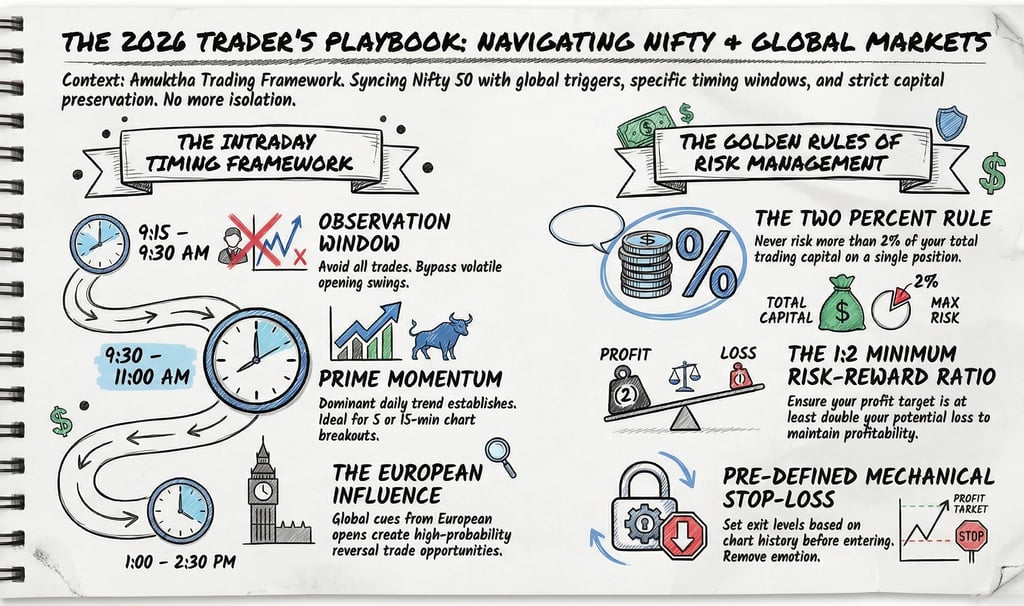
At Amuktha Trading Tips, our intraday framework for Nifty 50 and Bank Nifty is built around time-based trading windows that align with institutional activity patterns. The first fifteen minutes after market open — from 9:15 AM to 9:30 AM — is purely an observation window. No trade should ever be entered in this period. Wild opening swings driven by gap-up or gap-down openings often reverse sharply, and amateur traders who chase the opening move consistently lose capital.
The first real trading window opens at 9:30 AM and runs until 11:00 AM. This is where the day's dominant trend typically establishes itself, and momentum trades based on 5-minute or 15-minute chart breakouts offer the best risk-to-reward setups. Between 11:00 AM and 1:00 PM, markets often enter a consolidation phase — position sizes should be reduced, and traders should wait for clear trend confirmation before adding new positions.
The second trading window, between 1:00 PM and 2:30 PM, is influenced by the European market opening and often delivers excellent reversal trade opportunities. After 2:30 PM, volatility picks up as institutional players begin squaring off positions ahead of the close — only experienced traders should operate in this window. By 3:15 PM, all intraday positions must be closed. Carrying an intraday position overnight without a deliberate positional strategy is not a plan — it is a gamble.
For indicator-based analysis, Amuktha recommends using the Volume Weighted Average Price (VWAP) to identify institutional buy and sell zones, the Supertrend indicator set at 7 and 3 to track intraday trend direction, RSI at 14 periods to identify overbought and oversold conditions, and a 9-period and 21-period EMA crossover to confirm short-term momentum shifts. Open Interest data on Nifty and Bank Nifty options is the single most underused tool by retail traders — it reveals exactly where the big players are positioning, and forms the backbone of our daily trading alerts.
Bank Nifty Options Trading Tips — The Expert Playbook for 2026
Bank Nifty options are the most actively traded derivatives in India by volume. With weekly expiries every Wednesday and monthly expiries on the last Thursday of each month, Bank Nifty options offer high-frequency, high-leverage trading opportunities. But the very features that make them attractive — large point moves, high premiums, and rapid time decay — also make them dangerous for traders who approach them without a structured strategy.
Amuktha's options trading advisory focuses exclusively on high-probability setups with clearly defined risk parameters. We never recommend buying naked options on a directional hunch. Every options trade we suggest comes with a complete strategy, including the specific strike price, the expiry date, the entry zone, the stop-loss level based on premium value, and a defined profit target.
For traders new to options, the Bull Call Spread is the ideal starting strategy in bullish market conditions. You buy an At-the-Money Call option and simultaneously sell an Out-of-the-Money Call option on the same expiry — this limits your maximum risk to the net premium paid while still allowing meaningful upside participation. The Bear Put Spread works identically in the opposite direction for bearish setups. When Bank Nifty is trading in a sideways range — as it frequently does in the weeks between major events — the Iron Condor is our preferred strategy, combining a short call spread and a short put spread to profit from time decay on both sides.
One of the most important concepts that separates profitable options traders from losing ones is Implied Volatility, commonly referred to as IV. Implied Volatility determines whether options premiums are expensive or cheap at any given moment. The golden rule is simple: buy options when IV is low, and sell options through spreads when IV is high. India VIX serves as the best proxy for Nifty and Bank Nifty IV levels. When India VIX drops below 13, options are cheap and buying makes mathematical sense. When VIX spikes above 20, options are expensive and selling strategies through Iron Condors or Strangles become statistically more favourable.
Swing Trading Tips — Capturing 3 to 15 Day Moves in Nifty Stocks
Swing trading is the strategy of choice for working professionals, NRI traders, and global investors who cannot monitor the market during trading hours but still want to participate meaningfully in market movements. A swing trade typically stays open for three days to three weeks, riding a clearly identified medium-term momentum wave in an individual stock or index.
Amuktha's swing trading tips focus on stocks listed in the Nifty 50, Nifty Midcap 100, and Nifty Smallcap 250, selected through a rigorous multi-factor screening process. For a stock to qualify as a swing trade candidate, it must be trading above both its 50-day and 200-day Exponential Moving Averages, confirming a primary uptrend. The RSI on the weekly chart should fall between 40 and 60, indicating that momentum is building but the stock is not yet overbought. Volume on the breakout day must exceed the 20-day average volume by at least 50 percent — this confirms that institutional money is participating in the move, not just retail speculation.
We also screen for sector tailwinds. A technically strong chart in a sector facing regulatory headwinds or falling government spending rarely delivers the expected breakout. When technical analysis and sector momentum align simultaneously, the probability of a successful trade increases significantly. Our swing trade alerts come with all of this context — not just a "buy this stock" message, but a full explanation of the setup so that traders learn the reasoning behind every recommendation.
Long-Term Investment Tips — India's Growth Story in 2026
India is the world's fastest-growing major economy in 2026, with GDP growth projected between 6.5 and 7 percent for the financial year 2026-27. Corporate earnings growth is tracking at 12 to 15 percent year-on-year. GST collections continue to set monthly records. The government's infrastructure spending under the PM Gati Shakti programme and the National Infrastructure Pipeline is unlocking new sectors for long-term investors. India is firmly on track to become the world's third-largest economy by 2030 — making it one of the most compelling long-term investment destinations in the world.
Amuktha Trading Tips also serves investors who are not looking for short-term trades but for wealth creation over one to five years. Our monthly investment picks focus on sectors that are directly aligned with India's structural growth themes. Renewable energy is one of the most important of these themes, as India pushes towards its target of 500 gigawatts of renewable power capacity by 2030. The defence and aerospace sector is benefiting from record government capital expenditure and a deliberate push to reduce defence imports under the Make in India initiative. Indian IT and AI services companies continue to benefit from global technology adoption, with artificial intelligence creating significant new revenue streams for the top tier of the sector.
Banking and financial services remain the backbone of the Nifty 50 and offer some of the most reliable long-term compounding opportunities, particularly as financial inclusion deepens across Tier 2 and Tier 3 Indian cities. Healthcare and pharmaceutical companies continue to grow their global generics business, particularly in regulated markets like the USA and Europe. For NRI investors in the UK, USA, Canada, and Australia, Indian equities accessed through NRE or NRO accounts or through GIFT City routes represent both a currency diversification play and a participation in one of the strongest structural growth stories in global markets.
Global Market Trading — Dow Jones, Nasdaq, S&P 500, FTSE 100, and ASX 200 Insights
Amuktha Trading Tips goes beyond Indian markets to serve NRI traders and global investors who also hold positions in international equity markets. Our weekly global market commentary covers the key themes driving the Dow Jones Industrial Average, the Nasdaq Composite, the S&P 500, the UK's FTSE 100, Germany's DAX, and Australia's ASX 200 — and more importantly, explains how developments in these markets create opportunities and risks in Indian equities.
When the Nifty 50 holds firm despite significant weakness in US markets overnight, it signals a rare episode of Indian market decoupling — a bullish indicator for Indian ADRs listed on the NYSE and for India-focused ETFs traded in the USA. When the US 10-year Treasury yield rises above 4.5 percent, the risk-off trade typically accelerates globally, and traders in all markets should reduce equity exposure and move toward defensive positions. When the US Dollar Index climbs above 104, the Indian Rupee weakens, which creates pressure on import-dependent sectors in India while simultaneously benefiting export-oriented sectors such as IT services, pharmaceuticals, and certain textile manufacturers.
For traders based in the USA, UK, Canada, and Australia, our analysis translates Indian market signals into actionable context for their own portfolios — making Amuktha uniquely positioned as a cross-market advisory rather than just an India-focused tip service.
Risk Management — The One Skill That Separates Profitable Traders from the Rest
No trading strategy on earth, no matter how well researched and backtested, wins every time. What consistently separates profitable traders from losing traders is not their ability to pick winners — it is their ability to control losses and preserve capital. Without strong risk management, even the best trading system in the world will eventually wipe out an account.
Amuktha's risk management framework begins with the Two Percent Rule: never risk more than two percent of your total trading capital on any single trade. For a trader with ten lakh rupees in their account, this means the maximum acceptable loss on any single position is twenty thousand rupees. This single rule prevents the catastrophic drawdowns that end most trading careers.
Every trade — without exception — must have a pre-defined stop-loss set before the position is entered. A stop-loss set after entry is an emotional decision made under pressure, and it will almost always be set too wide or abandoned entirely when the trade goes against you. The stop-loss must be a mechanical level derived from the chart — below the previous swing low for long positions, above the previous swing high for short positions.
The minimum acceptable Risk to Reward ratio for any trade is one to two. This means for every one rupee you are risking, your profit target must be at least two rupees. With this ratio, you can be wrong on 40 percent of your trades and still be profitable overall — because your winners earn twice what your losers cost. Many of Amuktha's best swing trade setups target Risk to Reward ratios of one to three or higher.
After two consecutive losing trades in a single day, stop trading completely and review your setups the following morning with fresh eyes. Revenge trading — the compulsive need to immediately recover a loss — is the single most destructive behaviour pattern in retail trading. It transforms a small, manageable loss into a catastrophic account drawdown. Capital preservation is not a consolation prize for traders who cannot make money. It is the foundation on which long-term profitability is built.
Nifty 50 and Bank Nifty Market Outlook for 2026
The Nifty 50 enters 2026 with strong domestic fundamentals supporting its medium-term uptrend. India's GDP growth of 6.5 to 7 percent, sustained corporate earnings expansion, robust GST collections, and a steady flow of domestic institutional investment through Systematic Investment Plans (SIPs) all create a favourable backdrop for equities. The 21,500 to 22,000 zone represents the strongest structural support for Nifty 50 in 2026 — a zone where long-term investors have shown consistent buying interest. Immediate support lies between 22,800 and 23,200, with the current broad trading range between 23,500 and 25,500. The bull case target for 2026, assuming continued earnings growth and stable global conditions, points toward the 27,000 to 28,500 zone.
Bank Nifty enters 2026 with credit growth sustained above 12 percent, Non-Performing Asset (NPA) ratios at decade lows, and the RBI maintaining a calibrated liquidity posture. The 46,000 to 47,500 zone represents major structural support. The accumulation zone for medium-term investors lies between 47,500 and 49,000. The current trading range spans 49,000 to 53,000, with a bull case target of 54,000 to 57,000 — and a stretch target above 58,000 if the RBI delivers meaningful rate cuts in the second half of 2026.
For global markets, US equities face a moderated growth environment as the Federal Reserve holds rates at elevated levels. Nasdaq-listed technology and AI-focused companies remain the primary drivers of S&P 500 performance. The FTSE 100 in the UK appears relatively undervalued by global standards and is benefiting from the energy transition and defence spending themes. In Australia, the ASX 200 continues to be driven largely by commodity prices, particularly iron ore, which directly links Australian equity market performance to Chinese demand trends.
Who Amuktha Trading Tips Serves — India, NRI, and Global Traders
Amuktha Trading Tips is built to serve a diverse audience that spans the full spectrum of trading experience and geographic location. Intraday traders across India receive pre-market alerts every morning before 9:00 AM IST, complete with specific entry zones, stop-loss levels, and targets for Nifty 50 and Bank Nifty. Swing traders receive a weekly watchlist every Sunday evening, with detailed chart analysis, catalyst identification, and a clear trade management plan for the week ahead. Options traders receive dedicated F&O strategy ideas before every weekly and monthly expiry, including full strategy breakdowns with strike selections, premium cost estimates, and maximum risk calculations.
Long-term investors receive a monthly portfolio pick report covering fundamentally strong stocks in high-growth sectors, complete with a valuation thesis and a suggested entry range. NRI traders in the USA, UK, UAE, Canada, and Australia receive time-zone-friendly reports and alerts that allow them to stay on top of Indian market movements without disrupting their work schedules abroad. And beginner traders receive a structured learning pathway that combines basic market education with low-risk, clearly explained trade setups — so they build knowledge and confidence simultaneously rather than learning exclusively from costly mistakes.
All alerts and content are available in English, Hindi (हिन्दी), and Malayalam (മലയാളം).
Our Commitment to Transparency and SEBI-Aligned Practices
In an industry where false promises and unverifiable "sure-shot" tips are disturbingly common, Amuktha Trading Tips takes a deliberately different approach. We never make guarantees about trading returns. We never promise that any single tip will be profitable. Anyone who does is misleading you — because no individual or system can predict market outcomes with certainty.
Our recommendations are structured to align with SEBI's Research Analyst regulatory framework. We maintain transparent performance logs that document both winning and losing trades, because we believe that learning from losses is as important to your long-term trading success as celebrating wins. Our community of over 10,000 traders across India, the USA, UK, UAE, and Australia is built on genuine shared experience — not manufactured testimonials.
Every trading tip we send comes with the reasoning behind it. We tell you why we are recommending a trade, what conditions would invalidate the setup, and how to manage the position if markets move against you. This educational approach is what transforms a trading advisory client into a self-sufficient, consistently profitable trader over time.
Frequently Asked Questions
Is Amuktha Trading Tips suitable for complete beginners?
Yes. We have a dedicated beginner learning track that starts with stock market fundamentals and gradually introduces live trading setups with small position sizes and clearly defined risk parameters.
Do you provide tips for Bank Nifty weekly options and Nifty monthly expiry?
Yes. Bank Nifty weekly options — expiring every Wednesday — and Nifty monthly options are core parts of our F&O trading alerts. Every Monday morning we send a pre-expiry strategy note with specific strike price recommendations.
I am an NRI living in the USA, UK, or UAE. Can I use your service?
Absolutely. Our service is fully accessible to NRI traders globally. Many members trade Indian markets through NRE or NRO accounts, and we include relevant timing context for traders in US Eastern Time, UK GMT, and UAE Gulf Standard Time.
How are tips delivered?
Tips and alerts are delivered via WhatsApp, Telegram, and Email. We also publish weekly PDF analysis reports and a monthly performance review document. Our Telegram channel includes live market commentary during NSE trading hours.
What is your track record?
Our historical accuracy on swing trade setups averages between 65 and 70 percent, with intraday setups averaging 60 to 65 percent. These figures are maintained transparently — including months with below-average performance. With a consistent Risk to Reward ratio of one to two or better, a 60 percent accuracy rate still produces a profitable overall outcome.
Do you cover global markets like Nasdaq, S&P 500, or FTSE 100?
Yes. We provide weekly global market commentary covering all major indices and their implications for Indian equities — essential context for traders who also hold international positions.
Is your content available in Hindi and Malayalam?
Yes. All trading insights, educational content, and trade alerts are available in English, Hindi (हिन्दी), and Malayalam (മലയാളം).
Start Your Trading Journey with Amuktha — 2026
The stock market rewards the prepared and punishes the impulsive. In 2026, the difference between consistent profitability and constant frustration is not luck or inside information — it is knowledge, discipline, and access to the right guidance system. Amuktha Trading Tips provides all three.
Whether you are an intraday trader seeking daily Nifty 50 and Bank Nifty signals, an NRI investor wanting to capitalise on India's structural growth story, an options trader looking for Bank Nifty weekly expiry strategies, or a global investor seeking cross-market intelligence — Amuktha is your trusted partner in every market condition.
Contact us today via WhatsApp or Email to choose your service plan and receive your first trade alert within 24 hours of joining.
Serving traders across India, USA, UK, Canada, Australia, UAE, Europe, and globally. Available in English, Hindi (हिन्दी), and Malayalam (മലയാളം).
Disclaimer:- Trading in securities markets carries substantial risk and is not suitable for everyone. Past performance is not indicative of future results. This article is for educational purposes only and should not be construed as investment advice. Please conduct your own research and consult a SEBI-registered financial advisor before making trading or investment decisions.
© 2026 Amuktha Trading. Telangana, India. Serving global traders since 2013.