
How to Make Money from Intraday Trading in 2026: The Complete Guide for Indian & Global Traders
By Amuktha Trading Academy | Published: 2026 | For traders in India, US, UK, Canada, Australia & Worldwide
📌 What You Will Learn in This Guide
What intraday trading is and how it works in 2026 · How to select the right stocks on NSE, BSE, NYSE and more · Proven entry and exit strategies with real examples · Risk management rules every trader must follow · Best indicators and chart setups · Common mistakes beginners make and how to avoid them · How Amuktha's courses help you trade profitably
Why Intraday Trading Is More Relevant Than Ever in 2026
Intraday trading — buying and selling stocks within the same trading day — has exploded in popularity across India and globally. With retail participation on NSE (National Stock Exchange) reaching record highs, algorithmic tools becoming more accessible, and smartphone trading apps putting real-time markets in everyone's hands, 2026 is one of the most opportunity-rich environments for disciplined traders.
But here is the hard truth: most beginners lose money in intraday trading — not because the market is rigged, but because they trade without a plan, ignore risk management, and chase tips. This guide is designed to change that. Whether you are a beginner in Mumbai or a part-time trader in Toronto, by the end of this article you will understand exactly how to approach intraday trading with clarity, strategy, and discipline.
What Is Intraday Trading?
Intraday trading, also called day trading, refers to the practice of opening and closing all trade positions within a single trading session — meaning you start the day with no open positions and end the day with none. The objective is to profit from short-term price movements in stocks, indices, or derivatives.
In India, NSE and BSE trading hours are 9:15 AM to 3:30 PM IST. Intraday positions that are not squared off before 3:20 PM are typically auto-squared by your broker. In the US, the NYSE and NASDAQ operate from 9:30 AM to 4:00 PM EST. Understanding the session window of your target market is step one.
Unlike swing trading — where positions are held for several days or weeks — intraday trading demands quick decisions and precise execution. Unlike long-term investing, there is no waiting for a company to grow. You are simply profiting from short-term price movement within a single session.
Why Traders Choose Intraday Trading in 2026
Intraday trading has a unique set of advantages that attract traders from Mumbai to Melbourne:
No overnight risk — all positions are closed before market close, so you are never exposed to gap-down openings caused by overnight global news.
Leverage — Indian brokers offer up to 5x intraday margin; US brokers offer 4:1 for Pattern Day Traders, allowing you to control larger positions with less capital.
Profit in any market direction — through short selling, you can profit when stocks fall, not just when they rise.
High liquidity — stocks like Reliance, TCS, Infosys on NSE, and Apple, Tesla on NASDAQ move with predictable liquidity and tight spreads.
Immediate feedback — unlike long-term investing where results take years, with intraday trading you know your result every single day.
How to Select the Right Stocks for Intraday Trading
Stock selection is where most beginners go wrong. Picking the wrong stock is like driving a car with flat tyres — even perfect execution will not save you. Here are the key criteria:
1. High Liquidity
Choose stocks with daily volume above 1 million shares. In India, focus on NSE F&O (Futures & Options) stocks — they are the most liquid. In the US, focus on S&P 500 components. High liquidity means you can enter and exit quickly without significantly moving the price.
2. Adequate Volatility
A stock that barely moves will not give you profit opportunities. Look for stocks with an Average True Range (ATR) of at least 1–3% per day. Too much volatility (10%+) can also be dangerous for beginners.
3. Clear Trend
Stocks that are in a clear uptrend or downtrend are far easier to trade than sideways, choppy stocks. Before entering, ask yourself: is this stock clearly going somewhere today?
4. News Catalyst
Earnings reports, RBI policy decisions, budget announcements, sector news, or global macro events create temporary volatility that skilled traders can exploit. A strong news catalyst is often the difference between a mediocre trading day and an exceptional one.
5. Avoid Illiquid Small-Caps
Wide bid-ask spreads on small-cap stocks eat directly into your profits. They can also trap you in positions you simply cannot exit at a reasonable price — especially if the market moves against you.
💡 Pro Tip for Indian Traders
NSE Nifty 50 stocks and Nifty Bank stocks are among the best for intraday trading due to their high liquidity and tight spreads. Nifty Futures and Bank Nifty Futures are also extremely popular for intraday trades because they offer excellent leverage and near-instant execution.
6 Proven Intraday Trading Strategies That Work in 2026
1. The Opening Range Breakout (ORB) Strategy
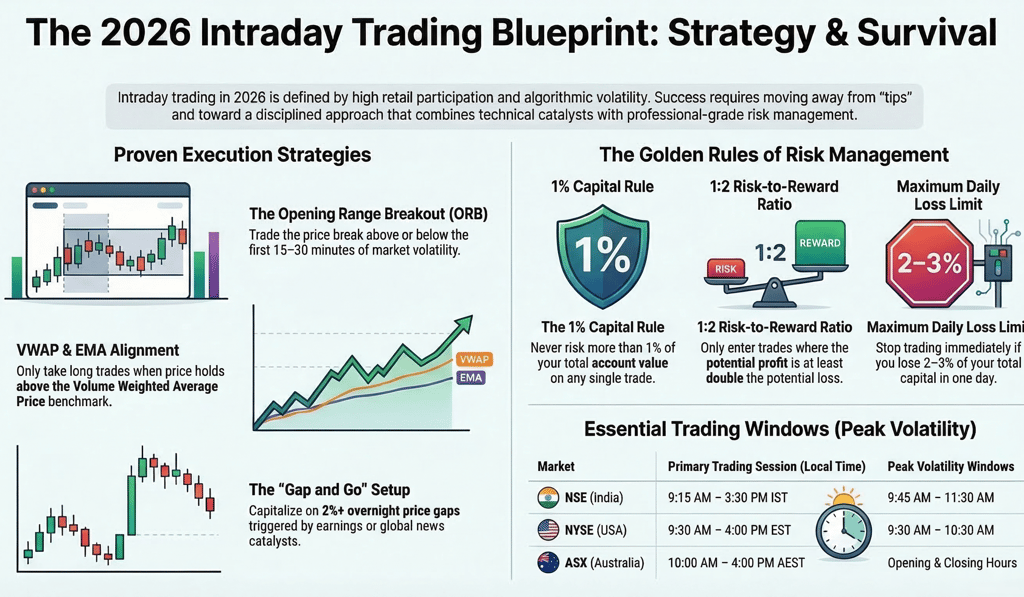
This is one of the most popular and beginner-friendly intraday strategies worldwide. Here is how it works: wait for the first 15–30 minutes of the market open (9:15–9:45 AM IST or 9:30–10:00 AM EST) and identify the high and low of that opening range. Buy when price breaks above the opening range high with strong volume, and short sell when price breaks below the opening range low. Place your stop-loss just inside the broken level and target at least 1.5x to 2x your risk as profit.
Example — Nifty 50 India
Opening range (9:15–9:45 AM): High = 22,400 | Low = 22,340
Breakout above 22,400 at 9:50 AM with high volume → BUY
Stop-loss: 22,370 (30 points risk)
Target: 22,445 (45 points reward) → Risk:Reward = 1:1.5
2. Moving Average Crossover Strategy
Moving averages smooth out price noise and help identify trend direction — a core tool for both Indian and global traders. Use the 9 EMA (Exponential Moving Average) and 21 EMA on a 5-minute or 15-minute chart. When the 9 EMA crosses above the 21 EMA, it generates a buy signal. When the 9 EMA crosses below the 21 EMA, it signals a sell or short entry. Always confirm that the crossover aligns with the broader market direction — check Nifty or Sensex first. Exit when price closes back below the 9 EMA for long trades.
3. VWAP (Volume Weighted Average Price) Strategy
VWAP is arguably the most important tool for intraday traders. It shows the average price weighted by volume throughout the day, and institutional players use it to benchmark their trades. When price is above VWAP, the bias is bullish — prefer long trades. When price is below VWAP, the bias is bearish — prefer short trades. The cleanest entries come on pullbacks to VWAP in the direction of the overall trend. VWAP resets every day, making it a purely intraday tool.
NSE institutional players — FIIs (Foreign Institutional Investors) and DIIs (Domestic Institutional Investors) — use VWAP extensively. When retail traders also understand VWAP, they can align their trades with where institutional money is flowing, giving them a significant edge.
4. Momentum Trading Strategy
Momentum trading means riding stocks that are already moving strongly in one direction. Scan for stocks that are up 2–5% in the first 30 minutes of trading on above-average volume. Wait for a brief consolidation or small pullback, then enter when momentum resumes and price breaks the consolidation high. Set your stop-loss below the consolidation low and exit once momentum slows or volume drops sharply.
5. Reversal Trading Strategy
Reversal trading involves identifying exhausted trends and trading the turn. This is a more advanced approach and carries higher risk, but it can offer very rewarding setups. Look for stocks that have moved 4–6% in one direction with declining volume. Watch for reversal candlestick patterns such as a Doji, Shooting Star, or Engulfing candle. Combine this with RSI — above 80 signals overbought conditions ripe for a reversal, below 20 signals oversold conditions. Only enter when there is clear confirmation of the reversal, and keep your stop-loss tight.
6. Gap and Go Strategy
Gaps occur when a stock opens significantly higher or lower than the previous day's close, usually due to overnight earnings, news, or global market moves. For gap-up openings of 2% or more, buy the first pullback after the initial surge. For gap-down openings of 2% or more, short the first bounce after the initial drop. This strategy works particularly well around quarterly earnings in India and Federal Reserve announcements in the US.
Essential Technical Analysis Tools for Intraday Trading
You do not need to master every indicator under the sun. Start with these six and learn them deeply:
RSI (14-period) — measures momentum and identifies overbought (above 70–80) and oversold (below 20–30) conditions. Best used for reversal setups.
EMA (9, 21, 50) — identifies trend direction and acts as dynamic support and resistance. The 9 and 21 EMA crossover is a core entry signal.
VWAP — the institutional benchmark price. Determines daily bullish or bearish bias. Default setting, resets every day.
Bollinger Bands (20, 2) — measures volatility. Price touching the upper band signals overbought; lower band signals oversold. Breakouts from a squeeze indicate strong momentum.
MACD (12, 26, 9) — confirms trend momentum and generates crossover signals. Best used to confirm other signals, not as a standalone entry tool.
Volume — the most underrated tool. Every price move must be confirmed by volume. A breakout on low volume is a false breakout. High volume confirms conviction.
Risk Management: The Skill That Separates Winners from Losers
You can have the best strategy in the world and still lose everything if you ignore risk management. This section is arguably the most important in the entire guide.
The 1% Rule
Never risk more than 1% of your total trading capital on a single trade. If your capital is ₹1,00,000, your maximum loss per trade is ₹1,000. This rule keeps you in the game even through extended losing streaks, which every trader experiences.
Always Use a Stop-Loss
A stop-loss is a pre-set price level at which your trade automatically exits if it moves against you. It is non-negotiable. Never move your stop-loss further away to "give the trade more room" — this is how small, manageable losses become account-destroying ones.
Risk-to-Reward Ratio
Before entering any trade, calculate your risk-to-reward ratio. The minimum acceptable ratio is 1:1.5 — meaning you risk ₹100 to make ₹150. The ideal target is 1:2 or better — risk ₹100 to make ₹200 or more. Reject any trade where the reward does not justify the risk. Over time, this ratio is what makes you profitable even when you only win 50% of your trades.
Maximum Daily Loss Limit
Set a hard rule: if you lose 2–3% of your capital in a single day, stop trading for that day. Log off the platform, review what went wrong, and return the next day fresh. Chasing losses is one of the fastest ways to blow up a trading account. The market will be there tomorrow.
Position Sizing Formula
Position Size = (Capital × Risk % per Trade) ÷ (Entry Price − Stop Loss Price)
Example: Capital = ₹5,00,000 | Risk per trade = 1% = ₹5,000 | Entry price = ₹1,000 | Stop-loss = ₹980
Position Size = ₹5,000 ÷ ₹20 = 250 shares
Trading Psychology: The Mental Game of Intraday Trading
Studies consistently show that successful trading is 20% strategy and 80% psychology. Your mindset determines whether you follow your rules under pressure — or abandon them.
The five most dangerous emotions in trading are Fear of Missing Out (FOMO), which leads to chasing trades at the worst possible entry; Revenge Trading, where you double down after a loss to win it back; Overconfidence after a winning streak, which leads to reckless position sizing; Analysis Paralysis, where you overthink every setup until the opportunity disappears; and Hope — holding a losing trade well beyond your stop-loss, expecting a recovery that rarely comes.
To build discipline, write your trading plan before the market opens every single day. Include which stocks you are watching, your entry criteria, stop-loss levels, and maximum position size. Treat each trade as one in a series of 100 — no single trade should feel like life or death. Keep a trading journal and log every trade with a screenshot, your entry and exit reasoning, and how you felt emotionally. Review it weekly to identify patterns in both your wins and your losses.
Intraday Trading in India: What You Need to Know in 2026
The Securities and Exchange Board of India (SEBI) regulates all trading activity in Indian markets. All traders must operate through SEBI-registered brokers. SEBI's peak margin rules require you to maintain adequate margin throughout the trading session — not just at the point of entry. STT (Securities Transaction Tax) applies to intraday equity trades at 0.025% on the sell side. Intraday trading profits are classified as speculative business income in India and taxed at your applicable income tax slab rate — always consult a CA for your specific tax situation.
The best time windows for Indian intraday traders are the primary trend formation period from 9:45 AM to 11:30 AM IST, when clear directional moves emerge after the opening volatility settles, and the closing momentum window from 2:30 PM to 3:20 PM IST. Avoid the dead zone between 1:00 PM and 2:30 PM unless there is a strong news catalyst — this period tends to be choppy and unrewarding.
⚡ Best Instruments for Indian Intraday Traders in 2026
Nifty 50 Futures · Bank Nifty Futures · Nifty Midcap Select Futures · Large-cap NSE F&O stocks (Reliance, HDFC Bank, Infosys, TCS, ICICI Bank) · Nifty Options (for experienced traders)
Intraday Trading for Global Traders: US, UK, Canada, Australia & Europe
United States
The US markets (NYSE, NASDAQ) are the largest and most liquid in the world. The Pattern Day Trader (PDT) rule requires a minimum balance of $25,000 in your account to make more than 3 day trades in a 5-day period. The opening hour from 9:30–10:30 AM EST and the final hour from 3:00–4:00 PM EST offer the highest volatility and the best intraday opportunities.
United Kingdom
The London Stock Exchange opens at 8:00 AM GMT. UK traders also have access to spread betting and CFDs for tax-efficient intraday trading on UK, US, and European indices. Spread betting profits are currently exempt from capital gains tax for UK residents, making it a popular choice for active intraday traders.
Canada
Canadian traders typically trade TSX-listed stocks alongside US markets. Those using US broker accounts are subject to the PDT rule. Interactive Brokers and CMC Markets are widely used by Canadian intraday traders. Trading hours align closely with US Eastern Time, giving Canadian traders excellent access to high-volatility US sessions.
Australia
ASX trading hours run from 10:00 AM to 4:00 PM AEST. Australian intraday traders commonly use CFDs on ASX stocks as well as US and global indices. ASIC (Australian Securities and Investments Commission) regulates CFD providers in Australia, and leverage limits apply to retail clients.
Europe
European traders have access to multiple major exchanges including Xetra (Germany), Euronext (France, Netherlands, Belgium), and the Milan Stock Exchange. ESMA regulations cap leverage on retail CFD accounts across the EU. Popular intraday instruments include DAX futures, CAC 40 futures, and individual European equities on high-volume days.
12 Common Intraday Trading Mistakes to Avoid in 2026
Learning from your own mistakes is good. Learning from other people's mistakes is far cheaper. Here are the twelve most common errors made by intraday traders around the world:
Trading without a stop-loss — a small loss turns into an account-wrecking one. Always pre-set your stop before you enter.
Overtrading — trading too many positions at once causes distraction, emotional exhaustion, and unnecessary commission costs. Limit yourself to 3–5 trades per day.
Revenge trading — doubling position size after a loss to win it back is the fastest route to a blown account. Walk away after two consecutive losses.
Trading illiquid stocks — you cannot exit at your desired price, and wide spreads eat your profits. Stick to the top 50–100 liquid stocks on your exchange.
Ignoring overall market direction — fighting the trend is dangerous. Always check Nifty, Sensex, or the S&P 500 before entering individual stock trades.
Not keeping a trading journal — without a journal, you repeat the same mistakes week after week with no awareness of why your results are not improving.
Trading with borrowed or essential money — emotional pressure from trading money you cannot afford to lose destroys decision-making instantly.
Following tips blindly — tips from Telegram groups, YouTube channels, or WhatsApp forwards come without context, without stop-loss levels, and without accountability.
Averaging down on losing trades — adding to a losing position multiplies your loss if the trade continues against you. Cut losses; never add to them.
Trading without a written plan — reactive, emotion-driven trading without a plan is speculation, not trading. Write your plan before the market opens.
Overusing leverage — leverage amplifies losses just as much as it amplifies gains. Trade at 1x–2x leverage until you have three consecutive profitable months.
Quitting too soon — most traders quit right before their breakthrough. Track your process and your improvement, not just your daily profit and loss.
Your Daily Intraday Trading Routine
Before the Market Opens
Check global market cues such as SGX Nifty futures for Indian markets, or US futures for global context. Read overnight news — earnings releases, economic data, and geopolitical events. Build a watchlist of 3–5 stocks that meet your criteria. Mark key support and resistance levels on your charts and set price alerts on your broker platform.
During Market Hours
Stick strictly to your watchlist and do not chase random stocks that you have not prepared for. Execute only the setups that match your strategy's entry criteria. Record each trade entry and exit in your journal in real time, not from memory at the end of the day. Monitor your open trades without over-managing them — trust your plan and your pre-set stop-loss levels.
After Market Close
Review all trades and honestly assess what worked and what did not. Update your trading journal with observations and emotional notes. Identify any patterns in your behaviour — did you take FOMO trades? Did you move a stop-loss? Study one or two new chart setups for the following day, then step away from the screens. Trading is mentally demanding, and recovery time is part of the performance process.
How to Learn Intraday Trading the Right Way in 2026
The internet is full of noise — YouTube channels promising guaranteed profits, Telegram groups sharing tips, and social media traders showing only their winners. Here is a structured learning path that actually works:
In your first two months, focus entirely on the foundation: understanding market structure, reading candlestick charts, learning basic indicators, and mastering different order types. Spend one to two hours daily on this. In months two through four, move to paper trading — practising your strategies on a demo account without risking real money. This is where you build confidence and refine your setups without any financial cost. From months four to six, begin live trading with a small capital base of ₹10,000 to ₹25,000. This is critical — trading with real money introduces genuine emotions that demo accounts cannot simulate. Only from month six onwards, after achieving three consecutive profitable months, should you begin scaling up your position sizes.
Start Your Trading Journey With Amuktha
Amuktha Trading Academy offers structured, mentor-led courses on intraday trading, Nifty and Bank Nifty strategies, technical analysis, and risk management — designed specifically for Indian traders and accessible to learners worldwide.
✅ Beginner to Advanced Courses ✅ Live Market Mentorship ✅ Nifty & Dow Jones Focus
👉 Visit amuktha.com to explore our courses and get started today
Frequently Asked Questions (FAQ) — Intraday Trading 2026
Q1: How much money do I need to start intraday trading in India?
Technically you can start with as little as ₹5,000–₹10,000, but ₹50,000–₹1,00,000 is more realistic to manage risk properly and see meaningful results. With ₹1,00,000 and the 1% rule, your per-trade risk is ₹1,000 — enough to trade most liquid NSE stocks with correct position sizing.
Q2: Is intraday trading legal in India?
Yes, intraday trading is completely legal in India and fully regulated by SEBI. All you need is a Demat account and a trading account with a SEBI-registered broker such as Zerodha, Angel One, ICICI Direct, HDFC Securities, or Upstox.
Q3: Can I do intraday trading as a full-time career?
Yes, many successful traders in India and globally trade full-time. However, it is strongly recommended to first develop consistent profitability over 6–12 months of part-time trading before making it your primary income. Build a 6-month personal expense reserve before leaving any day job.
Q4: What is the best indicator for intraday trading?
No single indicator is universally the best — successful traders use a combination. The most widely effective combination for intraday trading is VWAP for trade bias, the 9 EMA and 21 EMA for trend direction, RSI for momentum and reversals, and Volume for confirmation. Master these four before adding anything else.
Q5: What are the tax implications of intraday trading in India?
Intraday trading profits in India are classified as speculative business income and taxed at your applicable income tax slab rate. You must file ITR-3. Losses from intraday trading can be carried forward for 4 years and set off against speculative gains only. Always consult a qualified CA for your specific situation.
Q6: Is intraday trading suitable for complete beginners?
Intraday trading has a steep learning curve and carries high risk for untrained beginners. If you are new to markets, start by learning the basics through a structured course, practise on a demo account for at least 2–3 months, and trade with minimal capital before scaling. Amuktha's beginner modules are designed exactly for this starting stage.
Conclusion: Your Path to Becoming a Profitable Intraday Trader
Intraday trading in 2026 offers genuine, consistent opportunities for disciplined and educated traders — in India and across global markets. The markets are more accessible than ever, but that accessibility is a double-edged sword. Without the right knowledge, risk management, and psychological discipline, the market will take your money with ruthless efficiency.
The traders who consistently make money share a simple, common set of traits: they have a written plan, they manage their risk rigorously, they review and learn from their mistakes, and they never stop improving. These are not talents you are born with — they are skills that can be learned, practised, and mastered.
Amuktha Trading Academy exists to help you build exactly these skills — from understanding your first candlestick chart to executing a complete trading plan on Nifty, Bank Nifty, or global indices. Start your journey at amuktha.com.
Disclaimer:- Trading in securities markets carries substantial risk and is not suitable for everyone. Past performance is not indicative of future results. This article is for educational purposes only and should not be construed as investment advice. Please conduct your own research and consult a SEBI-registered financial advisor before making trading or investment decisions.
© 2026 Amuktha Trading. Telangana, India. Serving global traders since 2013.